How can we make our heat supply more sustainable?
Text Eva Goossens
Making heat more sustainable is a major challenge as we look towards 2050 and the energy transition. Individual heat pumps are one part of the answer, but the continued roll-out of district heating networks in Flanders can and will also contribute. District heating networks are not a sustainable heat source in themselves, but they are an ideal way to bring heat from large-scale and collective sustainable heat sources into our homes, offices, schools and other buildings.
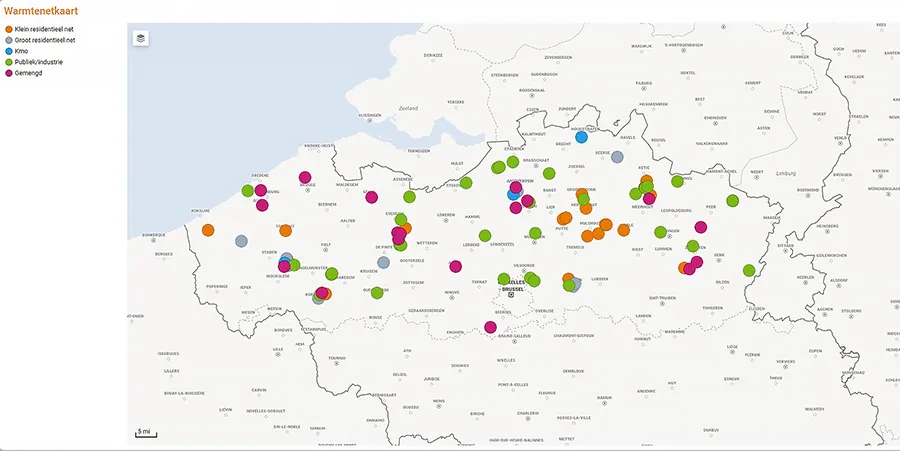
Compared with countries such as those in Scandinavia, Flanders still has considerable catching up to do when it comes to district heating networks. But there has been real progress in recent years. The VREG reports 84 registered district heating networks, which supplied exactly 1,139 GWh to 6,823 end users in 2021, and that number continues to rise.
District heating
Heat accounts for more than 50 per cent of energy consumption in Flanders, making it the largest component. For households, heating accounts for as much as three-quarters of energy consumption. So it is hardly surprising that there is considerable potential to make it more sustainable. District heating networks are one way to do this. Also known as stadsverwarming, district heating uses an underground network to bring heat from one or more large external sources to customers. These sources can be conventional fossil fuels such as natural gas, which is already more efficient than individual boilers, but they become truly interesting when renewable energy sources or waste heat are used. It is also possible to combine different heat sources or switch to another, more sustainable source over time. What is the potential? “The European STRATEGO study calculated that district heating networks could meet 40 to 65 per cent of heat demand in various European countries. For the Flemish Region, VITO carried out a cost-benefit analysis in 2015. It found that a network supplied with waste heat could cost-effectively meet 62 per cent of total heat demand in Flanders. This makes particular sense in densely built-up areas in towns and cities, as well as for heat exchange in industrial areas,” says Warmtenetwerk Vlaanderen. There are plenty of possibilities.
Putting waste heat to use
There are many potential heat sources, including waste heat. Like many other cities, Ghent has a district heating network supplied by a waste incineration plant. The ‘De nieuwe Dokken’ neighbourhood, in turn, receives waste heat from nearby company Christeyns, among other sources. The City of Antwerp has announced new heat sources for its southern district heating networks, including waste heat from Umicore in Hoboken. Another example is the Warmte Verzilverd district heating network, which uses industrial waste heat from the Agfa-Gevaert factory in Mortsel and now supplies heat to the Zilverkwartier and Minerve new-build projects. Existing buildings have also been connected. It is therefore a misconception that district heating networks are only suitable for new-build projects.
Renewable energy
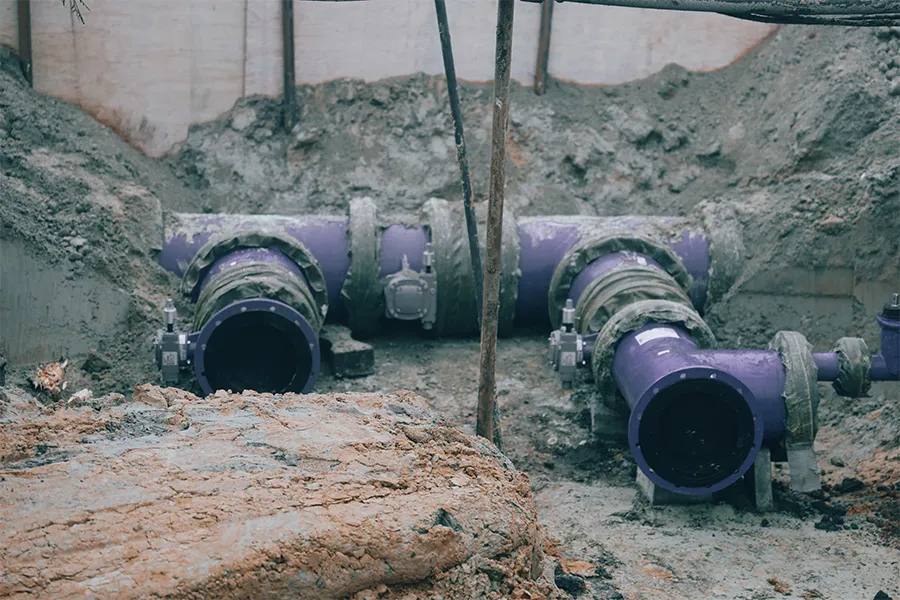
There are also several options when it comes to renewable energy sources, including shallow and deep geothermal energy, bioenergy and solar thermal energy. Germany, for example, already has successful solar-powered district heating projects. Around 50 large solar thermal district heating networks are in operation. Construction has begun in Groningen on the largest solar thermal park, which will supply heat to the district heating network. Closer to home, there is an innovative district heating network in Anzegem, West Flanders. A network is being developed at the De Voerman site to supply around thirty homes and a number of SMEs with heat in winter and cooling in summer. The most distinctive feature of this project is that the heat and cooling are taken from De Watergroep’s main drinking water pipeline, which runs past the site. Brecht Vermeulen, chair of De Watergroep, explains: “De Watergroep aims to be energy-neutral by 2030. We are also happy to make our infrastructure available to help facilitate the energy transition in Flanders. We see this as a pilot project that will give us experience with larger district heating networks, and we are actively promoting this concept to property developers.” More to come.
Sources: warmtenet.ode.be, De warmtegids, March 2022, published by VVSG and VEKA, Report on district heating network activity at the VREG in 2021-2022, www.vlaanderen.be
Question about this story? Ask your question
Keep following this
Get an email when a new story is published. No account needed.
- SubjectSustainable energy