Architecture with a story: David Driesen and Eva Vanderborcht (dmvA) on adaptive reuse, urban development and social impact
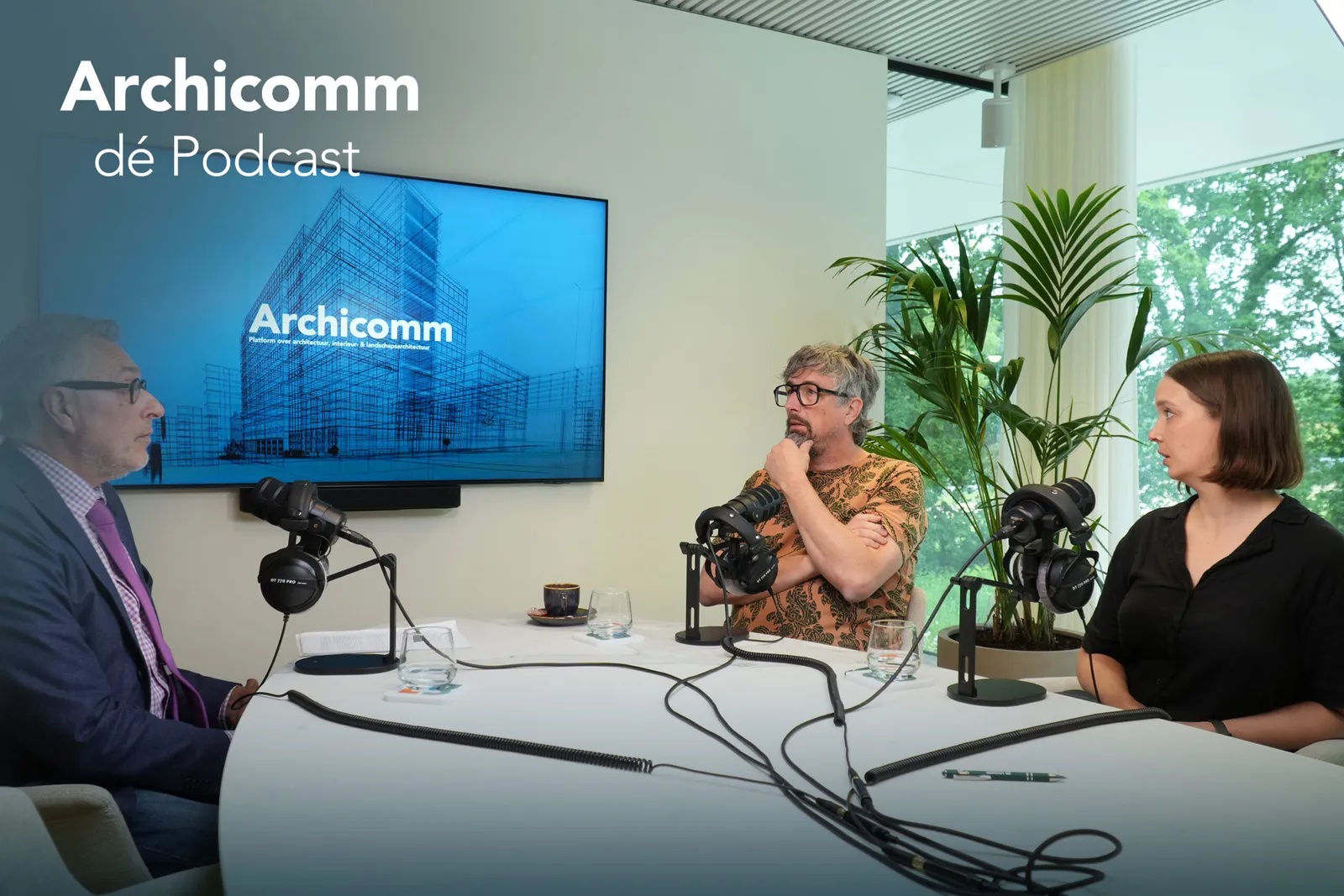
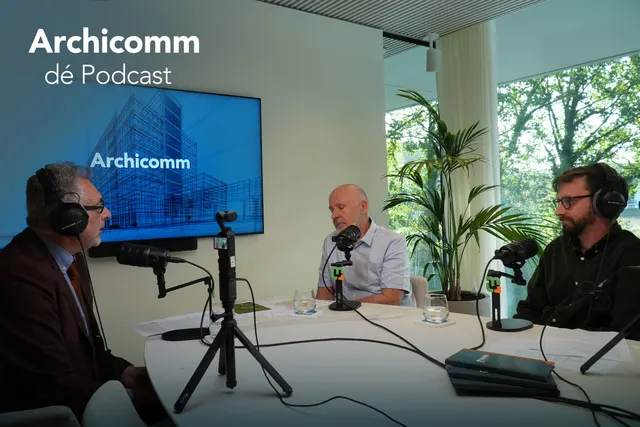
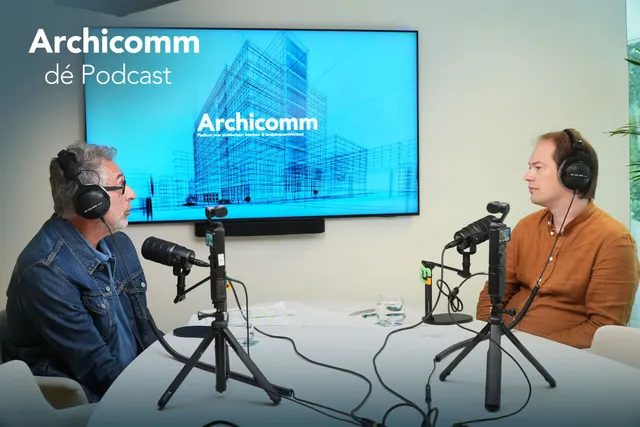
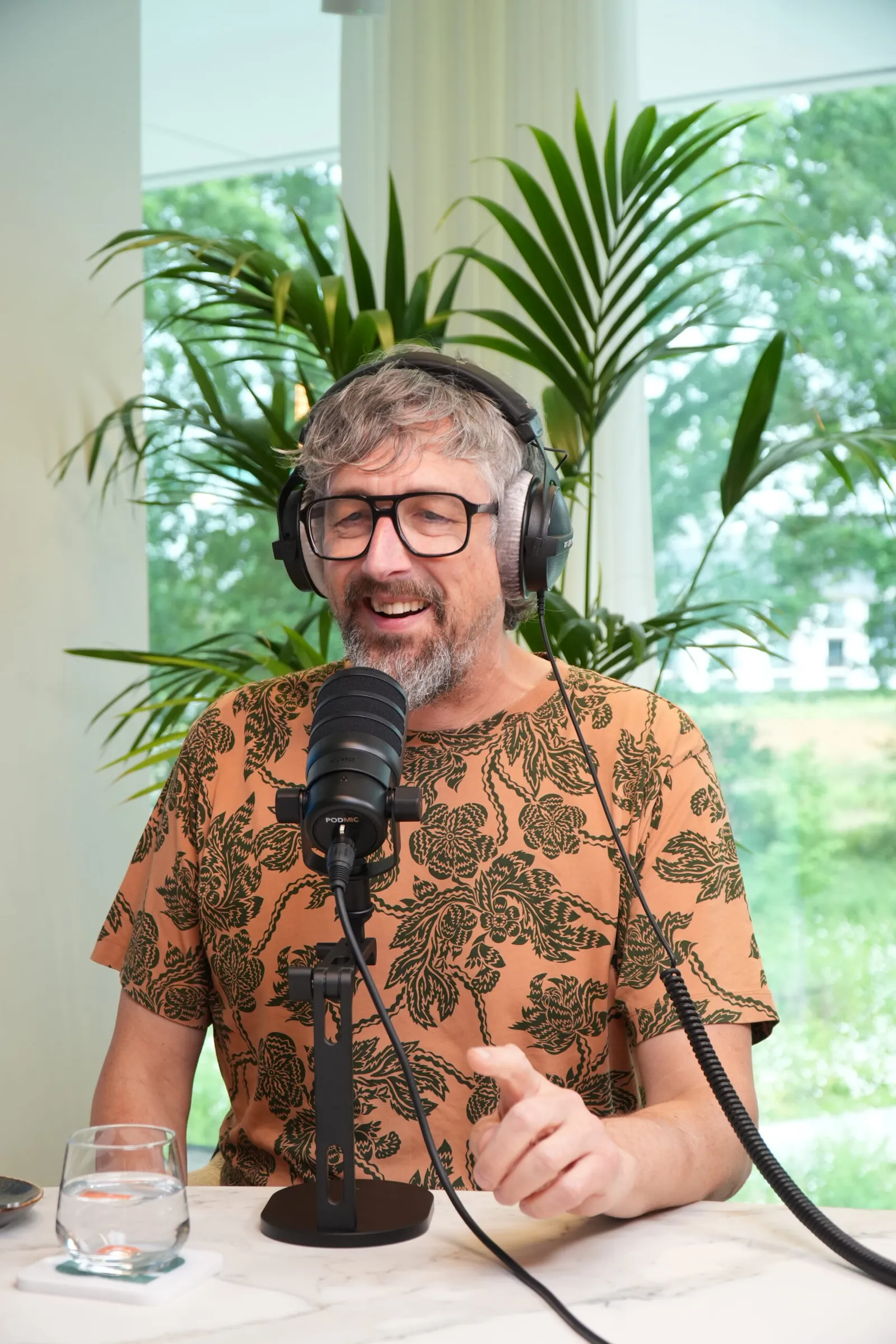
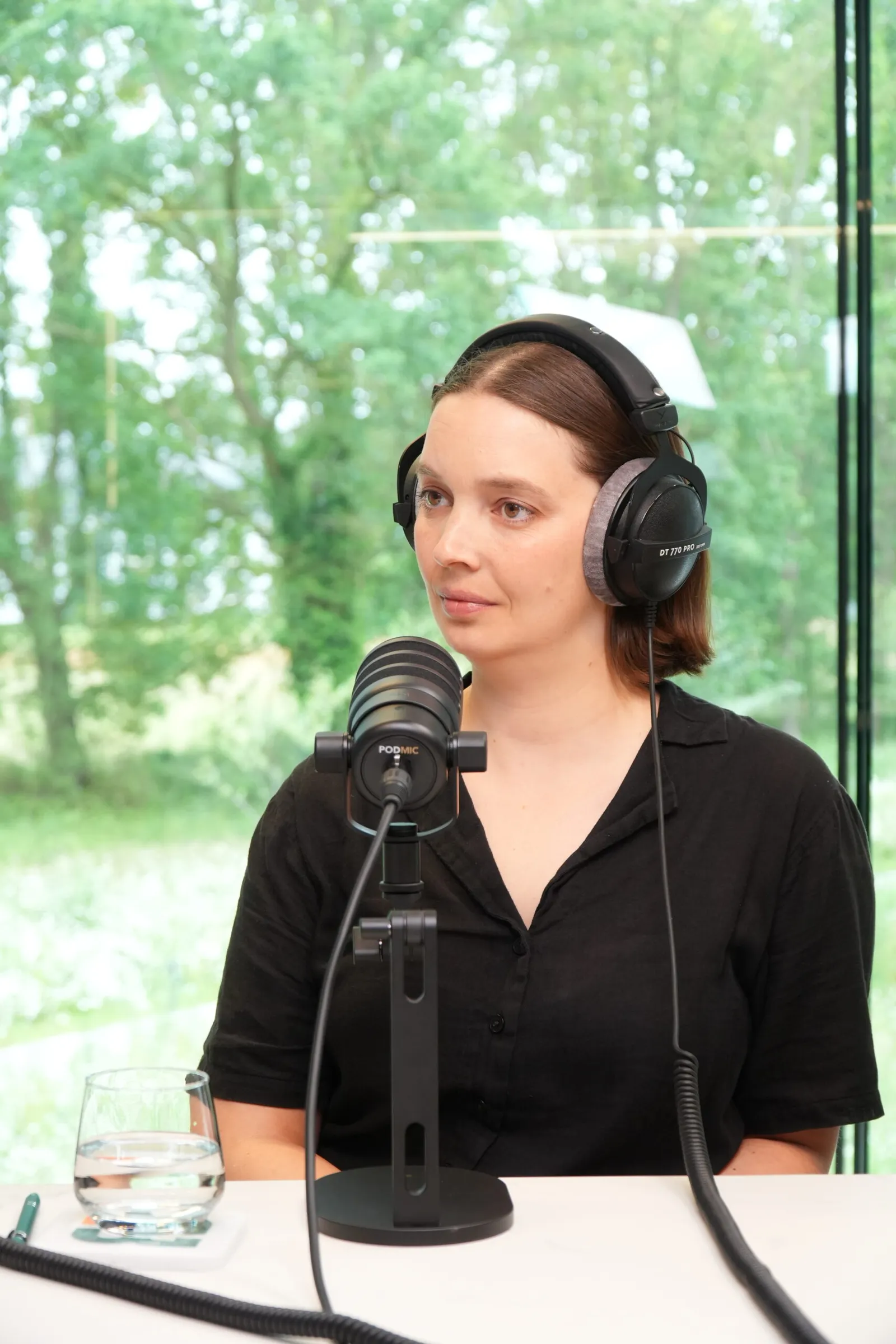
How do you give historic buildings a new lease of life without losing their identity? In this episode of Archicomm Dé Podcast, Patrick Retour talks to David Driesen and Eva Vanderborcht of dmvA about adaptive reuse, context-driven architecture, participation and urban development. Drawing on projects such as De Wasserij in Ghent, Residentie Bagardi in Mechelen, the Meurop-site in Rijmenam and Cultuurhuis nOna, they explain how architecture can help create liveable cities and strong neighbourhoods. An engaging conversation about minimalism with maximum impact, social responsibility and buildings that tell a story.
Full transcript
All chapters (16)
- Introducing the guests
- How dmvA came about
- The early years and the evolution of the practice
- Four directors at the helm
- Why architecture?
- The partnership between Tom and David
- Expressive architecture with social meaning
- Architecture as a driver of social dynamics
- Dialogue and collaboration
- Recognition and architecture awards
- De Wasserij in Ghent
- Residentie Bagardi, Mechelen
- Meurop, Rijmenam
- Cultuurhuis nOna
- Staying true to dmvA’s DNA
- Closing
Introducing the guests
Patrick Retour Hello, everyone. Welcome to the thirteenth episode of Archicomm Dé Podcast. My name is Patrick Retour, and as always, I’m your host and moderator for this Archicomm podcast recording. I’m also an editor for Archicomm magazine. Many architects feature in my Architect and Project column. I invite them to join me for a podcast recording too. Today’s guests are two architects from Mechelen, from an architecture practice based there. They create architecture in which buildings tell stories. So they are not just architects and master builders, but also masterful storytellers. We’re looking forward to hearing what they have to say. We’re keen to find out what stories they’ve brought with them. Please welcome David Driesen and Eva Vanderborcht of dmvA, based in Mechelen. Eva and David, welcome.
David Driesen Thank you.
How dmvA came about
Patrick Retour David, you and Tom were there at the birth of dmvA, some thirty years ago. You laid the first stone. How did things get started in those early days?
David Driesen We met during a postgraduate course in heritage conservation in Antwerp. I always like telling this story. The course actually lasted two years. The first year was mostly theoretical, and we never said a word to each other during that first year.
Patrick Retour But then you suddenly found yourselves on the same wavelength?
David Driesen No, not at first. That only happened in the second year. We were assigned a fieldwork site: an old holiday camp run by the socialist mutual insurance societies, in a castle. It was an ideal test case. We spent many weekends there. It was a really enjoyable time. That’s where our story began. I was also doing a placement at Pfeiffer & Van Goey in Lier, where I learned to experience architecture in a new way. I talked to Tom about it. It was completely different from the work we were doing in heritage conservation. Our first joint projects eventually came out of it, around 1997.
Read the full transcriptCollapse transcript14 chapters remaining
The early years and the evolution of the practice
Patrick Retour What’s impressive is that you often opt for the adaptive reuse of sites. It’s a nod to the past, combined with a modern vision of the future. Each time, the result is a project that makes a difference to people and society. That’s what I find so impressive.
David Driesen We did do that a lot at first. That was partly because we had no work. We didn’t know anyone.
Patrick Retour Starting a practice together, that takes some doing.
David Driesen Yes. At first, you try to write your own story. That developed strongly into a form of image-driven architecture, to make a bit of a splash in the field. At a certain point, that worked. After that, we started doing more and more projects in the city, including more adaptive reuse schemes. There is indeed a nod to heritage conservation in that, although for us it never meant that we wanted to do pure restoration, such as restoring a church. I have done that, but it was never the main aim. The idea was always that we had to try something different here. That kept designing enjoyable for me.
Patrick Retour There was always a critical response on social, economic and societal issues?
David Driesen I think that was there from the outset, more in some projects than others. But after thirty years, and especially over the last ten, it has become much stronger. That’s also thanks to having others in the practice and strengthening the core team. Eva and Christophe have been a key driving force in the practice for many years. As a result, we have taken an even more conscious approach to that socially critical aspect.
Four directors at the helm
Patrick Retour That brings me to Eva. Eva Vanderborcht, welcome to the Lauwers Media Group studio in Oostkamp, where we record all our podcast episodes. You have indeed been working with Christophe at dmvA for quite some time. You have since taken on a role in the management team. There are now four architect-directors at the head of the practice. That must have its advantages.
Eva Vanderborcht That’s right. In the twelve years Christophe and I have been at dmvA, we’ve seen the practice grow, both in terms of staff numbers and in the scale and complexity of its projects. That created a need, as David puts it, for us to help steer things. With four of us, we can manage and control the projects better. That led to the director roles we hold today.
Patrick Retour Another step towards the future. You’re keen on that.
Eva Vanderborcht Absolutely.
Why architecture?
Patrick Retour Let’s go back in time for a moment. How did you end up becoming an architect? Did you start at dmvA as a trainee, or did you gain experience elsewhere first?
Eva Vanderborcht I first did a year-long placement at Jo Taillieu Architecten in Leuven. But the idea of becoming an architect had been with me from an early age. I was always fascinated when I went into someone’s home. I would always wonder about the potential of a place like that.
Patrick Retour And what drew you to Tom and David? How did you feel at home at dmvA from the outset?
Eva Vanderborcht I already knew them from my studies. Their reputation preceded them. As David said, at the time it was mainly their iconic projects, with their strong focus on image-driven architecture. They were well known at the school, and that was a major reason why I wanted to work there.
The partnership between Tom and David
Patrick Retour Let’s come back to you for a moment, David. How did you and Tom’s roles take shape? At first you barely had any contact, then suddenly you clicked.
David Driesen It happened quite naturally. We simply spent time together, had fun and became good friends. After thirty years, we’re still friends, although our friendship is different now from what it was. At first there were just the two of us, and we did everything together. We designed everything together too. That went on for a very long time. We worked almost seven days a week. Looking back now, I realise that wasn’t healthy. But Saturday was our sacred day. We always spent it designing together. It was actually the best day of the week.
Patrick Retour Sacred, but also a day for work.
David Driesen Yes, but above all for exchanging ideas and brainstorming. Of course, you can’t keep that up forever. The practice grows, and then you need people. Architecture is a team sport. At first it may have been mainly Tom and me, but things are completely different today.
Patrick Retour There are fifteen of you now.
David Driesen That’s right. For me, architecture is a team sport. During your studies, it can sometimes seem as if you have to prove yourself as an individual, but afterwards you realise that on your own you never achieve much.
Patrick Retour You can’t achieve much on your own.
David Driesen In fact, that almost never happens. Every good practice has a strong team behind it.
Expressive architecture with social meaning
Patrick Retour With four directors at the helm, we can expect plenty more from dmvA. Later, we’ll discuss a number of projects to give listeners an idea of your work. It’s often described as expressive and meticulous, achieving the most with minimalism. Minimalist architecture with maximum impact. There’s a lot of meaning in that.
David Driesen It really grew out of that image-driven architecture. Tom and I trained in a very different era from the one in which I teach today. During my studies, I saw pretty much every movement come and go: postmodernism, innovative modernism, minimalism and deconstructivism. I experienced all of them. That meant I didn’t immediately find my own direction. Over the years, it gradually developed into a vision and a way of expressing myself.
Patrick Retour So architectural education has evolved for the better, partly thanks to people working in practice?
David Driesen That also has to do with social criticism. Today, we need to approach architecture in a very different way. We often talk about sustainability, but for me the social aspect has become just as important. Especially when it comes to quality in the city.
Architecture as a driver of social dynamics
Patrick Retour Eva, you often bring a sense of energy to a city. You give a neighbourhood a new lease of life and boost social life. That’s very important in your projects, which often start from neighbourhood life.
Eva Vanderborcht That’s right. It has become a very important layer in our projects. We take a fairly broad view of context-driven architecture. It’s not just about the built context, but also the social dynamics of a place.
Patrick Retour That leads to architecture that has broad support and gets people excited, rather than provoking protests.
Eva Vanderborcht Exactly. Where we have the opportunity, we also try to create a strong participatory process. We involve the neighbourhood in shaping the project, which gives it much broader support.
Dialogue and collaboration
Patrick Retour That doesn’t make things any easier, David. Involving so many people means making compromises. You’re known as headstrong architects who defend their vision, but ultimately you have to convince all the parties involved.
David Driesen That’s always our hope. Whether we always manage it is another matter. We do our very best.
Patrick Retour You are open to other ideas, though.
David Driesen Absolutely. I’m open to anything. Ultimately, a project is only judged once it’s built. You can explain a lot beforehand, but in the end a building has to prove itself.
Patrick Retour Sometimes a design doesn’t seem logical at first glance, but afterwards it turns out to have meaning.
David Driesen Yes. What’s more, it’s much harder today than it was thirty years ago, when I was working at another practice. Legislation alone makes a big difference. The local community can also make it more difficult to deliver architecture today. It’s a challenge, particularly in an urban context. The scale and way we build have also changed considerably. The large-scale expansion projects of the 1970s and 1980s have disappeared. Today, we work in a much finer-grained way, with smaller interventions. That brings architecture closer to the human scale again. Sometimes the authorities are a difficult partner, but sometimes quite rightly so.
Patrick Retour Yet you often work with public authorities. So you always have to reach an agreement.
David Driesen That’s why dialogue is so important. I’ve noticed that it has become less straightforward in recent years, particularly since the pandemic. When it should be the other way round. Architects are too often seen as being in opposition to the authorities. Yet we’re all professionals. Some may do it better than others, but good architecture comes from listening to each other. If you don’t, you’ll never have a genuine dialogue. If you do, you’ll get better architecture.
I’m thinking, for example, of what we’ve realised in Mechelen over the past thirty years. Almost all of it consists of smaller projects. For me, those are what really make a difference in a city. Not the icons such as the library or Museum Hof van Busleyden, which are fantastic buildings, but the smaller interventions that make a city liveable. Everyone I show around Mechelen feels that too. After thirty years, that still gives me a sense of fulfilment.
Recognition and architecture awards
Patrick Retour It’s a great success story. You’ve already won plenty of awards. Atelier received the Iconic Award 2020, Huis van Lorijnen won the FEBE Elements Award 2019, and Theater Hoge Rielen earned you the Gold Erich Mendelsohn Award for Brick Architecture 2023. But you also like to talk about nominations. They’re a form of recognition too. You don’t always have to win.
David Driesen It’s like sport. In the end, the person who crosses the finish line first is the winner. But looking back now, I realise that we were receiving nominations almost from the very beginning of our practice.
Take, for example, the intervention we carried out for nOna, with the rehearsal rooms. I’ve been involved with that for almost twenty-six years now. So in architecture, you need to be patient too.
Patrick Retour We’ll come back to that shortly.
David Driesen That project started around 2003, when we’d only been going for five years. Since then, almost every project has been nominated somewhere, both at home and abroad. That shows there’s a form of recognition you’re not always aware of yourself.
The first time feels fantastic. You think: “Wow, we’ve achieved something.” Later, that feeling fades a little.
Patrick Retour But it still feels good.
David Driesen Of course. Today, I see that recognition as belonging to the whole team, not to one individual. In 2005, we won the Belgian Architecture Prize. That was a really important turning point for us.
But perhaps one of my fondest memories is also a very naive one. We didn’t come from an established background. Neither of us had done an internship with a well-known architect.
Patrick Retour You went straight into independent practice.
David Driesen That’s right. We started almost immediately. We entered a lot of competitions. One of the first was in Lommel. We won first prize in an anonymous competition. When the envelope was opened and my name was read out, everyone wondered: “Who’s that?” All the big names in Belgian architecture were there. We arrived as complete unknowns.
Afterwards, the mayor even had us thrown out because, supposedly, we weren’t well-known. Not because we’d misbehaved, but because we meant nothing to anyone. And yet, for me, that was the real beginning of our career. That was when I realised things could be done differently.
De Wasserij in Ghent
Patrick Retour Eva, let’s turn to De Wasserij in Ghent. There, you’re firmly committed to accessibility and connection. Tell us the story behind the site. Have the works been completed yet?
Eva Vanderborcht Yes, the works were completed in March, so very recently.
Patrick Retour What’s the story behind the place?
Eva Vanderborcht It was a former industrial laundry site, right in the middle of a completely built-up urban block. We started without a very specific programme. The only condition was that it should serve the local community, preferably with a creative and innovative purpose.
What followed was an extensive participatory process with the local community. In several workshops, we mapped out what local people wanted and explored how they saw the place. We then started from the site’s identity, retaining the laundry’s defining features.
Another key intervention was clearing the centre of the block. We opened it up again to create outdoor space, something the local community really needed. We also created an informal passage between two streets, reconnecting the site with its surroundings.
Patrick Retour The site is truly permeable. Not just outside, but also via an internal street. Less valuable buildings have been removed, creating space for greenery and openness. What was valuable, such as the laundry itself, has been retained. This is what you call scar architecture: a nod to the past that gives the place a new lease of life.
Eva Vanderborcht That’s right. There were many valuable elements: a nineteenth-century townhouse, an industrial laundry building with an impressive concrete structure, modernist façades, a water cistern and an industrial chimney that recalled the site’s former activity.
We combined those historic elements with new interventions, in what we call scar architecture. The new elements sit alongside the historic ones and engage in dialogue with them, without displacing them. Both remain clearly legible.
Patrick Retour The place really fires the imagination. It feels like a new place to be in Ghent.
Eva Vanderborcht We hope so too.
Patrick Retour I’ll definitely have to go there, get to know the neighbourhood, talk to people and have a drink. I’ll take a photo and we can catch up again.
Eva Vanderborcht The site will actually open this summer.
Residentie Bagardi, Mechelen
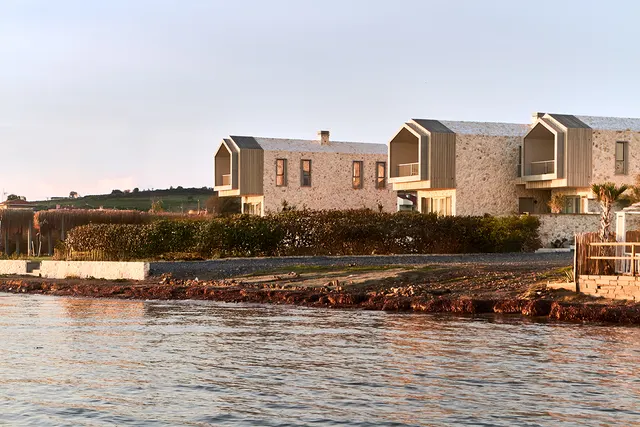
Patrick Retour David, I’d like to take a moment to imagine a visit to Residentie Bagardi. It’s in Mechelen city centre, on the former De Voorzorg hospital site. One branch of the Dijle runs through it. A beautiful façade has been preserved and incorporated into a newer development. Is that a fair description?
David Driesen That’s a fair description. The place has its own particular story. We’re between Scheppers, one of Mechelen’s major primary and secondary schools, which dominate the blocks around the Melaan, and an area behind it. It almost directly adjoins Mechelen’s Old Beguinage. You get a blend of something very large-scale transitioning into something very small-scale.
The site was completely built up with buildings for its former hospital use. We thought long and hard about whether to reuse them. In the end, we decided not to, because the city had set us strict requirements. If you did anything there, you also had to provide parking. That forced us to question the approach. Besides, the building had far too great an impact on the smaller-scale residential buildings around it. Demolishing it was really a gift, allowing us to explore how to create that change in scale while also making use of the existing De Voorzorg building, whose history goes back to around 1700.
Patrick Retour Is that a listed façade?
David Driesen No, that’s the strange thing. It has been altered far too much over the years. The building’s main defining features are really its façade and the L-shaped form of the De Voorzorg wing. That also made us a little apprehensive, because we’re so close to the Beguinage. What is a Beguinage? There are different kinds, but Mechelen’s is characterised by its network of small streets. We tried to translate that idea through the story of the old Begardenstraat, creating an architecture of alleyways that forms the entrance to all those buildings. There’s a mix of around fifteen units, all different from one another.
Patrick Retour The façade gets the tribute it deserves, and the rest is a contemporary Beguinage where you can truly unwind.
David Driesen Yes. We removed the large building that stood in the centre of the site to make way for the car park that had to go underneath. In doing so, we nodded to another project we once did in the city. It was an old bed factory, later a mattress factory. When we surveyed it, we discovered a historic building on the site. It turned out to be a summer house. That’s really the opposite of what happens today. Today, we leave the city. Two hundred years ago, people went to the city instead. They did so within a walled enclosure, with a building inside it.
Patrick Retour Have you perhaps created a bit of a holiday feeling in the city?
David Driesen We certainly built that into it. When you visit, you get that feeling. The good synergy with nature, introduced by the landscape architect, adds to it too. The nod to that summer house ultimately became four summer houses in the centre of the site. Within the walled enclosure, they have a quality all of their own.
The connection between the history and the other homes lies in the dynamic we sought to create through alleyways and passageways. The historic building was L-shaped. Seen from the outside, it suggests a building that you would once have driven through by carriage to reach an inner courtyard. We tried to weave that atmosphere into every aspect of the project, so that every place within the main volume has that feeling. You sense both the scale of the neighbouring buildings and the smaller scale reintroduced alongside those larger buildings, in interaction with the central area.
Patrick Retour Just to be clear, it’s all finished?
David Driesen Yes, it’s all complete.
Meurop, Rijmenam
Patrick Retour We’re moving on to a project that’s currently out to tender. We also featured you in what we call Meet the Architect, where we build bridges between architects and contractors to explore potential collaborations. Eva, I spoke with you about the former Meurop industrial site in Rijmenam. Four architecture practices are working there, each developing part of the site. What exactly will you be doing?
Eva Vanderborcht On the one hand, we’ll be building a number of homes along a green residential street.
Patrick Retour Is there a communal garden at the back?
Eva Vanderborcht That’s right. There’ll be a communal garden behind the homes, linked to the access routes to the gardens and the cycle storage. That gives the homes an added quality.
The second part of the project consists of two Dijlevilla’s, oriented more towards the greenery of the park setting.
Patrick Retour When do you expect it to be completed?
Eva Vanderborcht Probably no earlier than 2029, so we’re still looking a little way ahead.
David Driesen I’d like to add something. The Meurop site is a historic site. It tells the story of the growth of the Meurop furniture factory in the 1970s. It was really the IKEA of its day. They made fantastic furniture. It was design for everyone. Sadly, the factory burned down, leaving the company in financial difficulty, and the site stood empty for almost thirty years.
For me, the place also has an emotional significance. My godchild fell through the roof there and died. When I was asked to get involved, I hesitated for a long time. In the end, I decided to do it, because it could also become a positive tribute.
POLO Architects is developing the existing building, which will form the anchor of the project. As much as possible, the rest is being developed on a scale that responds to nature and to Rijmenam itself. It’s a gigantic project for the village.
Patrick Retour And all those architecture practices have to work together too.
David Driesen Yes, but actually it all went very smoothly. It doesn’t always have to be complicated. Omgeving laid the groundwork at urban-planning level, which also made collaboration easier.
Eva Vanderborcht There’s also an important transition in scale within the project. On the village side, the scale is smaller, with terraced houses along the residential street. Further towards the green space, the scale increases slightly with the Dijlevilla’s. This allows us to fit in well with the village while still creating a substantial residential density, tailored to Rijmenam.
Cultuurhuis nOna
Patrick Retour And so all the different types of housing sit together in harmony. Lovely. Let’s move on to Cultuurhuis nOna. We’ve already talked about it, and you’ve been working on it for some time. It’s now being prepared for the 21st century in a final phase, or perhaps the penultimate phase. What do you think?
David Driesen As I said earlier, I’ve been working on it for twenty-six years. There are two projects in my life that have taken up that much time: Museum Hof van Busleyden and nOna. Each has taken up twenty-six years of my life.
Patrick Retour That really is a life’s work.
David Driesen Yes, but this one even more so. Axel, who was the business manager at the time, and I really tried to bring about the first phase of nOna. We tried to convince everyone to make the project possible. It was really a continuation of the 2003 confiscation project, which had been nominated. In the end, it was realised on that site.
It was a fascinating process, but it took a long time before we could realise it. Now we’re working on the historic auditorium, the theatre space where it all began for nOna. It was partly refurbished in the early 1990s.
Patrick Retour You’re transforming a nineteenth-century auditorium into a new performance space for theatre, dance and music. Ultimately, the aim is to create a place where everyone in Flanders who loves culture feels at home.
David Driesen The new building we completed earlier was the first step. We didn’t really create a single building there, but rather a series of rooms, outdoor rooms that flow into indoor rooms. In this way, we tried to make the quality of urban rooms visible. We wanted to bring what you experience on the scale of a square down to the scale of a room: a place where people meet and then move on through the building.
Now we’re going to work on the existing building. It’s completely built up today, and even has a much older core. It’s a traditional deep-plan house dating from Mechelen’s heyday in the sixteenth century, with the nineteenth-century auditorium behind it, which is really a mixture of styles. The auditorium no longer meets today’s requirements for theatre at all.
The most important thing we’re going to create is the heart between those buildings. It used to be an inner courtyard, but it has been completely built over. We’re going to clear it out again. It will be covered, but once again it will be a place centred on bringing people together. That way, we want to bring people into closer contact with culture, and also draw in passers-by.
Staying true to dmvA’s DNA
Patrick Retour In this way, Cultuurhuis nOna will once again be a source of encouragement for the city of Mechelen. And dmvA is once again helping to tell a wonderful story, one that warms my heart.
To round off, let’s look back. You started out with iconic projects such as The Blob, the rehearsal rooms at nOna and Sporthal KA Heist. Then came a steady progression towards bigger challenges: Museum Hof van Busleyden, the Lorettenklooster and various cultural, educational and residential projects.
That increase in scale naturally brings added challenges and responsibilities. But what strikes me is that you’ve always stayed true to dmvA’s DNA. That can’t be easy.
David Driesen I hope we can continue to uphold that. It’s not easy. I once heard something from former Flemish Government Architect Bob Van Reeth. At the start of our careers, he said: “You should never adapt. Just keep doing what you do, because it’s different from everyone else.”
That has always stayed with me. The moment you start adapting to others, you’re really lost. Just stay true to who you are. That’s the most important thing.
Patrick Retour So you mainly do what you yourselves want to do, in keeping with your instincts as architects. But it’s also successful. People like it. That’s another thing, of course.
David Driesen That is indeed another thing. But it shouldn’t be the starting point. Perhaps it was at the beginning of our careers, when we had to make a name for ourselves. Today, success should no longer be the driving force. It should serve something else.
That’s how I see it. Eva may see it differently.
Eva Vanderborcht No, that matters most to me too. When you see that a project really has an impact on its users and the surrounding neighbourhood, that gives me the greatest satisfaction.
The vision dmvA started out with remains important. We want to create high-quality architecture. But if I see a common thread running through the projects we’ve discussed today, it’s above all the creation of permeability in an urban context and rooting projects in their surroundings. That’s an additional layer that has emerged over the years, and one we want to keep bringing to larger projects too.
Closing
Patrick Retour I think that’s a lovely note to end on. Thank you for joining us as our guests. David Driesen and Eva Vanderborcht from dmvA in Mechelen.
You’re brilliant storytellers, and of course brilliant architects too. We’ll certainly take that with us. We’ll follow that storyline into the future. No doubt every project will have a happy ending. Perhaps even a cliffhanger that leaves us looking forward to the next season.
We’ll keep following what dmvA brings to the world through its architecture. Something to look forward to and to keep enjoying.
Everyone at home, thank you for listening. And you know the drill: I’ll be back soon for another episode of Archicomm Dé Podcast.
It’s been a pleasure. Bye.
Keep following this
Get an email when a new story is published. No account needed.
- ThemeGiving existing buildings a new future
- SubjectGeneral