Lighting is a job for specialists

There is no doubt about the value of good lighting. What’s more, almost everyone agrees. Better concentration at work and improved general wellbeing are just two of the benefits of good lighting.
It is also widely known that traditional light sources are being phased out because they are not energy-efficient enough. Replacing those lamps involves more than simply fitting a different bulb. And what about so-called smart lighting?
Relighting. Put simply, replacing one lamp with another. Job done. Or is there more to it, with other factors to consider? The answer is clearly yes. Here’s a simple example. The light fitting in the corner of the living room is not on every day. Its incandescent bulb (admittedly, this is a far-fetched example, but we all have fond memories of incandescent bulbs) is still working. Even so, we want to switch to a more energy-efficient alternative. Enter the LED bulb, which uses far less energy. A straight swap and job done. But does the LED bulb produce exactly the same light? Does the fitting give off too much light, changing the whole feel of the room? Now imagine replacing not just one bulb in the living room, but all the lighting on an entire floor of an office building, or even throughout the whole building. Would the entire lighting plan need to be reviewed? The layout of the desks? Read more about this later in the feature. We can already reveal that relighting involves more than meets the eye, and that, as with any lighting project, it is advisable to seek advice from a specialist.
What is smart lighting?
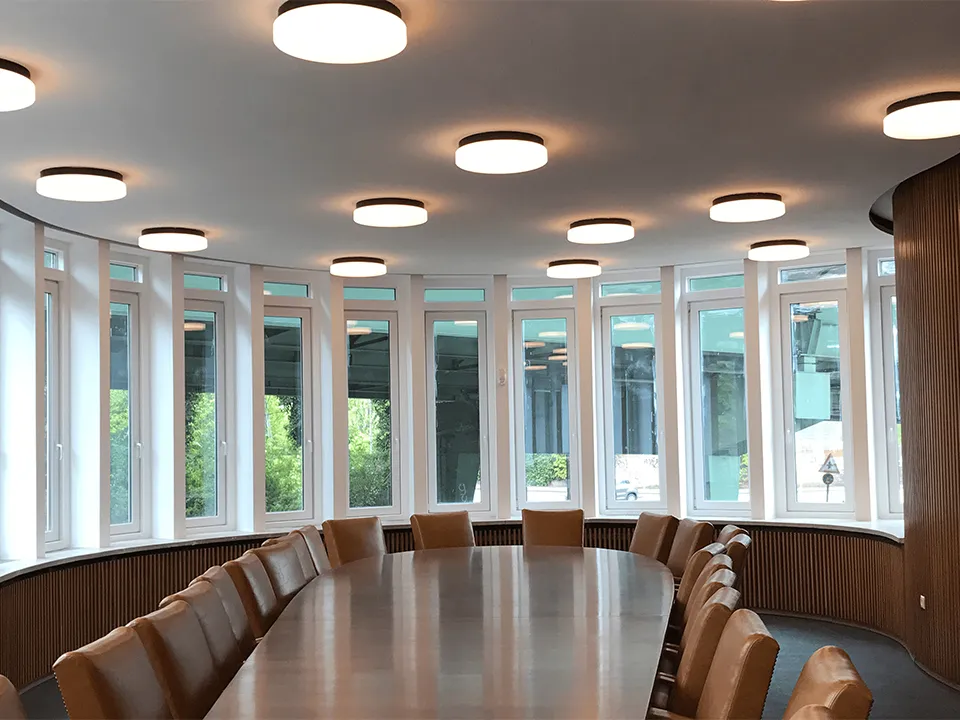
Smart lighting is a broad term covering a wide range of applications and associated solutions. Any place where a light is switched on, and therefore each individual lighting point, can incorporate some form of intelligent lighting. In this sense, smart lighting means adding something extra to simply providing light, for example by using motion and presence detection. A further step could be to create a network of light fittings, with or without built-in sensors, which then use the data they collect to develop and carry out a whole series of processes.
Another interpretation of smart lighting, which is also important, concerns positioning lighting points according to a detailed lighting plan. The plan is drawn up based on the space itself and how it will be used. If the lighting plan meets expectations, this too can be described as smart lighting: lighting points positioned to do exactly what is needed.
Ask for help
Lighting is a job for specialists. Whether it is a relighting project, a new-build (private or commercial) or public lighting, all kinds of specialists are on hand to guide you through the project. Good lighting, with light in the right place at the right time and in the right way, ensures that a space is used as intended and feels welcoming. It can make or break a space.
Question about this story? Ask your question
Keep following this
Get an email when a new story is published. No account needed.
- ThemeLight and sound as design tools
- SubjectInteriors