How do you find the right architect? It’s about chemistry, trust and clear agreements
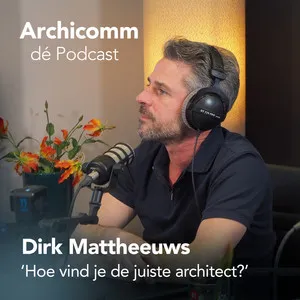
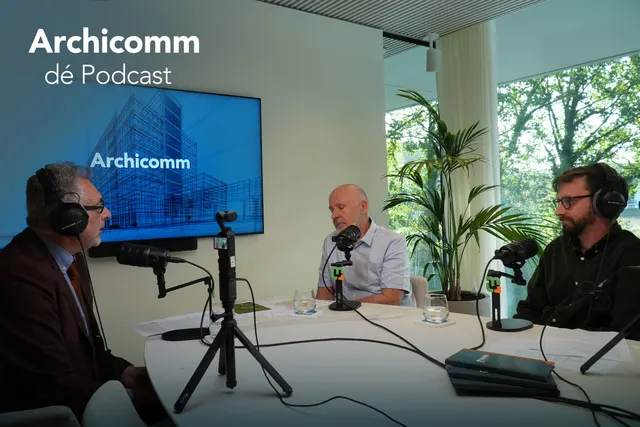
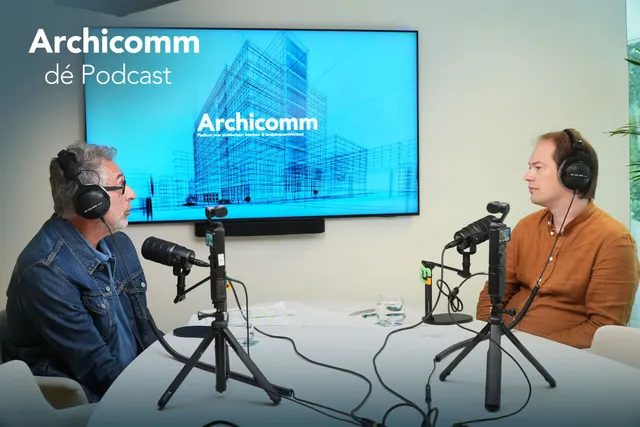
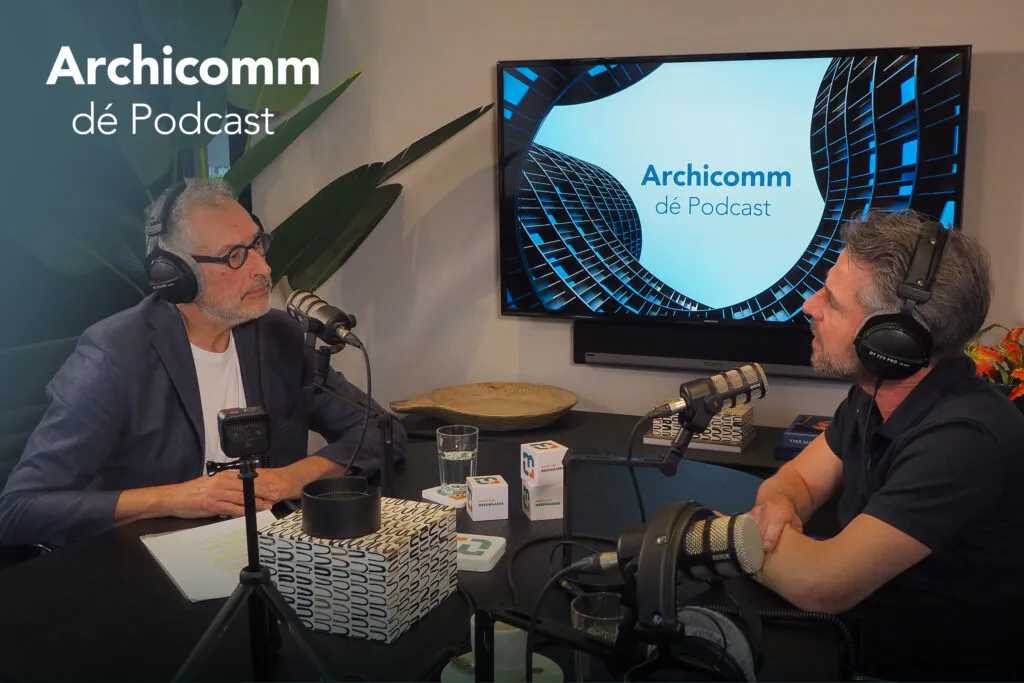
In this fifth episode of Archicomm Dé Podcast, host Patrick Retour talks to Dirk Mattheeuws, chair of Netwerk Architecten Vlaanderen (NAV). Together, they consider a question every client or renovator asks sooner or later: how do you find the right architect?
From word-of-mouth recommendations to online searches, from the first meeting to clear fee agreements, the conversation explores what clients should look out for and the role architects play today in an increasingly complex construction process. Topics such as liability, taking the stress out of the process, communication on site and the importance of both a personal and professional rapport also feature prominently.
A nuanced discussion about expectations, responsibilities and collaboration. And about how architects and clients can work together to make the difference between construction stress and construction success.
Full transcript
All chapters (27)
- Part 1: Introduction, NAV and Dirk Mattheeuws’s role
- What architects can turn to NAV for
- Supporting everyone from new entrants to practice leaders
- Dirk Mattheeuws on his own practice and training
- People and the environment in practice
- Third role: external environmental planning officer
- Juggling responsibilities and organising the team
- Term as NAV chair
- Limited to two terms
- What has changed since 2020?
- Word of mouth and visibility
- Part 2: Early-career architects, online searches and finding the right fit
- Searching online and potential pitfalls
- The practical benefits of working locally
- Style, references and preparation by the client
- The dream home, peace of mind and chemistry
- Complexity and liability
- The next step after choosing an architect
- Trial commission and feasibility study
- Part 3: Fees, contracts, communication and closing remarks
- NAV’s purpose
- Contracts and legal advice
- Communication is key
- There are limits to taking the burden off clients
- Working together to put things right
- Small practice versus larger practice
- Passion and variety in the profession
Archicomm Dé Podcast, Episode 2026/2
Host: Patrick Retour
Guest: Dirk Mattheeuws
Part 1: Introduction, NAV and Dirk Mattheeuws’s role
Patrick Retour A very warm welcome to the second episode of Archicomm Dé Podcast, the 2016 series. My name is Patrick Retour, and I’m your host for Archicomm Dé Podcast. I also produce features for Archicomm magazine.
Patrick Retour Today we’re asking ourselves: how do I find the right architect? And how do I find an architect with the right skills to guide me through the construction process and relieve me of all the stress that comes with it? To help us answer that, we’re turning to today’s guest.
Patrick Retour He’s a seasoned architect who is also chair of NAV, Netwerk Architecten Vlaanderen. A very warm welcome to our studio, Dirk Mattheeuws. Hello, and thank you. NAV, Netwerk Architecten Vlaanderen, what exactly is it and
Dirk Mattheeuws what do you do? We’re a professional association, and we aim to support architects in their professional practice. To be clear, we’re not a professional body or an order.
Dirk Mattheeuws In Belgium, that’s the role of the Orde van Architecten. You must be registered with the Orde van Architecten to practise as an architect. Membership of a professional association is not compulsory, it’s voluntary. We therefore also rely on our members’ subscriptions.
Dirk Mattheeuws We currently have around 3,500 member practices, from sole practitioners to larger firms. Together, they represent around 6,000 to 7,000 people.
What architects can turn to NAV for
Patrick Retour What can they turn to you for?
Dirk Mattheeuws Well, on the one hand, we’re a networking organisation. We call ourselves the largest community of architects in Flanders. We can actually say the same for Brussels and Belgium. We do this in various ways. At national level, we have a number of sub-communities, including Vrouwen in de Architectuur and Starten en Starters. We also have a regional network. We now have a regional network in every province, where architects can network with others in their area. They meet up and sometimes have a chance to air their grievances about the profession. Alongside networking, we also advocate for architects’ interests. That means meeting with politicians and policymakers, as well as departments and ministerial offices, to discuss new legislation, or existing legislation that is causing problems. Then, alongside networking and advocacy, I think a third important area is sharing knowledge. We provide training, among other things, and make an important online knowledge database available to architects.
Read the full transcriptCollapse transcript25 chapters remaining
Supporting everyone from new entrants to practice leaders
Patrick Retour And, of course, that’s particularly helpful to architects starting out.
Dirk Mattheeuws That’s right. It’s for all architects, including those starting out, trainees and employees, as well as directors and business owners.
Dirk Mattheeuws on his own practice and training
Patrick Retour You’re also an architect and director at ARW Architecten in Merelbeke-Melle. To what extent does your work help you be a
Dirk Mattheeuws better chair? I do indeed still have a practice in Merelbeke-Melle. I started out after graduating as an architect in 1995. I did my professional placement in 1995, and my placement supervisor said that new legislation, the VLAREM regulations, was coming in. So we went to a course on it together. I also trained in environmental management and as an environmental expert. Today, I combine those roles and describe myself as an environmental planning expert. In the years that followed, I also undertook further training. I trained as a health and safety coordinator, demolition expert and asbestos expert, and recently completed the asbestos inventory expert course. I’ve always enjoyed taking additional courses over the years. I think that experience also helps me in my role as chair of NAV. I’m reasonably familiar with the various professional fields related to architecture. We no longer practise in all of them, though. The only things we still do in the office are architecture and environmental work. The rest is outsourced. But I do have the knowledge, and it’s useful to know something about those areas.
People and the environment in practice
Patrick Retour We’re all interested in people and the environment these days, of course, because they’re under pressure from global warming, the need to manage water properly, the need for more insulation and lower consumption, keeping a close eye on energy use and watching our budgets. So that expertise can certainly come in handy.
Dirk Mattheeuws Yes, that’s right.
Third role: external environmental planning officer
Dirk Mattheeuws As I said, all that training certainly helps me in my role as chair. But I also have a third role. I’m also an external environmental planning officer for a Flemish municipality. As you know, environmental planning officer is an occupation facing a staff shortage. These days, many of those positions are filled by consultants, external consultants. I’m one of them. So I also provide advice from the other side, as an external environmental planning officer. Both roles add value to my work as chair, of course.
Juggling responsibilities and organising the team
Patrick Retour That’s a lot of responsibilities to juggle. How do you manage it?
Dirk Mattheeuws I have a good team in the office. There are nine of us, including me. We have three architects, one of whom is a trainee. There’s also a full-time environmental consultant, and two interior architects. I’m a spatial designer, not an interior architect. I see that as a specialism in its own right. They take care of the interior design side of our work. I also have two freelance environmental consultants who help with the environmental work. We want to offer businesses and professional clients a kind of one-stop service and take the stress out of the process, despite the administrative burden involved these days. So a lot is delegated to the team.
Term as NAV chair
Patrick Retour When did you become chair of NAV, and how long does a term last?
Dirk Mattheeuws Well, I can tell you now: it’s nearly over.
Patrick Retour And how are you elected as chair? How does that work?
Dirk Mattheeuws I was elected in February 2020. At the time, both a new chair and a new director were appointed. Our new director, Steve Lano, joined NAV in March, as I might put it. How are you elected? There were two candidates, and at the general meeting the board members choose one of the candidates who put themselves forward. Hopefully, the same will happen at the next general meeting, because I’m coming to the end of my maximum term of two three-year periods. So in April 2026, I hope a number of candidates will come forward, so we can hold another election and choose a successor.
Limited to two terms
Patrick Retour Like the US president, you can’t serve a third term.
Dirk Mattheeuws No, and I actually think that’s healthy.
Patrick Retour Yes, yes.
Dirk Mattheeuws It’s good to have a fresh perspective. That’s no bad thing.
What has changed since 2020?
Patrick Retour What would you say you’ve achieved as chair, in a nutshell? Or what fresh perspective have you brought since you took over?
Dirk Mattheeuws I think a lot depends on the partnership and the relationship between the chair and the director. I think we’ve worked really well together and made quite a lot of progress on new legislation and other initiatives. These days, NAV is asked for its input when new legislation is in the pipeline. In the past, people didn’t know enough about us to approach us. I think we can now say that we’re known and that people know where to find us when it comes to new legislation. We’ve also moved. Over the past three years, we looked for a new office, and a new office in Ghent has been set up. So, yes, things have changed. NAV looks different. I’m convinced NAV has changed since 2020.
Word of mouth and visibility
Patrick Retour Dirk Mattheeuws is certainly a good chair, in my view.
Dirk Mattheeuws I hope so. After April, we’ll see whether the results are really there.
Patrick Retour Okay, we’ll have to catch up again then. Dirk, I once had an architect at the table who told me: as an architect, I never advertise. I rely on word of mouth. The façades of the houses I design are my calling card. People see a home I’ve built. They knock on the door and ask what it was like working with the architect. Or they put a note through the letterbox and ask: who was the architect you worked with? That may work for someone who has completed a lot of projects, but architects just starting out may not be able to work that way. So, what would you say to that? He felt there was no need to make himself known. The clients found him anyway.
Dirk Mattheeuws I can certainly relate to that to some extent. I’ve never had a flyer through the letterbox, that’s never happened to me. But most clients do come through word of mouth. And what persuades them is what you’ve delivered in the past. In that respect, I’ve sometimes found, I dare say, that I’m a problem-solver. That’s why quite a few environmental planning cases and complex projects end up with us. So it’s true: a lot of work comes through word of mouth. I think I went four years without a website, from 2019 onwards. We launched a new website this year. I went without a website for a while because it wasn’t a priority and, in fact, word of mouth was bringing in plenty of work. But we now have a new website. I’m actually pleased we have one, and the staff are pleased too. Of course, it gives you… you can imagine. It’s a different approach. So the website is definitely a positive development.
Part 2: Early-career architects, online searches and finding the right fit
Patrick Retour Of course, early-career architects sometimes complain that there isn’t enough work coming in. Perhaps there are too many of them, or they haven’t yet had enough chance to prove themselves, so they’re less in demand. What advice would you give early-career architects? And what role can NAV play in supporting them?
Dirk Mattheeuws Well, I’d point them straight to our “Find an architect” website. You can post projects there, including small ones. You can also post studies. As an early-career architect, you can add studies too; they don’t have to be completed projects. You can also post visualisations. If you’re a NAV member, you can create a profile on “Find an architect” and add projects. Homeowners can then find you using specific search terms.
Searching online and potential pitfalls
Patrick Retour Yes, driving around to look at houses has perhaps always been part of the process. It can be a day out, or a house-hunting trip, but these days we’ll mainly be searching the information superhighway. What are the obstacles and pitfalls when consumers look for architects online? What should they be wary of? What should they look out for? And again, should they
Dirk Mattheeuws turn to our website, “Find an architect”, of course. It’s very useful for homeowners. I think it makes sense for them to start their search online. But I’d advise looking locally. You can search by municipality and see which local architects appeal to you. Then visit their individual websites. I wouldn’t look at too many, either. We architects have learnt from experience that if homeowners shop around too much, or, to be honest, if I receive a generic email that I can tell has been sent to ten or fifteen architects, I’m not motivated to reply. After a while, you can lose sight of what you’re looking for. So I’d say: search online, narrow it down to a few architects in your area, and perhaps arrange a meeting with them.
The practical benefits of working locally
Patrick Retour As a gardening editor, I also have a lot of contact with garden designers and landscape contractors. I hear from them that they like to work locally too, to avoid travel costs and sitting in traffic. That’s not a productive use of time. It helps them work efficiently. Perhaps the same applies to the architect you need. If they live nearby and work in the area, things are easier.
Dirk Mattheeuws Absolutely. We’ve grown into a practice that works throughout Flanders. We still have a few projects in Wallonia and Brussels. I think I drive 35,000 to 40,000 kilometres a year. I’d be very happy if I could cut that down, so I certainly wouldn’t mind. So, ideally, your architect should be local. It’s always useful. If you hire a local architect, they’ll probably know a few local contractors too. And if you have contractors you know and trust to do a good job, it’s obviously helpful to be able to carry out the project with contractors from the area as well.
Style, references and preparation by the client
Patrick Retour I think clients need to do a bit of research too. Images can spark ideas. You look at references and perhaps put together a mood board. You work out what kind of home and lifestyle you want. Then I assume you see whether you and an architect are a good fit.
Dirk Mattheeuws That’s right. There are all kinds of online tools now, such as Pinterest and mood boards. AI can certainly help to some extent. So there are plenty of ways to work visually and start expressing your ideas to the architect. But I think meeting in person is still important.
The dream home, peace of mind and chemistry
Patrick Retour Ultimately, the aim is to realise someone’s dream home, and the architect plays a very important role in that. So it’s worth giving the choice proper consideration and taking the time to make a successful search as a consumer.
Dirk Mattheeuws That’s right, and you also need to click. I think that’s an important aspect. It’s not just about what you see on a website. As well as sharing a visual sensibility, there needs to be personal and professional chemistry. The personal side is about creativity: are your creative expectations aligned? But of course, an architect is more than a designer. They also have to bring the design to fruition, and that means the business side has to work too. The budget has to be right and respected, and the project has to go out to tender. It has to be built. It can’t just remain a dream. It has to become reality.
Complexity and liability
Patrick Retour The profession has become even more complex, and that obviously needs attention.
Dirk Mattheeuws It’s not just the complexity, but also the consequences of that complexity. Architects face enormous liability. But NAV can perhaps act as a bit of a safety net. Absolutely. We always try to highlight how complex the profession has become. That’s come up recently in discussions about remuneration, not just for firms, but especially for young architects too. Everyone in the sector should be paid fairly and properly. And the issue of liability and complexity is certainly part of that.
The next step after choosing an architect
Patrick Retour Suppose I’ve set my sights on an architect, male or female, and decided: this is someone I want to work with. What happens next? First, you arrange a meeting to get to know each other and talk things through. What happens after that?
Dirk Mattheeuws Well, if there’s both personal and professional chemistry, I think you need to agree on a good fee. That isn’t always straightforward. The brief needs to be clear before you can agree a fee. And we do see some issues here: clients don’t always have their brief finalised, or haven’t clearly set it out. That makes it difficult to prepare a quote straight away.
Trial commission and feasibility study
Patrick Retour Is it a good idea to give one or two architects a kind of trial commission? Ask them to draw up a sketch or carry out a feasibility study, then see whether you part ways or continue together. Is that a good approach? And would it be free, or would there be a fee, as with any consultation with a doctor?
Dirk Mattheeuws We do that, in fact. We currently have a number of commissions under way that begin with an introductory brief. It doesn’t necessarily have to involve two architects. It can be the architect you’ve chosen. You give them an initial commission. One example is an introductory commission for a new office and business premises, which runs up to an initial review with the municipality. We prepare a massing study, an organisational chart and a programme. We then develop an initial building proposal, which is put to the municipality. If it gets a positive response, the project can go ahead. That is indeed a feasibility study, and it’s not unusual to do this.
Part 3: Fees, contracts, communication and closing remarks
Patrick Retour Do you ever feel that architects’ work is undervalued and deserves more recognition? It may be a slightly sensitive question, but the job often involves a lot of hard work, I think. Just look at all the concerns they have to shoulder. It’s easy to say, “The architect will sort it out”, and they’re expected to do just that. They have to manage everything, coordinate and delegate, ensure everyone works together and communicate with the client. There’s a lot involved.
Dirk Mattheeuws I don’t know if it’s a sensitive question. I think it’s a very pertinent one. The job has evolved. We’re no longer “Mr Architect”, as we used to be, like “Mr Doctor” or “Mr Notary”.
Patrick Retour But a great deal is expected of you.
Dirk Mattheeuws A great deal is expected of us. We’ve already touched on this. The liability is enormous. The profession has also become very complex, with so many separate elements, so many new requirements and so many standards. The 1939 Act doesn’t really reflect how the profession works today. We have the traditional triangle, and NAV has also developed a position on this. We’d like to see the traditional triangle of contractor, client and architect evolve into a team, with the architect still able to direct the team as a whole, but each member taking responsibility for their own contribution. Instead of a health and safety coordinator, the person responsible for health and safety, so to speak, and the ventilation assessor, the ventilation designer,
Patrick Retour with everyone, of course, taking responsibility for their own contribution, along with the associated liability. Is that something NAV is working on too, helping architects develop additional skills? How do you approach that?
Dirk Mattheeuws That’s right, it’s definitely something we’re working on. We offer training courses, including repeat courses. So there’s training on the one hand, and on the other, we have a helpdesk. If you’re a NAV member, you can call NAV for first-line advice.
NAV’s purpose
Patrick Retour Does NAV help us get better architects, then? That’s the idea.
Dirk Mattheeuws Yes, better architects. The aim is, on the one hand, to take some of the burden off them, support them in their profession and help them do their work better, improving the profession and, hopefully, producing better architects as a result.
Contracts and legal advice
Patrick Retour When you make agreements with an architect, they need to be set out in a contract, and there’s a price tag attached to that, which needs to be agreed very clearly. Are contracts and legal support also areas NAV focuses on, and where people can turn for help?
Dirk Mattheeuws I think that’s more something for our insurers. When it comes to legal support, I usually turn to the insurer. They’re more likely to provide advice. We’re not lawyers either. We need to be careful not to give legal advice to our clients. As architects, we should steer clear of that. So when it comes to legal advice, whether about our own contract or, for example, a contract with the contractor, it’s important that we don’t get involved, because we’re not lawyers, we’re architects. Our advice is always technical, not legal. NAV can certainly advise you on this. They know where to find the standard contracts provided by the various insurers, and they can point you towards them. But if I need specific legal advice about my potential liability, I’ll contact the insurer.
Communication is key
Patrick Retour In any case, I think dialogue and communication are always the key to a successful collaboration. I’m speaking from personal experience. When we built our home, did some renovation work and refurbished our bathroom, I also showed a great deal of interest as a client in the architect and the men and women on site. They always appreciated it. It motivated them. I think that when people build or renovate and show too little interest, it can sometimes be demotivating. So it works both ways. If the architect is motivated and the client is motivated, you can build something together.
Dirk Mattheeuws Absolutely. I think so. The team remains the triangle of ’39. It’s still a partnership between the contractor, the client and the architect. The architect isn’t always supposed to take the client’s side, even though the client pays them. Sometimes they may find themselves acting as a kind of referee between the contractor and the client. Communication is important here. When work starts on site, I always say: call before the fire. Make sure you communicate in good time, and keep communicating, because mistakes do happen sometimes. Keep communicating, whether by email, phone or whatever, but above all, keep communicating, because it’s very important.
There are limits to taking the burden off clients
Patrick Retour Clients also need to keep asking enough questions. I’ve experienced that myself. I’ll ask, “How exactly are you going to do that?” If you don’t ask, you may end up thinking, “I didn’t know that.” But perhaps you should have asked.
Dirk Mattheeuws That’s right, and there are limits to taking the burden off clients. You can’t take everything off their hands. It’s an illusion to think you don’t have to do anything on site just because you have a contractor and an architect. As the client, you’ll still have to make a lot of effort, even if it’s just making choices and decisions. And, guaranteed, there’ll still be plenty of building stress. I apologise in advance.
Working together to put things right
Patrick Retour Of course, we’re aiming for satisfaction. Always. That’s a challenge for many architects.
Dirk Mattheeuws Certainly, but as I’ve said, something always goes wrong on site now and then. The key is to resolve it as quickly as possible. We all meet on site to look for solutions. If there’s enough flexibility and, for example, the contractor puts things right, then it’s not a problem. But something will always happen on site that’s different from what was expected, or from what the client expected. That’s not unusual.
Small practice versus larger practice
Patrick Retour Working with an architect who works alone can have its advantages, because the relationship is very personal. A larger practice may have more resources. What has your experience been? What should people choose? Of course, they all need to make a living.
Dirk Mattheeuws Well, as I’ve said, it usually comes down to choosing someone you click with, personally and professionally. I find that people usually choose an individual. I see it at the office too. Sometimes they specifically ask me to come to the site in person, even though we have a project architect appointed to oversee the work. They’ll still ask, “You’ll come by in person too, won’t you?”
Passion and variety in the profession
Patrick Retour Of course, at a large practice, it’s the people who make the company. So you still have that personal collaboration.
Dirk Mattheeuws That’s right. We all do our work equally well and with equal passion. But people still sometimes want to see the person they first made arrangements with.
Patrick Retour What’s so enjoyable about being an architect, Dirk?
Dirk Mattheeuws It’s still a fascinating, rewarding job. Above all, it’s very varied. As you’ve heard, I have three areas of responsibility, so to speak. There are three activities, and the variety is really interesting. [28:26] Closing remarks
Patrick Retour Thank you for coming all the way to our studios in Weert, Netherlands, the Studio’s van de Louwers Media Groep. This was another episode of Archicomm, Dé Podcast, the fifth in a row, all available to listen to on Spotify. I hope to welcome you back soon for another episode of Archicomm, Dé Podcast. Best wishes. Goodbye.
Keep following this
Get an email when a new story is published. No account needed.
- SubjectGeneral