Archipelago: Caring architecture that makes a difference to people and society
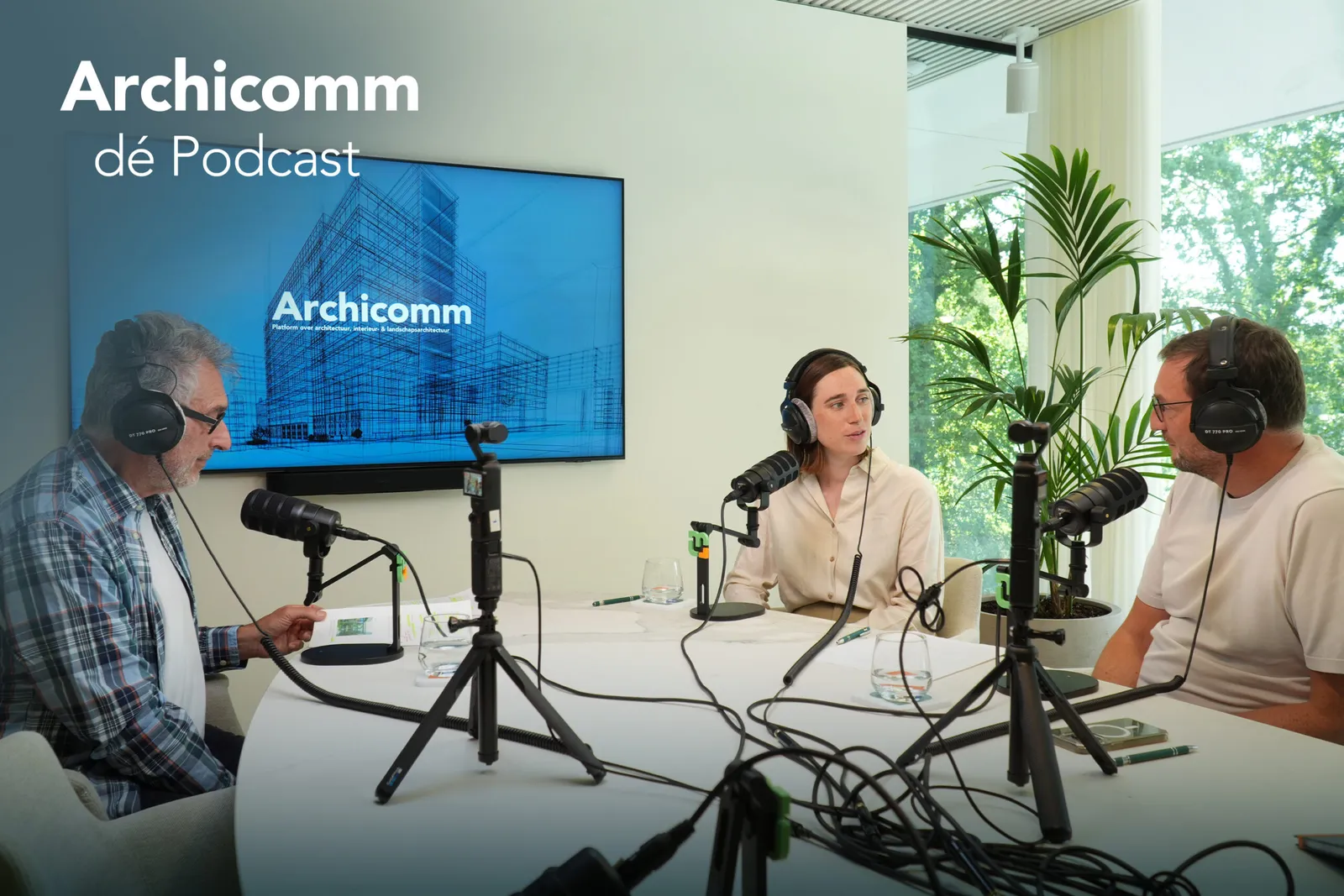
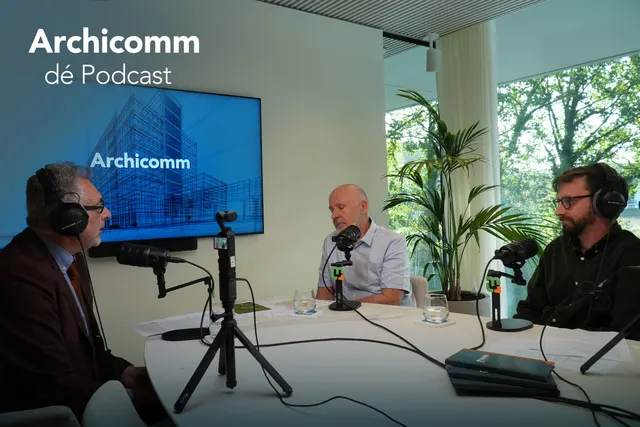
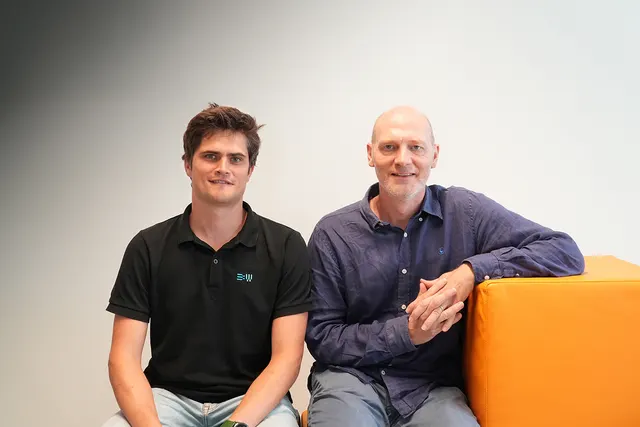
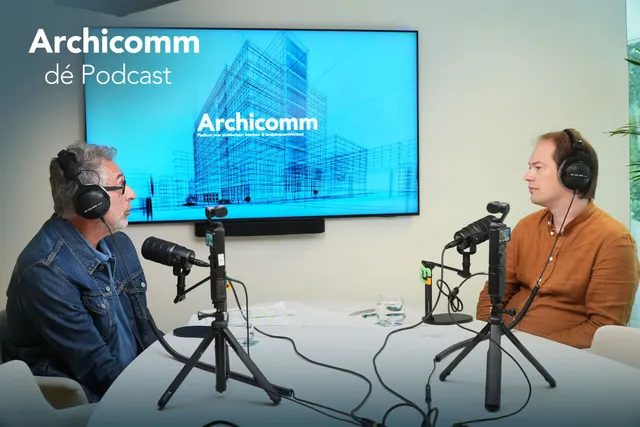
In this episode, Patrick Retour talks to Clara Van Geel and Kris Loix from archipelago. They discuss the practice’s growth, its international ambitions and their vision of caring, sustainable and future-proof architecture. From flexible workspaces and research into natural ventilation to hospitals, adaptive reuse and new forms of housing, the question at the heart of it all is how architecture can benefit people and society.
Full transcript
Alle hoofdstukken (19)
- Introduction and guest introductions
- The origins and philosophy of archipelago
- International expansion
- Clara Van Geel’s career
- A caring workplace culture
- Kris Loix’s responsibilities and role
- Complex challenges and flexible buildings
- Communications at archipelago
- Collaboration between the offices
- The Leuven office as an architecture lab
- Workspaces and collaboration
- Healthcare architecture
- CHwapi in Doornik
- AZ Diest and the European Healthcare Design Award
- Repurposing Sainte-Thérèse in Montignies-sur-Sambre
- Reuse and existing buildings
- Fluvius in Hasselt
- Buur&Berg in Sint-Truiden
- Closing
Introduction and guest introductions
Patrick Retour A warm welcome to the fifteenth episode of Archicomm Dé Podcast. My name is Patrick Retour. You may know me from my many books on residential gardens, 42 in total, available worldwide. I’m also the regular host and moderator of Archicomm Dé Podcast, now in its fifteenth episode. You can listen to all the episodes on Spotify. Today we have two leading figures from an architecture practice renowned at home and abroad. A name that rings a bell. Innovative architecture. Built on solid foundations and expertise, it produces gems of projects. They safeguard quality, delivering architecture of the highest calibre, in every sense of the word, and making a difference to people and society. I’m delighted to introduce Clara Van Geel and Kris Loix from archipelago.
Clara Van Geel Good morning.
The origins and philosophy of archipelago
Patrick Retour Kris, you’re the right person to ask, as you’ve been in the profession for thirty years, I believe. You can guide us through it and explain: what path has archipelago taken? What can we expect next? What is the philosophy?
Kris Loix Yes, that’s right. Thirty years.
Patrick Retour It’s flown by, hasn’t it?
Kris Loix Time does fly, now that you put it like that. Yes. No, that’s right. archipelago was initially formed through the merger of two practices. archipelago has now been around for ten years, so we’re celebrating our tenth anniversary this year. The two practices were the Brussels-based BAEV, Bureau d’Architecture Emile Verhaeren, and Ar-te from Leuven.
Patrick Retour Were you involved from the start?
Kris Loix Yes, absolutely.
Patrick Retour OK, so you’re one of the founders.
Kris Loix I’m one of the founders, that’s right. Why did we merge? At the time, we were both already fairly sizeable practices, I think. But we could see that the healthcare landscape was changing, and healthcare was an area in which both practices had a great deal of expertise. Second, there was the changing, or rather ongoing, demand for research in our sector. As a partner, you need that to reach a wider market and share research objectives. We found that in our partner in Brussels, and they found it in us.
Read the full transcriptCollapse transcript17 more chapters
International expansion
Patrick Retour The archipelago has grown even larger since then, with new offices in Paris and Barcelona. That’s quite something. What prompted that, and how did it come about?
Kris Loix At the same time, at the start of our merger, we also looked a great deal at opportunities abroad, because we have a whole team of fantastic healthcare architects, people who really specialise in healthcare. And we wanted to share that knowledge abroad, including in France. France has been playing catch-up in healthcare over the past few decades. It’s been a long-haul effort, but it’s starting to bear fruit today.
Patrick Retour It’s impressive that you’ve managed to establish a foothold there. Your expertise has preceded you. People know your know-how and experience, and want to draw on them.
Kris Loix Yes, and our philosophy is this: first, we make sure our own roots, our Belgian roots, are strong and deep, so that we can reach far. That’s what we’re doing. I’d say those roots are now firmly embedded deep within our organisation, allowing us to reach far. And indeed, we’re now working on projects in France and looking at projects in Spain too. So yes, we’re very much on the move.
Clara Van Geel’s career
Patrick Retour I’m curious to see what the future holds. It seems to me that the sky’s the limit, I’d almost say. Clara Van Geel, over to you. How did you become an architect? When was that? What path did you take? How did you end up at archipelago? I also know you’re multilingual, which is perhaps an extra asset as archipelago expands internationally.
Clara Van Geel Yes, that’s right. My story really begins around the time of the merger. I joined in 2016 as an architectural intern, working mainly under Kris’s wing. I gradually developed my career at archipelago. Today I’m an architect and director at archipelago, and I’m responsible for communications as well as design and architecture.
A caring workplace culture
Patrick Retour You pay a lot of attention to working together internally. You’re not just a practice that cares for people outside the organisation, your clients, but that care is built into the way you work internally too. The wellbeing of your staff and nurturing their talents are crucial to you. Is that how you’ve experienced it from the start?
Clara Van Geel Yes, one hundred per cent. We think it’s really important. It’s one of our core values too: care. We talk about it as ‘care for’ within our practice. I’ve experienced it very strongly myself from the outset, even as an intern: there’s room to grow. If you have particular areas of interest, you can always raise them and then they’ll look at how you can develop in that area. I remember that in 2016, when the circular economy was a major topic, I took a course on it. That was never questioned. If there are opportunities that fit within archipelago’s values, there’s room to pursue them.
Patrick Retour It sounds as if there are plenty of opportunities to progress and build your career there.
Clara Van Geel Yes, that’s how I feel too. So I’m very positive about it. Yes, definitely.
Kris Loix’s responsibilities and role
Patrick Retour Kris, back to you. What does your role involve, and what have you achieved? What’s on your CV? Could we run through it briefly? Thirty years is a lot to cover, of course, but could we pick out a few things? What have you achieved?
Kris Loix Today I’m one of the chairs of our practice. Among other things, I try to get the members of the board looking in the same direction, and make sure, as we put it, that the mayonnaise comes together. I want everyone to be committed to the values we’ve set out, including the different aspects of ‘care for’ that Clara mentioned. And, of course, to make an impact on society through our projects. That’s what my role involves today. I also have a great deal of experience with projects on a certain scale, where we’ve worked with both in-house teams of architects and external architects. Leading those whole teams, guiding them and making sure we’re all working towards a shared goal: that’s something I’ve been doing at archipelago for many years, even decades.
Complex challenges and flexible buildings
Patrick Retour I hear you’re good at turning complex challenges into simple, legible buildings. That’s a real strength.
Kris Loix Yes, that’s really… Clients come to us with a problem or a challenge, and we’re very keen to get to work on it and come up with a building, or an envelope, as a solution. Or a structure, whatever. Because the question is: do we still need to build buildings today? But we have structures that can evolve to accommodate other uses. We’ve won a number of projects by making it clear that we should consider not just today’s needs, but also those of next year, or in ten, twenty or thirty years. That brings us to the question of the programmatic flexibility of buildings. Taking these things into account in our practice and in the minds of all our architect-designers. Yes, I do feel there’s a kind of social role for architects there. People come to architects with a challenge, and we try… Absolutely. I find it hugely fascinating, and I think everyone here does, to develop a sustainable solution based on those challenges. We also want to consider them in a broad context, including the social context, if I may put it that way. Provided the problem can be solved. That may be a caricature, but in some way, that’s part of the solution for the coming years and decades.
Clara Van Geel Yes, and sometimes that also means questioning the brief.
Communications at archipelago
Patrick Retour OK. Clara, what does your role involve?
Clara Van Geel I’m responsible for communications at archipelago, both internal and external. That also involves critically reflecting on how we translate our designs and research into a clear story. This matters at several levels. It means our clients have a clear understanding of our design, but it’s just as important externally, as it is today in recording a podcast. What does archipelago stand for? How do we communicate that to the outside world? We also try to explain some of our more complex research in plain language.
Collaboration between the offices
Patrick Retour And when you’re in touch with colleagues in France and Barcelona, do you have a lot of Teams meetings?
Clara Van Geel Not really. There’s a very easy flow of communication between our offices. Someone from Barcelona was at our welcoming Bremberg just on Monday. So we really do try to see each other in person often enough to stay connected. And yes, of course, we have online meetings, that’s part of it. But we make the most of team-building events and other opportunities when they come along.
Patrick Retour A group of architecture practices, each autonomous, but all held to the same standards. They form a whole with the same philosophy, and in that sense it’s a bit like one big family.
The Leuven office as an architecture lab
Patrick Retour Yes, Kris from archipelago. I suggest we head down to Leuven now, where you also have your offices. I’ve been told it’s an architecture lab, a kind of laboratory for testing and trying things out. Then you take what you’ve learnt with you in your backpack to future projects. Can you give us some concrete examples of what you’ve tried out there, what didn’t work, what did, and what you’ve had to refine further? Because things do occasionally explode in a lab.
Kris Loix Yes, absolutely. Fortunately, that doesn’t happen to us. No, but it builds on what I was just saying: the research we carry out with various organisations, including many universities, on new ways of working, new ways of living and new forms of care. That also informs a number of principles, both technical and architectural. It’s about that same sustainability: if you’re going to build, try to make it as sustainable as possible, and spread the impact over time. There’s no getting around the impact you have on the ground and on nature when you build. But make sure that the interventions you do make have an effect over as long a period as possible. That’s why we’ve done a number of things that may have cost more upfront, but will help the building, in this case our office, stand the test of time. What does that mean? Making sure the plan is as flexible as possible. We call them beam-free floors, so there are no structural obstacles, there’s plenty of clear height, and as much as possible is surface-mounted, making it easy to dismantle. That’s the first principle. The second is: can we rely as much as possible on natural elements? We’ve made our façade with 55 motorised opening windows. Together with the windows in the roof, they allow for full natural ventilation, using the principle of natural ventilation. September is a perfect example of this, as is the period when summer is just ending. Those are the ideal months for the system, when the building can be conditioned entirely without any mechanical systems.
Patrick Retour Do they also respond automatically to the seasons and the weather?
Kris Loix Yes.
Patrick Retour Okay.
Clara Van Geel There’s another nice anecdote about the summer. It was a really hot one, and we have ceiling fans in the office. You don’t see them that often in Europe, perhaps, but they’re common on other continents. It’s a simple solution. Just moving the air makes you feel much more comfortable. I don’t know how many colleagues have since bought a ceiling fan for home. There was a real wave of it. I think the company selling those fans must have wondered what was going on at archipelago. Suddenly there were so many orders. But a huge number of colleagues have now installed a ceiling fan at home too, because it simply works so well. And all you really need is an electrical connection. It doesn’t require a massive investment, and it’s incredibly effective. So, yes.
Workspaces and collaboration
Patrick Retour What you’ve created, in the end, is flexible, activity-based workspaces. An open work café. And a strong connection with the garden. All of that is intended to promote wellbeing and collaboration within the teams. The same applies to your other office in Brussels.
Clara Van Geel Yes, we’ve carried those principles through. So, yes, open workspaces, new ways of working, offering different types of workspace. We also have a work café at both locations, where people can meet informally. We have more spaces for focused work. And we have studio spaces where we work on models, doing 3D printing as well as making models by hand. So, yes, that’s something we consider very important, and we’ve carried the same approach through to our different offices.
Healthcare architecture
Patrick Retour At archipelago, you’re hugely committed to sustainability and a caring workplace culture. We’ll see that in the projects we’re going to visit virtually in a moment. Quite a few of them are hospitals, where, of course, people’s care is central. But we’ll talk more about that shortly. The healthcare sector certainly seeks you out. That’s no coincidence, because you’re very caring, both within the practice and towards your clients. So you’ve found a great market that you keep returning to. And one thing leads to another.
CHwapi in Doornik
Patrick Retour I suggest we head down to CHwapi in Doornik. What’s the story behind the site?
Kris Loix It’s a new hospital built in the city, essentially bringing together several peripheral hospitals.
Patrick Retour But it’s a completely new concept, an archipelago concept, you could say?
Kris Loix Yes. It starts with a public plinth, where the reception areas and logistical services are located, and which also gives the hospital, CHwapi, a real presence in the city. It forms part of a kind of urban walking route. On top of that public service plinth, we’ve built two volumes. They’re distinctive triangular forms, very recognisable, especially when you look at the images. The care model has been developed in great depth. One factor behind our search for a model was the shortage of nurses. We wanted, for instance, to keep walking distances as short as possible, so nurses can care for as many patients as efficiently as possible. The design also takes account of both the nurses’ and the patients’ needs. That’s why the layout is jagged, so none of the rooms looks directly into the opposite room. There are also views of the city and the surrounding urban fabric.
Patrick Retour What kind of feedback have you been able to gauge? From staff and visitors, for example. Can you tell what effect it has on people?
Kris Loix It’s still in the handover phase, so it’s not in use yet. But the feedback so far has been very positive.
AZ Diest and the European Healthcare Design Award
Patrick Retour But AZ Diest has been around for a while. We’ve also won an award for it: the European Healthcare Design Award 2026. How did you manage to win it? I already know the answer: because you’re doing innovative work with a hospital site like this.
Clara Van Geel Yes. It was also very important to us to integrate the hospital into its surroundings and context. We made a strong connection with the public realm, with a warm welcome through a large gallery and open spaces where both staff and patients can connect and re-energise. I think the relationship with the surrounding landscape is what really set us apart.
Kris Loix Yes, and above all, the connection with nature. There’s lots of natural light, and every room has a relationship with what we call a healing environment. It has a healing effect. You can see it for yourself as you walk through, it speaks volumes. The water, the greenery, the blue-green landscape, are all beautifully integrated into what is a very green hospital, even in an urban setting. The competition was fierce. The other projects were from Australia and Shanghai, real heavyweights. I remember thinking, “We don’t stand a chance.” But what people around the world really appreciated was something we, as Belgians and Flemings, deal with every day: the human scale, quality and our connection with nature. Those fundamental principles are highly valued around the world.
Clara Van Geel Yes, daylight really is very important to us. It’s something we want to prioritise in every project, and we put a lot of effort into it. It adds immeasurable value, particularly in a healthcare context.
Repurposing Sainte-Thérèse in Montignies-sur-Sambre
Patrick Retour We’ll head down to Montignies-sur-Sambre now, to the former Sainte-Thérèse hospital. The design is being developed and the project is still at an early stage. But we already know what it’s going to become. It looks ambitious, from what I can see: an auditorium with 350 seats, specialist laboratories, simulation rooms, a therapeutic apartment, a teaching radiology unit, an animal technology centre and a lab for the study of form and human function. That’s quite a lot. How do you get started? How do you bring it all together and organise it?
Clara Van Geel It’s a lovely project, because it starts with an existing hospital building that we’re converting into a school. It’s been a real puzzle, working out how the existing structures can be made to fit a new programme. A hospital is very different from a school, after all. I’ll spare you the technical details, but it’s been a really interesting process. We’re very proud of what we can present today. It also fits perfectly with our sustainability ambitions. We’re going to wrap and insulate the entire façade, creating a completely new school campus in Charleroi that will once again be integrated into its context and surroundings. A new university college campus for Charleroi. We call it a school in a garden, rather than a garden at a school, because of the surroundings. There’s also a terril, a distinctive feature of the Charleroi landscape, which is part of the school site.
Patrick Retour So it’s also about finding a balance between old and new, I imagine.
Clara Van Geel Yes, absolutely. We analysed which parts could be retained and still perform well. In fact, I think 90% of the project has been retained, and we then looked strategically at where to bring in light.
Patrick Retour I’m convinced this will be another huge success for the region and another feather in archipelago’s cap. I’d just like to point out that we’re visiting a number of projects virtually here, but you can also discover them in Archicomm magazine. The wonderful photographs speak for themselves, and you can read more about the projects too. That’s how we bring the spoken and written word together. Archicomm Dé Podcast and Archicomm magazine: two parts of a whole. People should definitely give them a try. They’re well worth it.
Clara Van Geel Yes, I’ll definitely do that too.
Reuse and existing buildings
Patrick Retour Clara, we’ve already talked about questioning the question. Shall we explore that a little further? These days, we no longer automatically assume that we should demolish everything. Instead, we ask ourselves what we can reuse and how we can give those areas and volumes a new purpose. It’s a challenge, Kris, but also something you’re working on a great deal.
Kris Loix Yes, absolutely. We regularly get asked, including through public tenders, about what needs to be built. And quite often, that means existing infrastructure or buildings have to be demolished. We come across that very regularly. Our response is: look, that might be an option, but it should really be the last resort. First, you need to look at what’s already there. We’re always surprised by how suitable existing buildings are for other uses. So we always analyse the question itself, as Clara just said: is the brief right? Is it really true that the building needs to go? Because it might actually have a very clever structure, a very rhythmic structure, that you can build on and dismantle, then wrap in a new high-performance envelope.
Patrick Retour But of course, that brings us to an important trade-off. We need to reduce our ecological footprint and cut CO2 emissions. But naturally, we also need to keep an eye on the costs. Yes, that’s the challenge for you.
Kris Loix If you can retain the structure, you’ve already saved a large part of the cost. If it’s sound and performs well, you’ve saved a significant amount. That’s exactly what we’re doing with a very concrete project in Hasselt today. The structure is invaluable. Don’t demolish it, let’s wrap it in a new envelope and combine it with a new building. Yes, absolutely. So that, ultimately, the old and new can become, and will become, one new whole.
Fluvius in Hasselt
Patrick Retour Which project in Hasselt are we talking about, Clara or Kris?
Kris Loix Fluvius.
Patrick Retour Ah, yes, OK.
Kris Loix The Fluvius project. So, with Fluvius, we’ve taken all those considerations into account. We’re now working towards a very good masterplan, a long-term vision for the whole site. How can the site continue to evolve into one that can be used by different companies, for example, or allow for different expansion options? That methodical approach has really opened people’s eyes.
Patrick Retour The big news is that we’re going to turn off the gas supply in due course. Fluvius has also been in the spotlight in this respect. In any case, I hope they opt for sustainable energy sources. What’s planned for the building?
Kris Loix Yes, we’re still very much at the masterplan stage.
Patrick Retour What are you going to propose to them? Yes, it won’t be gas.
Kris Loix No, of course not.
Patrick Retour Perhaps they won’t even get a connection.
Clara Van Geel That would be best.
Kris Loix First, we’re looking at how to make sure the buildings themselves perform well, and then how to meet their energy needs as sustainably as possible…
Patrick Retour I’d say they have a role-model function to fulfil, and we’re counting on them.
Buur&Berg in Sint-Truiden
Patrick Retour Finally, let’s move on to another project here: Buur&Berg in Sint-Truiden. You could describe it as a city within a city.
Clara Van Geel Yes, we started there with the masterplan as well, a good many years ago now, I think.
Kris Loix It’s a pilot project for care. We actually took part in a competition that we…
Clara Van Geel I still remember the booklet. I think it’s been around for more than ten years now.
Patrick Retour And when do you think it will come into use?
Clara Van Geel We’re working on it, aren’t we?
Kris Loix Yes, work on site is in full swing.
Patrick Retour A project like this can take a while, but that’s normal. In the end, we’ll be able to enjoy it once it’s ready. Once again, you can see it proving its value to people and society. That’s the idea. Yes.
Clara Van Geel Yes, and the good thing is that the concepts have stood the test of time. The project also makes strong use of the fine-grained network within the city: how it connects with the neighbouring plots and how we can bring care into the city. I think that’s what sets the project apart. It offers a very varied mix of housing: the kind of housing we’re familiar with, as well as supported living. The site is highly inclusive. And we’re actively encouraging this interesting mix of housing, including through small meeting places, squares and green spaces. So we’re really creating a piece of urban fabric there.
Patrick Retour I assume people in Sint-Truiden are delighted with the plans, in the end.
Kris Loix Absolutely. As we’ve just explained, archipelago works on everything related to care. And care can be interpreted very broadly. People can need care in all sorts of other areas. That can be physical or mental. It can be schools. People need care at school too. We’ve applied that way of thinking to Buur&Berg as well. And you can see that care is much more widely present across the site. There’s elderly care, there are sheltered workshops. All kinds of care. What was unique about the original Buur&Berg project was that we introduced the concept of invisible care. You couldn’t see that care was there, but it was very much present. We all want to be cared for and pampered. Care should… So all those themes are part of the project. One reason it’s taken so long to bring it to fruition is that you keep running into issues with standards and regulations. The original care brief can no longer be delivered, or cannot be delivered to the same pilot-project standard, because subsidies naturally come with certain requirements. We had the principle of a floating bed, which I still think is a very good approach. A floating bed is a bed that needs care and can move to the place, to the home, where it’s needed. But that conflicts with subsidy legislation, because the bed has to stay in that room. So there’s still work to do. We’re certainly still open to finding a way to make it happen, so that the bed can go to the patient who needs that care.
Closing
Patrick Retour You’ll have to do a bit more persuading and negotiating, Kris, but I’m sure you’re very good at it. In any case, I’m delighted that archipelago will be looking after us, even in our old age. I’m also curious to see whether that archipelago of architecture practices will keep growing, but we’ll hear more about that another time. Thanks to our guests, Clara and Kris from archipelago. Have a safe journey home. All the best with everything you’re working on. I’ll be back with you soon, dear listeners. Thanks for joining us again. Bye.
Clara Van Geel Bye, take care.
Keep following this
Get an email when a new story is published. No account needed.
- SubjectGeneral