Ceramic House: unique façade with 3D-printed tiles
Text Eva GoossensImage Riccardo De Vecchi / Studio RAP
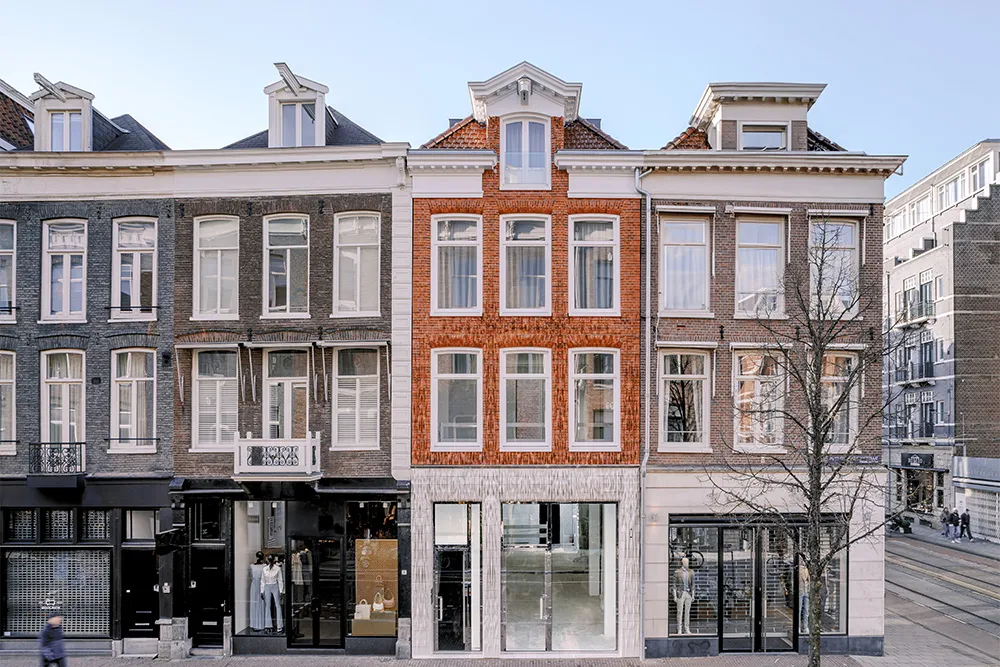
With innovative façade applications among the central themes of this issue, this exceptional project was a must: Ceramic House in Amsterdam, designed by architecture practice Studio RAP. The façade comprises around 3,000 3D-printed ceramic tiles, each one unique and finished by hand. The result is well worth pausing to admire, both literally and figuratively.
Rotterdam-based Studio RAP is not an architecture practice in the conventional sense. Alongside its office are an R&D robotics lab and a production facility equipped with high-tech robotic arms, where new fabrication technologies are developed. The idea is to put these technologies to use straight away in its own distinctive projects. As well as Ceramic House, Rotterdam’s Theater Zuidplein is another notable project. Its acoustic interior walls are clad with no fewer than 6,000 different aluminium triangles, which enhance both its striking aesthetics and its acoustics. Another project related to Ceramic House is New Delft Blue, where 3D-printed ceramics nod to Delft Blue porcelain. This too shows how computer algorithms, 3D-printed ceramic elements and hand-glazing demonstrate the new architectural potential of ceramics.
Inspired by knitwear
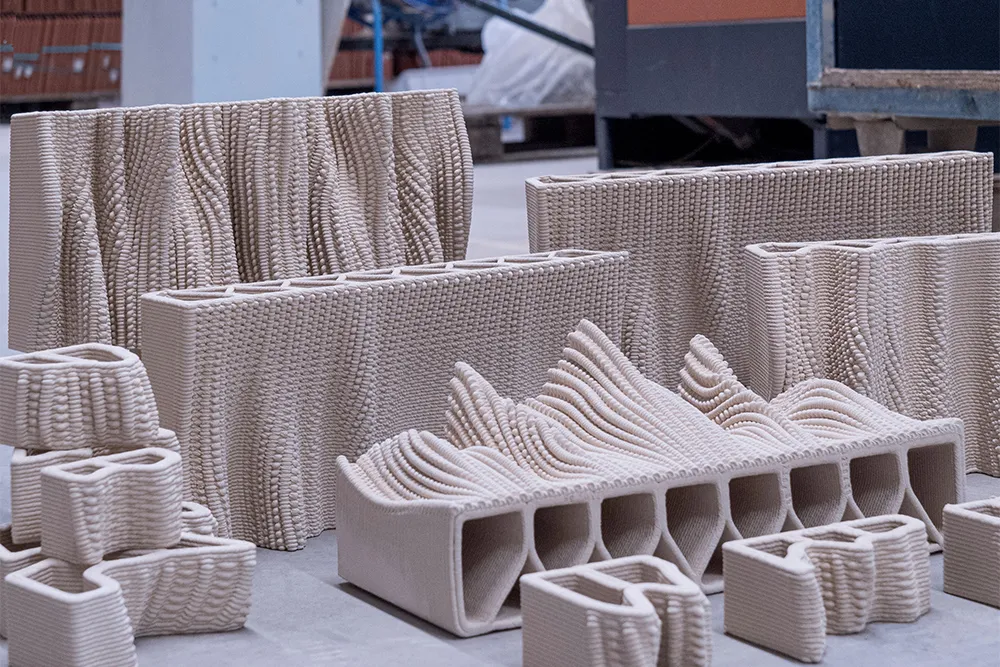
How do you stand out as a high-end fashion boutique on Amsterdam’s P.C. Hooftstraat, one of the most luxurious shopping streets in the Netherlands? With the façade! It was a challenge Studio RAP was keen to take on. Naturally, the team had to take account of the historic city’s aesthetic requirements. But that did not stop the architects from coming up with an innovative concept. They developed a design inspired by fashion, and knitwear in particular. Wessel van Beerendonk, architect and co-founder of Studio RAP, says: “When you look at knitwear, you see a number of interesting ingredients that we translated into the architectural design: first the elegant folds in the fabric, then the interlocking yarns and, when you zoom in further, the stitch pattern. We translated this concept into the digital realm, into patterns created by the computer.” Digital design taken to the next level, for an exceptional architectural application.
Bringing digital technology and craftsmanship together
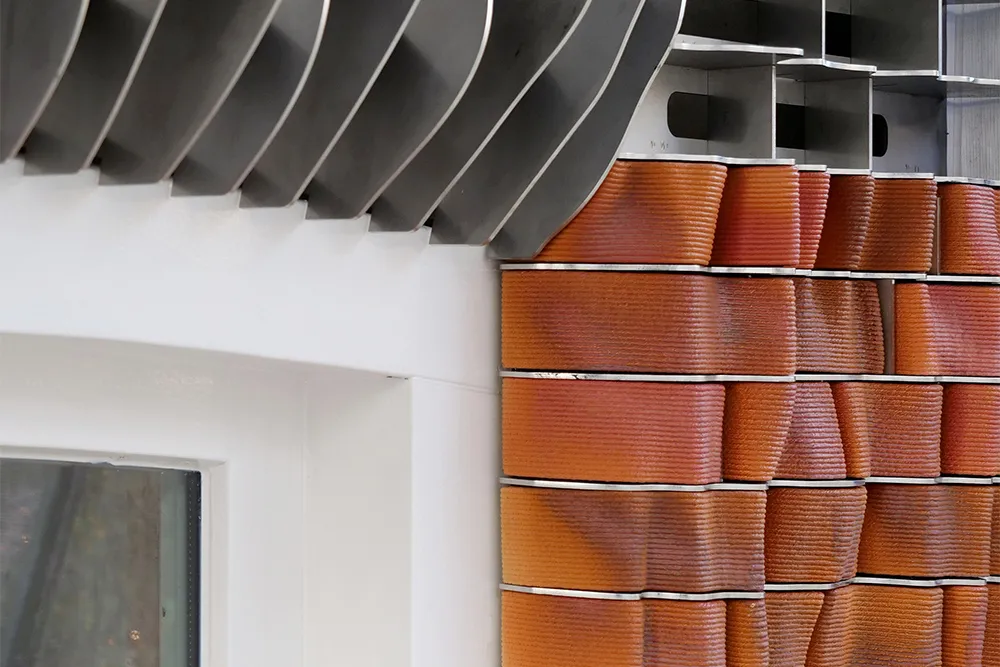
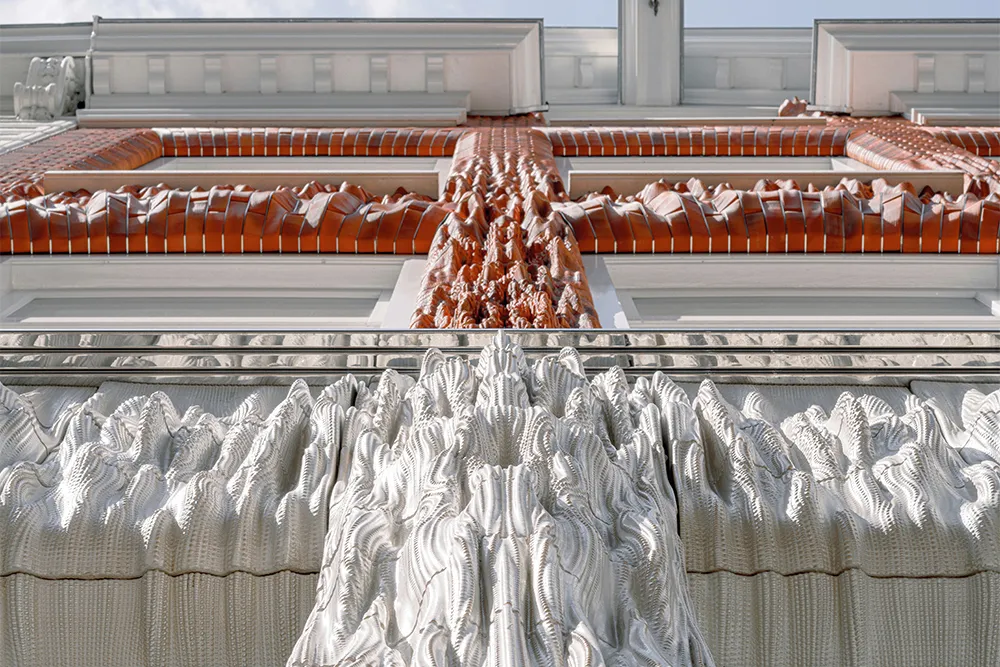
The entire façade is clad in 3D-printed tiles, built up layer by layer before being fired and glazed by hand. The design takes account of the original façade’s silhouette, with its distinctive tripartite structure, as well as the aesthetic requirements. The scale, size, type and colour of the ornaments and materials are carefully coordinated with the neighbouring buildings. The aim is to integrate traditional and innovative architecture seamlessly into the street. The organic, undulating structure of the ceramic façade changes as the viewer approaches the design from different angles. The light-coloured tiles at the bottom, pearl white with a hint of yellow, are designed to be particularly expressive at eye level, transitioning seamlessly to a flat alignment where they meet the ground. On the upper floors, the façade features 3D-printed tiles glazed in three shades of red. The detailing of the knitwear-inspired pattern gradually fades towards the top. The tiles were laid in a cross-bond pattern, neatly aligned with the adjacent masonry façade. They were also fitted into laser-cut stainless-steel cassettes and bonded on site in a sequence that had to be followed precisely. No easy task, but the result speaks for itself. Digital technologies and computational design in the service of a distinctive architectural language that enriches the world and makes it more exciting and diverse.
Question about this story? Ask your question
In this story
- Project:Ceramic House
- Location:Amsterdam
- Architect:Studio RAP
Keep following this
Get an email when a new story is published. No account needed.
- ThemeBuilding envelopes for a changing climate
- SubjectRoofing & facades