Solutions for a circular economy
Text and images Zinkinfo
HOT-DIP GALVANISING AND SUSTAINABLE CONSTRUCTION
Galvanising and circular construction go hand in hand. Together with its sister organisations across Europe, Zinkinfo, under the auspices of EGGA (European General Galvanizing Association), has published a substantial document entitled “Galvanized Steel and Sustainable Construction: solutions for a circular economy”.
What is the circular economy?
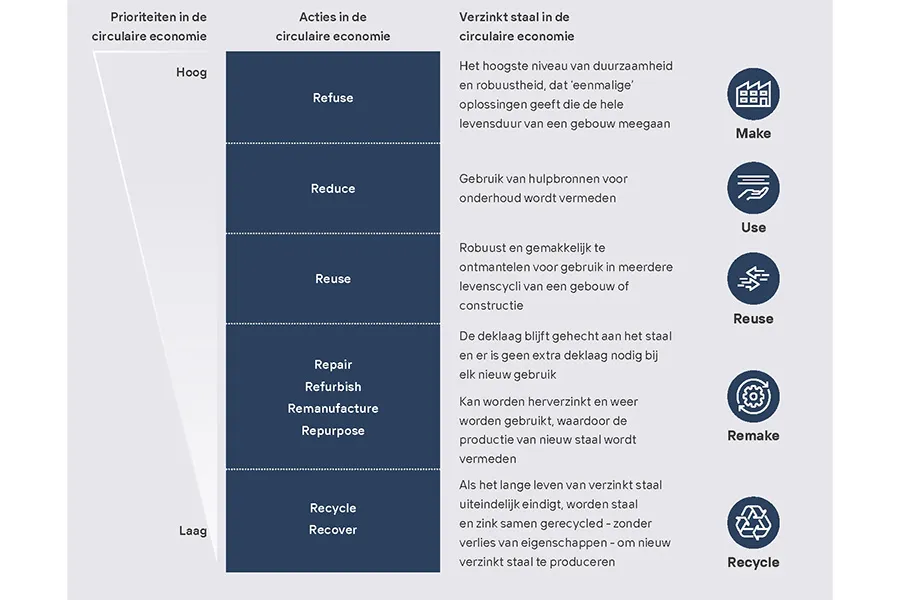
The circular economy is already a familiar concept to most people, but we would like to briefly clarify it. The circular economy represents a shift away from linear business models, in which products are made from raw materials and end up as waste at the end of their useful life, towards circular business models, where intelligent design means that products or their components can be repaired, reused, returned and recycled.
An important aspect of the circular approach is the need for a clear hierarchy of options. There are several hierarchical models of the circular economy that show the priorities. These different models share the same foundations. Recycling at the end of a product’s life is considered the lowest priority.
Traditionally, we have always said that metals are circular because they can be recycled at the end of their useful life without losing their properties. This is true and still very important, but circular thinking involves more than that. This publication seeks to show what galvanised steel has to offer higher up the hierarchy.
Reusing galvanised steel: case studies
When discussing circular construction, a distinction must be made between two approaches. One is the reuse of existing structures, giving them a second life in another building or structure. The other is designing new buildings or infrastructure in such a way that all building components can be dismantled and reused in the future.
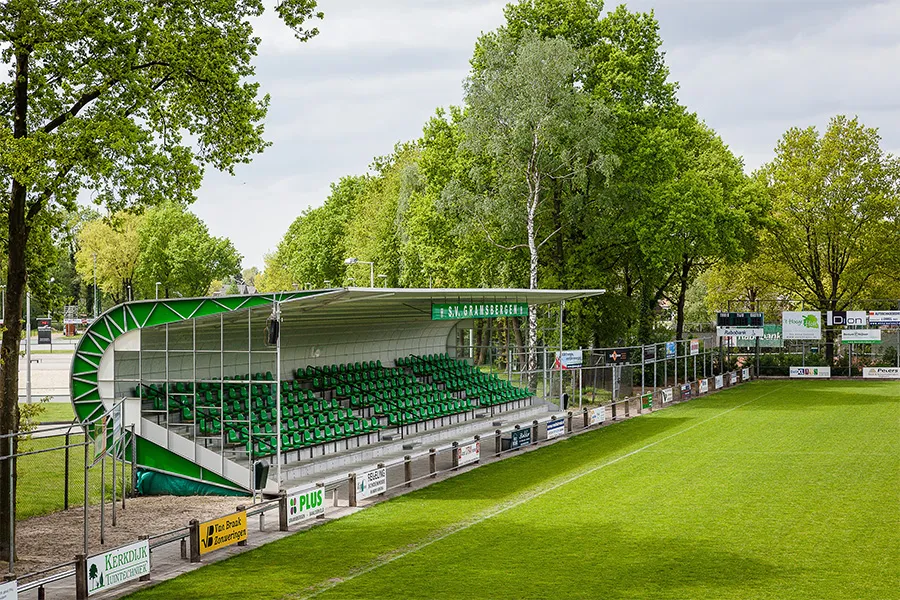
Reuse: Main stand in Gramsbergen
An existing Elascon stand was saved from demolition thanks to the enthusiasm and decisiveness of one man. In the summer of 2011, Harry Haverkotte, a board member of SV Gramsbergen, heard that their neighbours from Hoogeveen were moving to a new sports park. Impressed by the good condition of the main stand, he bought it for 7,000 euros, including the cost of dismantling.
The stand was originally built in 1976. At the time, the Hoogeveen board commissioned its construction for 139,200 Dutch guilders, equivalent to 163,000 euros. Within two years, a magnificent 32-metre-long stand had been built.
In the end, the stand cost just 35,000 euros, including dismantling and reconstruction, whereas a new one would have cost at least 200,000 euros. Everything was reused except the old wooden planks, the seats and the glass side panels. The only decorative painting required was on the inside of the roof.
The excellent condition of the galvanised steel was confirmed during dismantling.
The outer structure had been exposed to the elements for forty years, but the galvanised steel was in perfect condition and did not need to be re-galvanised. The remaining galvanised coating is more than 100 μm thick, and the stand can last for decades to come.
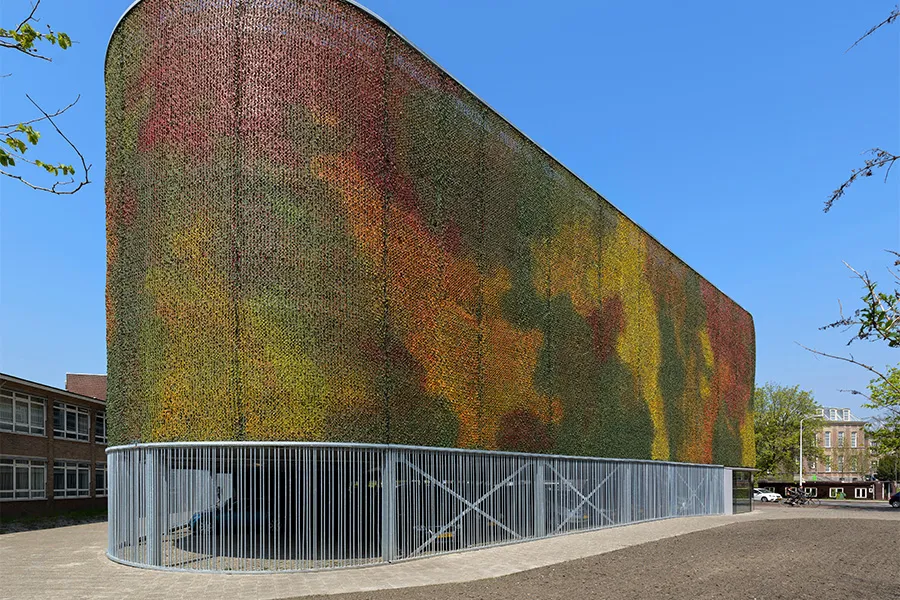
Circular design: Morspoort car park in Leiden
The mobility sector is transforming at a rapid pace. More and more cities are banning cars from their centres and building temporary car parks on the outskirts, ideally near tram or bus stops so that people can easily switch from car to public transport.
A temporary multi-storey car park in Leiden is a fine example. The car park is opposite the western city gate, the Morspoort, and is operated by the municipality for ten years. This period may be extended by a flexible term of ten years, both structurally and in terms of management. Ultimately, the site must be made available again for urban development. Thanks to its reusable materials, the building can easily be dismantled, removed and rebuilt elsewhere.
The entire car park structure is made up of hot-dip galvanised elements: columns, beams, crossbeams and railings. Hot-dip galvanised steel proved to be the best choice for designing a car park that could be easily dismantled after a period of use. The choice was also influenced by the contours of the building: these had to follow the curve of the road, allowing views along and through the building. Steel proved to be the ideal material for this. Steel is also lightweight, allowing the profiles to be dimensioned more slenderly. What is more, the more slender the profiles, the more daylight enters the building.
The impact of maintenance on CO² emissions
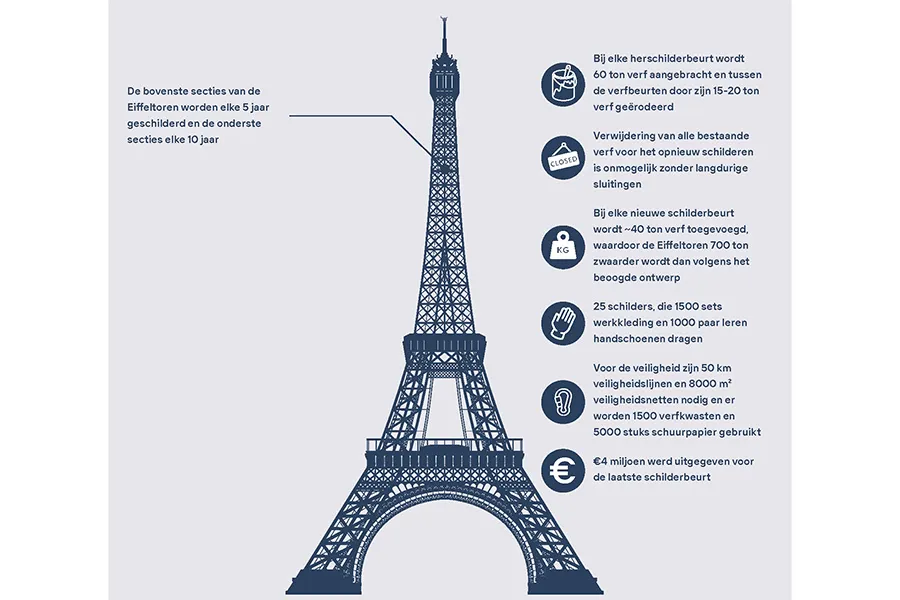
When Gustave Eiffel built his famous Eiffel Tower in 1889 for the international exhibition and the centenary of the French Revolution, it was intended to be a temporary structure. He had no idea that 130 years later it would still be a much-loved landmark in Paris. But this long life comes at a price. The ironwork of the Eiffel Tower has been repainted 19 times, and a maintenance painting cycle takes 18 months and costs 4 million euros. The cost of repainting is estimated at around 14 per cent of the tower’s current construction cost.
But the millions of tourists who visit this iconic structure do not see the costs in terms of resources, the risks to workers’ safety and the structural consequences of repeated painting. With around 40 tonnes of residual paint added to the structure after each repainting, the structural consequences of this additional weight will ultimately have to be addressed. During the most recent repainting, it was necessary to start by removing all 19 previous layers of paint from certain sections of the tower in order to preserve its structural integrity. This is a lesson for today’s buildings, which are too often constructed without considering sustainability or how to avoid maintenance.
Question about this story? Ask your question
Keep following this
Get an email when a new story is published. No account needed.
- ThemeCircular construction and material awareness
- SubjectSustainable & circular