Building sustainably with circular and green concrete
Text Eva GoossensImage Buildwise, Befimmo, Stad Gent, Enjoy Concrete
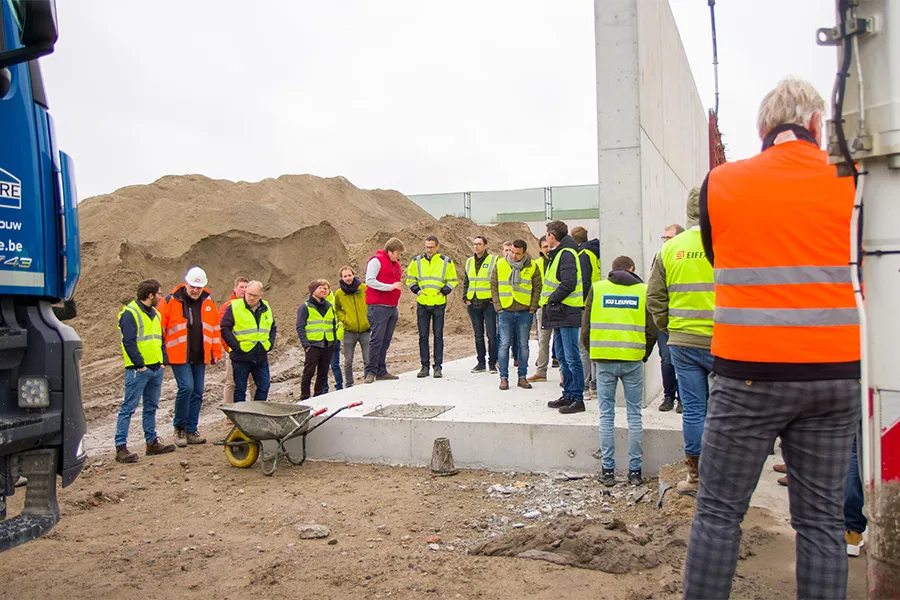
Circular concrete: where do things actually stand? We asked specialist Jeroen Vrijders, head of Buildwise’s Sustainable and Circular Solutions laboratory. What did we find? Although some types of circular concrete are already in common use, there is still a way to go for many other innovative solutions, especially those that currently fall outside the standards framework. But there is no doubt that a great deal of work is being done to get there.
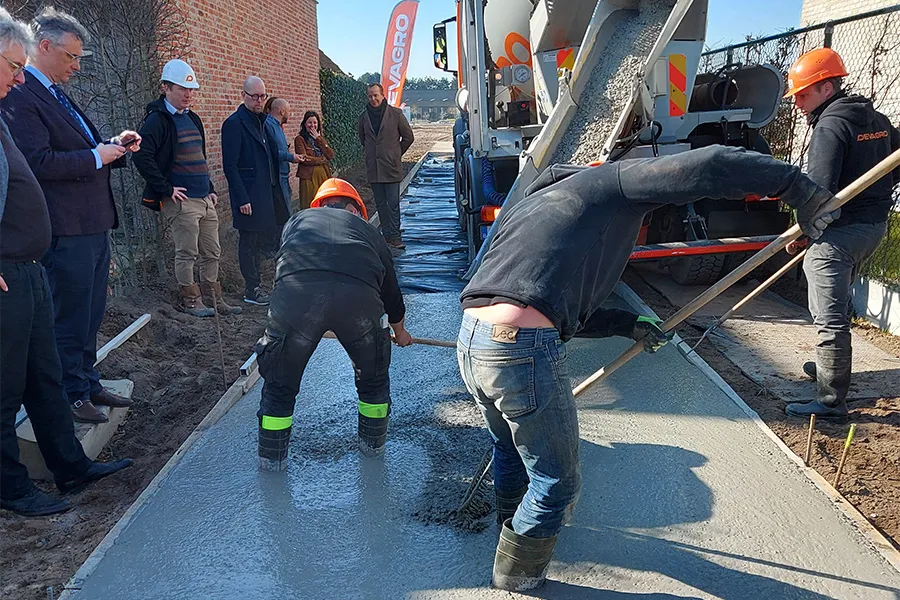
“The innovative nature of circular concrete means that people often still lack confidence in it,” begins Jeroen Vrijders of Buildwise. “Through further research and pilot projects, we need to try to scale things up.” Various initiatives and organisations are already working towards this. Buildwise is also taking its role in providing information seriously. One result is the ‘Practical guide to circular concrete’, which can be easily downloaded from the Buildwise website. There is also the website www.circular-concrete.be, with up-to-date information on innovative technologies, environmental impact and the projects being monitored.
Why circular concrete?
Why choose circular concrete? “Pressure on the climate is, of course, an obvious first reason. Concrete has a considerable environmental impact,” says Jeroen Vrijders. Production volumes of ready-mixed concrete in Belgium are substantial: more than one cubic metre per inhabitant per year. Around eight per cent of global CO2 emissions come from cement production, according to EOS Wetenschap. Given its composition, cement based on Portland clinker, water and aggregates, traditional concrete does not fit into the picture of sustainability. On the one hand, cement production generates CO2 emissions; on the other, primary natural resources have to be extracted. Jeroen Vrijders adds: “There is also pressure from regulations to use more circular materials. And, last but not least, choosing circular concrete can earn extra credits towards BREEAM and green building certificates, or help you achieve a good score on the CO2 Performance Ladder.” In short, using circular concrete is in line with the broader ambition to build circularly.
What exactly is circular or green concrete?
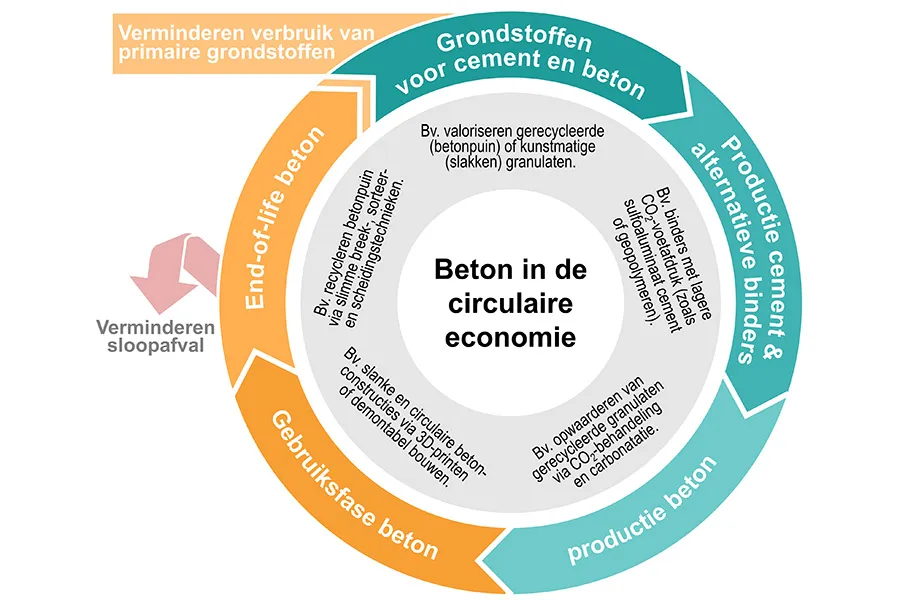
Various circular concrete technologies can help make construction more sustainable. First, there is concrete made with recycled or artificial aggregates. This avoids the extraction of finite natural resources. Jeroen Vrijders says: “Concrete containing recycled aggregates falls within the existing standards framework and is already available with BENOR certification. This builds confidence and means it is already being used more widely.”
Belgium has quite a few frontrunners in the use of recycled aggregates in concrete. Most are active in the Groen Beton Vert federation. A second way to make concrete ‘greener’ is to address the binders and partially or fully replace Portland cement, for example with blast furnace slag, fly ash or limestone. A more innovative option is to use alternative cement-free binders such as geopolymers. The third pillar is optimising the use of concrete and its service life. Self-healing concrete is one example. The fourth and final pillar is reuse and recycling techniques, involving not only recycled aggregates but also entire structures or specific concrete elements. Vrijders says: “Think of standard modules for bridges or sheds, but also smaller elements such as blocks and tiles. In this context, it is worth documenting these elements in, for example, a materials passport or a building’s post-intervention file.”
A wealth of initiatives
There is clearly a lot going on in the concrete sector. Various initiatives and organisations are driving progress. One example is the Circular.Concrete project mentioned earlier. The VLAIO Living Lab Circulair Beton is also worth noting. Vrijders says: “Here, we take a value-chain approach to finding ways to significantly increase the use of circular concrete. We support the demand side from design through to delivery, with a practical guide, for example, as well as specifications for typical applications and the development of an ecosystem.” We should also mention the Concrete Circularity Center, a project subsidised by VLAIO-EFRO to shorten and simplify the evaluation process for new circular concrete mixes. This has involved a large-scale testing programme, as well as an advice desk, site monitoring and the development of a new laboratory at Acasus Veurne.
Circulair Betonakkoord Vlaanderen
Last but not least, we should of course mention the Circulair Betonakkoord Vlaanderen, an initiative that is part of Vlaanderen Circulair and the targeted 2020 call for the circular construction economy. The final text, presented at the end of 2022, has already been signed by many federations, contractors, concrete producers and others. Its specific ambitions are to halve CO2 emissions from concrete production by 2030 and reduce them to zero by 2050. It also specifies that demolished concrete should be reused as aggregate to the greatest possible extent, alongside a number of sustainable applications. For example, it states that by 2030 buildings should be designed so that their concrete elements can be reused to the greatest possible extent. Also by 2030, the most suitable sustainable concrete mix should be used for every application. Ambitious, but ambition is what we need.
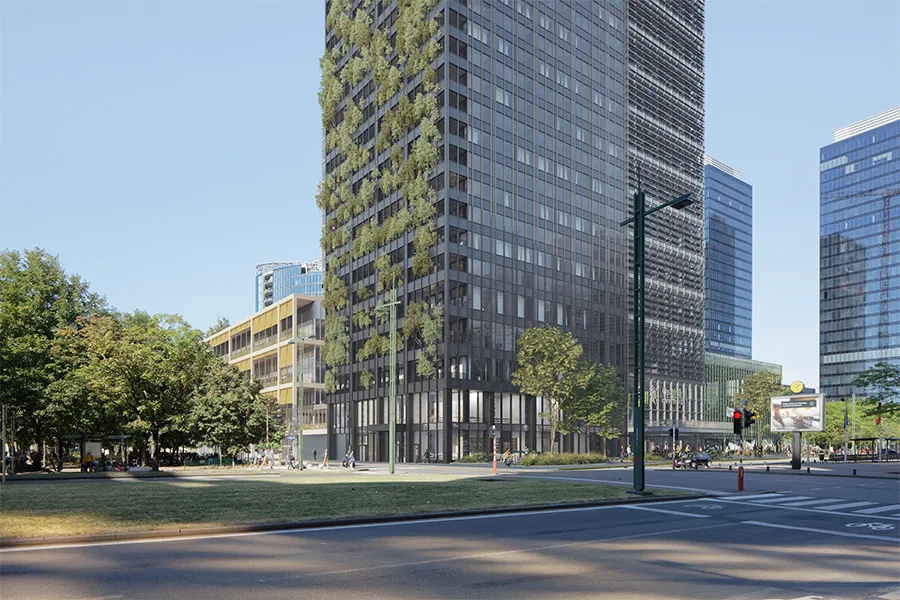
30,000 tonnes of circular, C2C-certified concrete
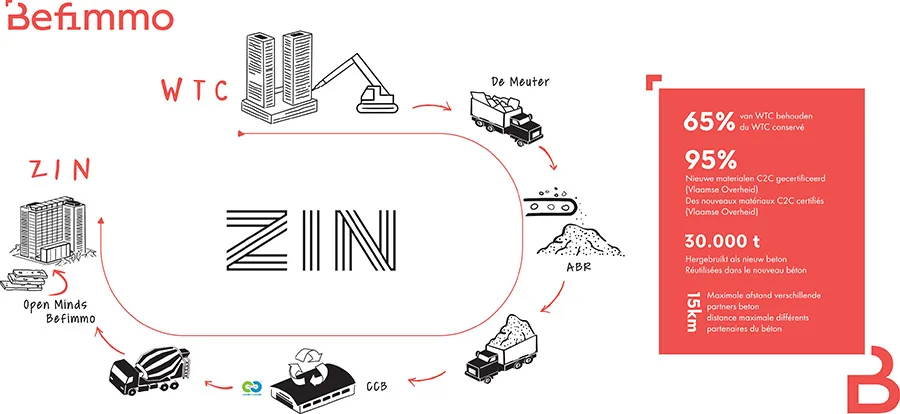
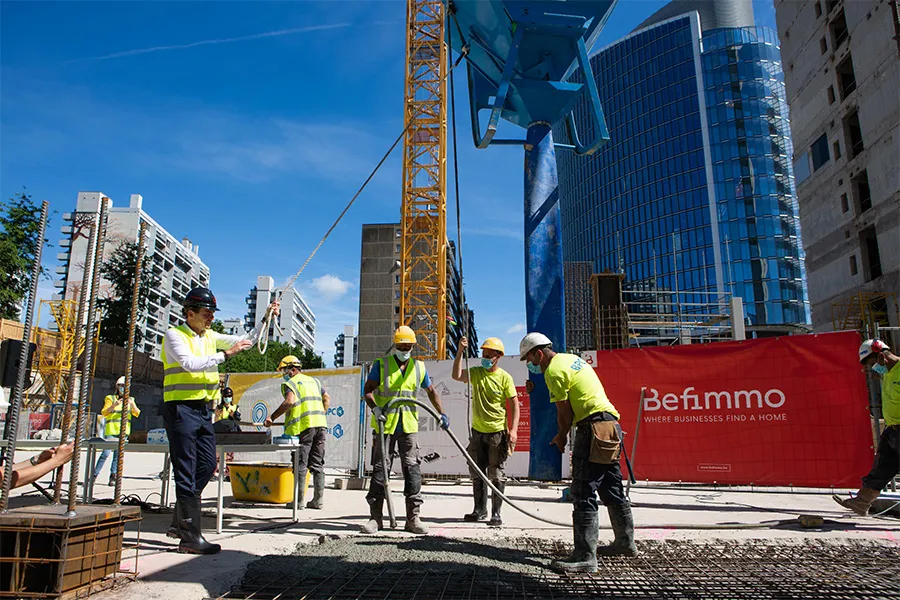
So much for the theory. But what is already happening in practice? The WTC towers provide a striking example. Rubble from the old WTC towers was upcycled and reused in the ZIN project, Befimmo’s innovative, multifunctional development in Brussels’ Northern Quarter, which replaces the WTC. No less than 30,000 tonnes of rubble were collected, sorted, crushed and turned into 3,500 tonnes of A+ aggregates. These high-quality aggregates were then incorporated into new concrete that received Cradle to Cradle certification. The total distance travelled to make this process, from demolition to new concrete, possible was no more than 15 kilometres. To complete the process successfully, Befimmo joined forces with De Meuter, ABR, CCB, Seco and the Open Minds construction consortium.
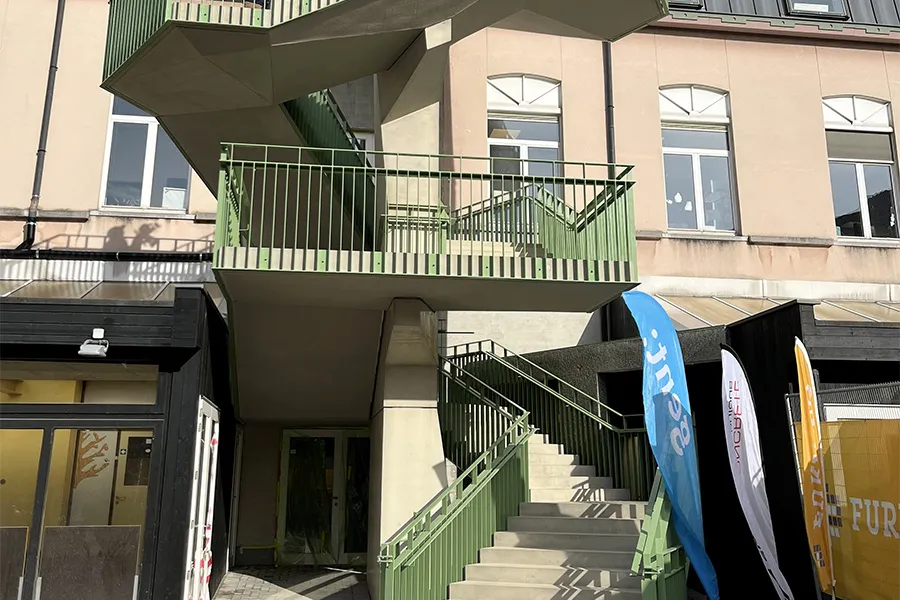
URBCON project
The next project takes us to Ghent, which is establishing itself as a European frontrunner in ‘clean technology’ and the reuse of raw materials. A footpath and benches made of circular concrete were already in place, and a recent addition is the fire escape staircase at De Zonnepoort primary school. Most of the cement was replaced with by-products such as slag and ash from the steel industry. The result: a 70 per cent reduction in CO2 emissions. This fire escape staircase, made of ‘green’ concrete, is part of the European URBCON project, led by the City of Ghent, UGent and thirteen partners from Belgium, the Netherlands, Germany and Great Britain. As a third project, we would also like to mention ’t Centrum, Kamp C’s circular office building. Here too, sustainable concrete mixes with eco-binders were used, also developed as part of the URBCON project. The result: cement-free foundations with minimal environmental impact. These are examples of what can be done and how things will continue to develop in the future.
Question about this story? Ask your question
Keep following this
Get an email when a new story is published. No account needed.
- ThemeCircular construction and material awareness
- SubjectSustainable & circular