Antwerp Provincial Government Building | “Sustainability and challenging architecture are not mutually exclusive”
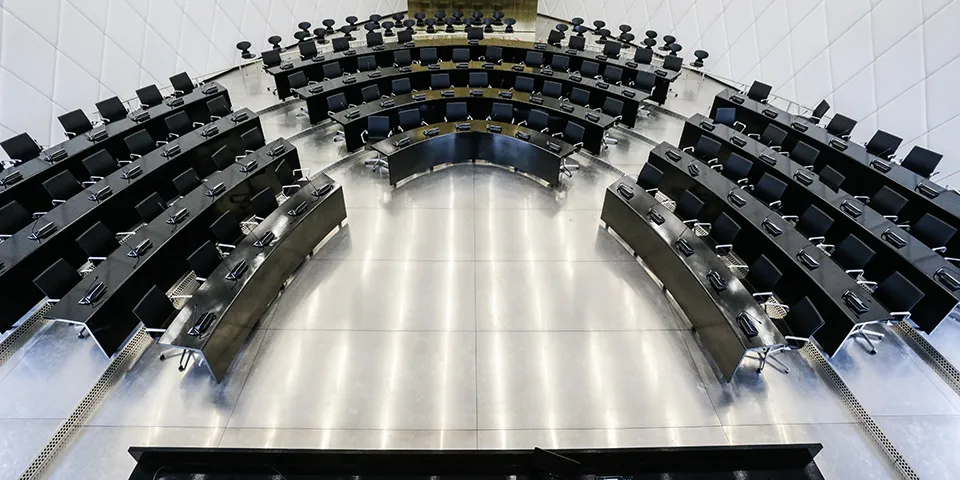
The new Antwerp Provincial Government Building offers its users and visitors a very high level of thermal comfort. Yet its energy consumption is minimal, and the building does not use active cooling. Nor, for that matter, does it use fossil fuels.
“The Provincial Government Building was designed with sustainability as its starting point,” says Kurt Corvers, operations director and partner at Studiebureau Boydens. “We are very proud to have shown, together with architecture practice XDGA, that ambitious sustainability and challenging architecture are not mutually exclusive, provided both aspects are taken into account from the outset and balanced with respect for one another. That was certainly the case here. The result is a certified passive office building that is heated and cooled without traditional solutions such as boilers or chillers.”
Geothermal energy
The ground is the Provincial Government Building’s main energy source. A field of 350 geothermal borehole probes beneath the underground car park makes this possible. “In winter, heat pumps draw heat from the ground, storing cold there in the process. This can then be used to passively cool the building in summer. The building’s heat distribution system consists mainly of thermally activated building systems, supplemented by underfloor heating in a few areas. These low-temperature systems enable the heat pumps to operate at optimum efficiency and make passive cooling possible.”
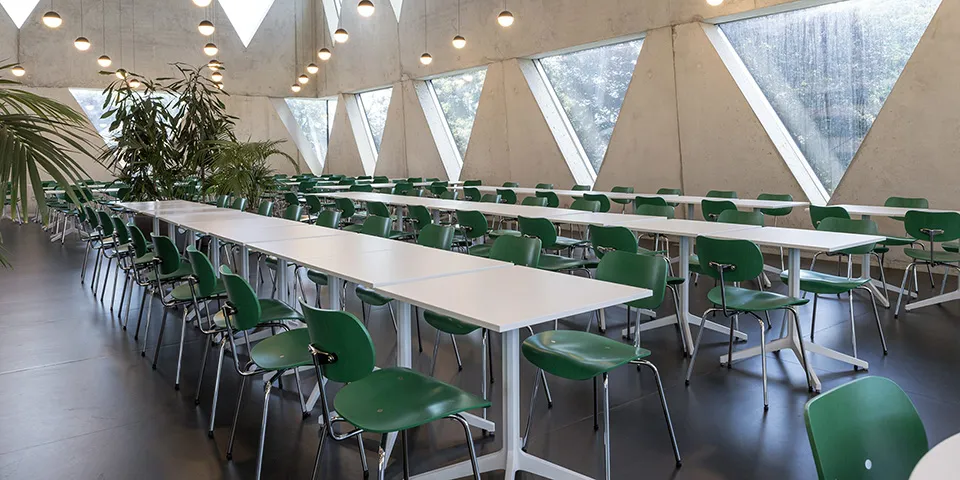
The passive office building is heated and cooled without traditional solutions such as boilers or chillers.
Ventilation
The building’s hygienic ventilation is demand-controlled according to air quality in its various zones. “Heat is also recovered from the extract air from the large kitchen’s cooker hoods through a degreasing process using UV lamps. Degreasing cooker hood air is common practice, partly to reduce contamination in the ductwork. Here, we also recover heat from the extracted air. That is unusual. Traditionally, at -10 °C, gas-fired heating is used to raise the temperature of the make-up air from outside to 20 °C. Here, we use a heat exchanger, so very little additional heat needs to be added to the fresh air supplied to the kitchen. The air handling units for the auditorium, council chamber and exhibition spaces are fitted with adiabatic cooling. This uses rainwater to cool the incoming outdoor air indirectly.”
Lighting
The offices are lit entirely by high-performance LEDs. These can be programmed individually, giving them maximum flexibility. “A daylight control system will reduce consumption further by dimming the light fittings. The roof of the tower volume is covered with as many PV panels as possible, providing an output of around 35 kWp.
BREEAM
The architects, Studiebureau Boydens and the provincial administration are aiming for a BREEAM Excellent certificate. “To that end, we built a model incorporating the building’s building-physics, building-services and operational characteristics,” explains Corvers. “We represented the building geometrically in a way that allowed us to analyse the questions posed as accurately as possible.”
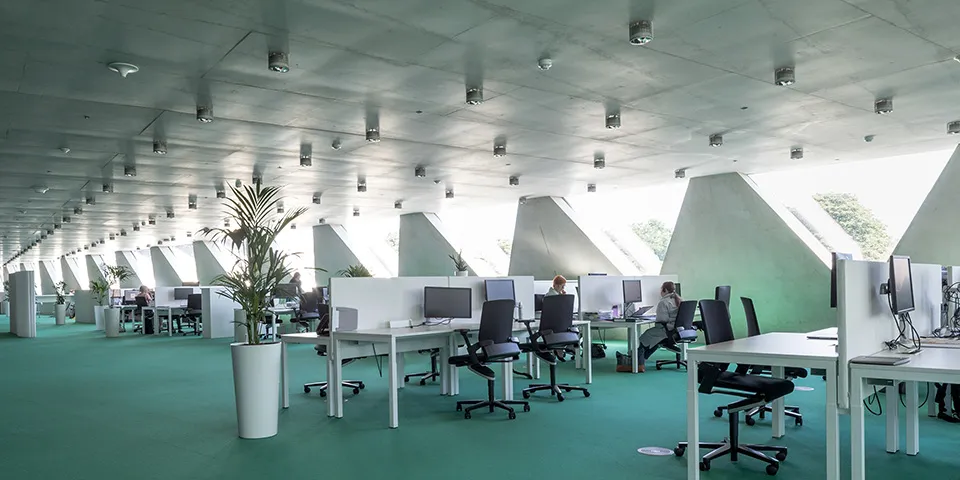
The offices are lit entirely by high-performance LEDs.
Dynamic simulation
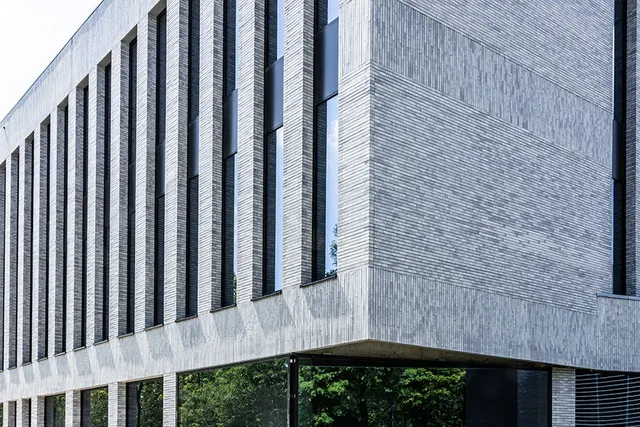
Boydens carried out a dynamic simulation of the indoor temperatures in the building’s occupied spaces, in line with BREEAM’s thermal comfort requirements. “Hourly results gave us a picture of the indoor comfort expected over a full ‘typical’ year. This enabled us to produce a numerical assessment that determined whether the BREEAM standard would be met.” A daylight calculation, carried out across a sufficiently large area of the Provincial Government Building, provided a conclusive assessment of the BREEAM ‘daylight’ credit. “Walking through the building today, you immediately notice how much daylight streams in, despite the limited window area. This is thanks to the triangular shape of the windows, which allows maximum daylight to enter from above.”
LZC technology
“As part of BREEAM, we also evaluated the effectiveness of the low- or zero-carbon (LZC) technology used. In particular, we examined the ground-source heat pumps. We looked at how far they could reduce CO2 emissions over the long term compared with a ‘traditional’ system for a building of this kind. Compared with a conventional gas-fired boiler and chiller, the two technologies reduce building-related CO2 emissions by 32%!”
Question about this story? Ask your question
Keep following this
Get an email when a new story is published. No account needed.
- SubjectSustainable & circular