From smart homes to smart cities
Text Ingrid Allaerts
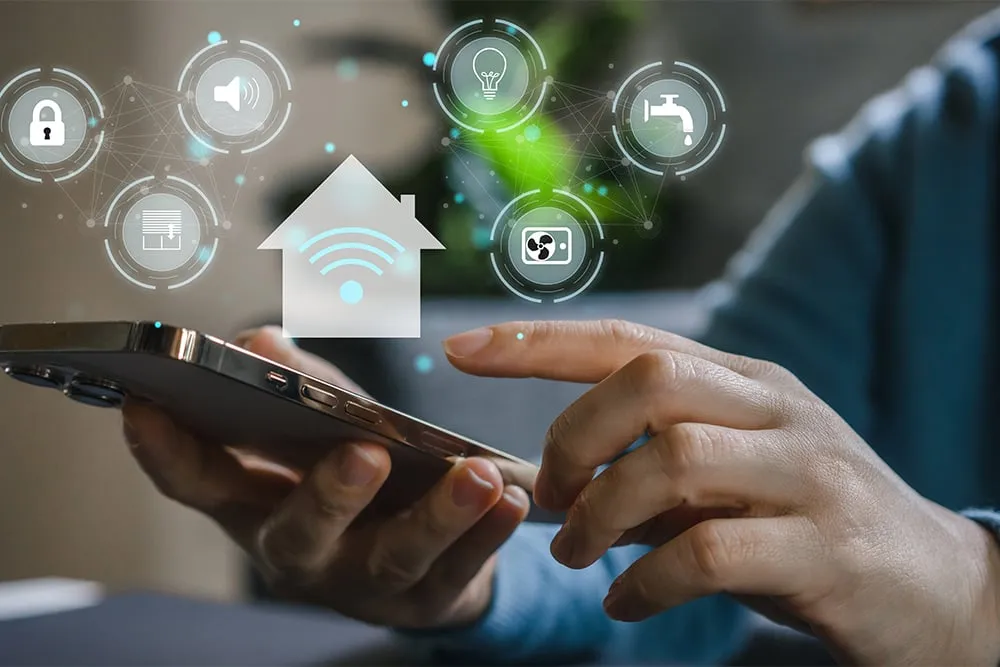
We are in the midst of a transition and a period of accelerated innovation across many fields. Given the pace of change, we can never be sufficiently well informed. Smart homes are evolving at a rapid pace. What are the latest trends and innovations in smart home comfort?
In a smart home, lighting, heating and humidity are controlled intelligently and simply to create a healthy indoor climate using sustainable, energy-efficient solutions.
Efficient heating systems
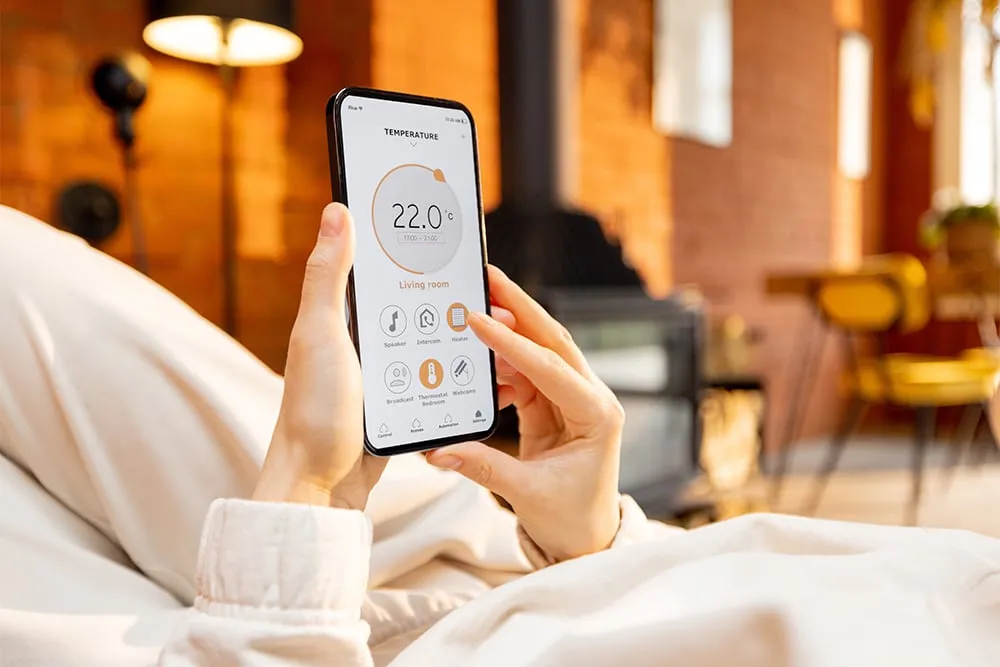
A smart home is equipped with intelligent radiator thermostats. Flexible control options and demand-based consumption can help you make substantial savings on heating costs. An app, which acts as a kind of control centre, intelligently and automatically distributes the solar energy generated on site. This can also help you save on electricity costs. In a smart home, all heating and energy technologies are brought together. Europe aims to be climate-neutral by 2050 and emit as few greenhouse gases as possible. Investing in heat pumps is a smart investment in greener, future-proof living. Heat pumps are not just suitable for new-build homes. There is also a suitable heat pump for every application in existing homes. By drawing on heat from the surrounding environment, a heat pump makes you independent of fossil fuels. If you combine a heat pump with solar panels, you do not have to get all your electricity from the grid. This allows you to make the most of the electricity you generate yourself. A home battery lets you use as much of your self-generated electricity as possible. Smart homes use energy management systems to optimise energy consumption. This helps you save energy and reduce the home’s environmental footprint.
Smart ventilation for every room
Healthy indoor air is essential for comfortable living, and there are now many ventilation systems on the market. But what if your home is fully finished and a central ventilation system is not practical? A decentralised ventilation unit with humidity and VOC sensors, and optional CO2 monitoring, can offer a solution. It provides full ventilation without major renovation work, and keeps the toilet smelling fresh.
For anyone looking for a central ventilation system as part of a major renovation, there are systems that start up automatically when sensors detect excessive humidity, odours or CO2 in the indoor air. They ventilate only where and when needed, and in the right quantity, preventing unnecessary energy use. These systems supply fresh air naturally through window vents, while contaminated air is extracted mechanically under controlled conditions.
This means you can ensure healthy, fresh indoor air in any situation, whether you choose a decentralised or central ventilation solution.
Advanced security
A smart home is also a safe home for its residents. Security challenges have increased considerably in recent years. A smart alarm system with sensors and cameras that record everything offers optimal protection against burglars, fire hazards and the threat of water damage. The alarm system is highly effective because all the devices are connected and communicate with one another and with the outside world. In a smart home, all the devices communicate with one another. In a smart home, all the devices communicate with one another, with one goal in mind: to increase comfort and safety and make everything as simple as possible. This is made possible, among other things, by easy installation (wireless or using the existing network), ease of use (everything in one app) and intelligent options for expansion.
Intelligent home automation
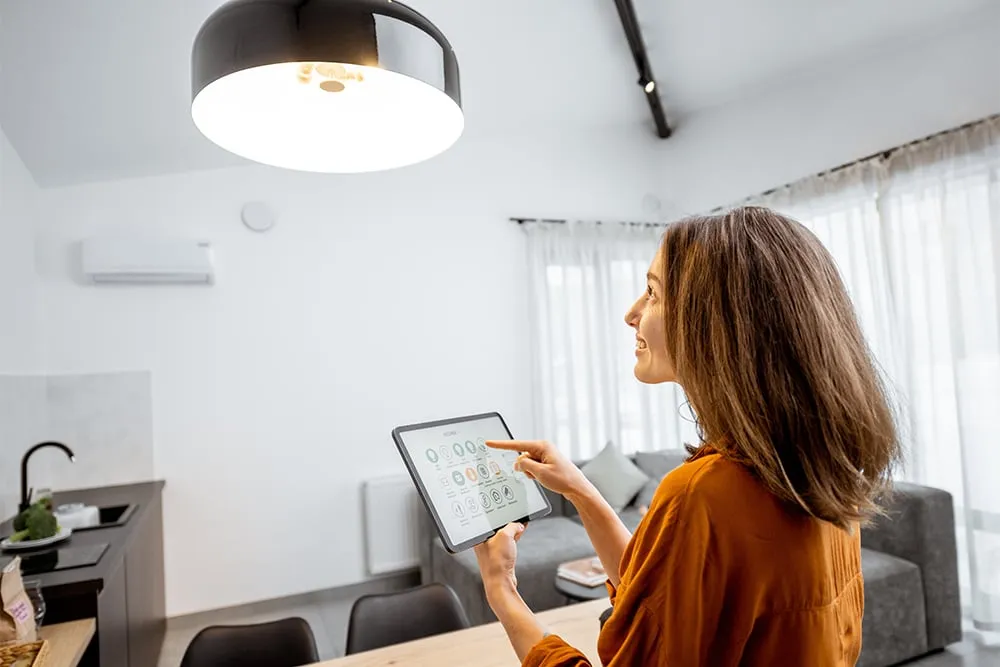
Sensors are the eyes and ears of an intelligent home automation system. They continuously collect data and send it to the central controller, allowing the home to respond proactively to different situations. For example, the heating switches on when the temperature drops, or the lights come on when movement is detected. From thermostats to lighting and security cameras, smart devices add comfort and efficiency. The room temperature can be adjusted automatically for optimum comfort. The lights dim according to the time of day. Live camera footage is streamed to your smartphone. These accessible systems make any home smart. Smart automation systems let you use energy more efficiently. It is important to understand your home’s energy consumption and generation, as well as that of all your individual devices. By intelligently managing energy flows and automatically spreading out your consumption, you can avoid peaks in energy use.
Connected sockets or smart plugs switch on automatically when you have surplus solar energy. This means you always make the most of the energy you generate yourself. You can automate switching lights on and off with a motion sensor, saving up to 30 per cent on energy. A personalised all-off function is also handy.

Smart cities
By 2030, people around the world will be living in cities. Cities are growing and innovating at a rapid pace. They are becoming low-emission zones, while green architecture is springing up. Smart homes are becoming smart cities. Local authorities want to redesign their districts to make them more resilient and environmentally friendly. They are doing this by making their energy policies more sustainable, developing energy communities for renewable energy and storing energy collectively.
In the future, these technologies will be seamlessly integrated into our daily lives. They will optimise traffic flows and reduce energy consumption. Increasing amounts of renewable energy will be systematically integrated into buildings. Transport is being electrified rapidly, and this trend is accelerating. The Internet of Things is an ingenious network that connects everything, collecting and exchanging data. By analysing and exchanging data, companies can improve their production processes, reduce maintenance costs and personalise customer service. All this contributes to a better quality of life by improving health, safety and comfort in everyday life.
Question about this story? Ask your question
Keep following this
Get an email when a new story is published. No account needed.
- SubjectHome automation & lighting