








“We need more decisive measures to meet the climate targets”
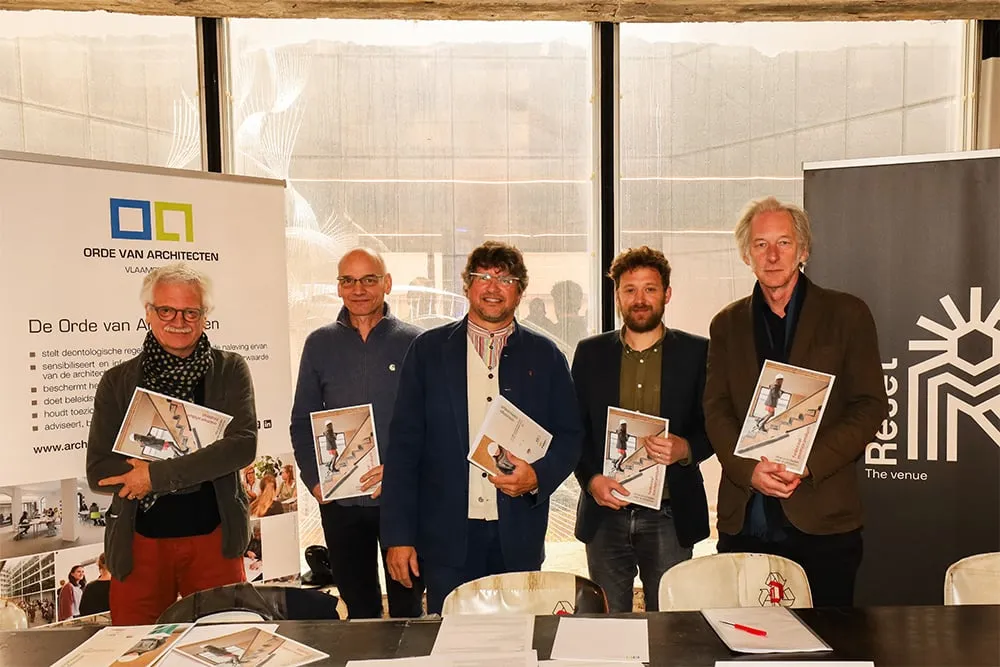
From better permitting policies to greater consumer protection, Belgian architects’ organisations are calling for more decisive measures in a joint action plan to make spatial development and the existing building stock more sustainable at pace. “The urgency of the climate targets requires us to act in unison,” say the Belgian architects’ organisations.
Ahead of the upcoming regional and federal elections, Belgian architects’ organisations and Orders have joined forces and drawn up a joint action plan for the first time. It sets out practical solutions for a more sustainable living environment. “We are calling on government at every level in our country, federal, regional and local, to take measures that enable high-quality architecture and a high-quality living environment for everyone. Our aim is to promote sustainability and improve quality of life by putting people and nature at the heart of every spatial and urban design,” says Jos Leyssens (Orde van Architecten).
The challenges are clear
Rising costs, higher interest rates and problems with permitting policies: building and renovation have become increasingly challenging of late, even as investment in our building stock needs to be accelerated. Existing buildings need to become more sustainable, and there is an urgent need for climate-neutral new buildings. Architects play a crucial role in this transition as innovators, partners and advisers. Unfortunately, they are constantly encountering challenges and difficulties that could be avoided.
The Belgian architects’ organisations have therefore developed a range of proposals, both at federal level (Orde van Architecten, NAV, G30 and FAB) and at regional level (Orde van Architecten, NAV and BVA). The action plan also ties in with the New European Bauhaus initiative, which aims to turn the European Commission’s Green Deal into creative projects for an attractive, sustainable and inclusive living environment.
They are putting forward these five practical measures:
1. Effective consumer protection in construction
The action plan also calls for greater consumer protection. “If you hire only a contractor for your project today, you can hold that contractor liable only for any construction damage incurred. Architects, meanwhile, are required to take out liability insurance for every project, covering every stage. A more balanced allocation of responsibilities is needed, first and foremost to protect consumers. There is also a need for a platform where consumers can check whether a contractor is registered, insured and qualified to provide their services,” says Dag Boutsen (Orde van Architecten).
2. Comprehensive reform of VAT rules
Meeting the climate targets requires everyone to make an effort, and consumers need further encouragement to renovate their homes sustainably. The Belgian architects’ organisations point out that current VAT rates for building and renovation do not reflect society’s needs and are therefore acting as a brake.
“For example, the distinction between demolition and reconstruction on the one hand, and renovation on the other, is a purely fiscal and legal construct that only partly promotes circular construction. As a result, luxury finishes in a renovated flat are subject to the reduced VAT rate, while advice from an architect and an EPB reporter for the renovation of a terraced house is not. The rules are also unnecessarily complex, leading to ambiguity, grey areas and legal uncertainty,” says Steven Lannoo (NAV).
The Belgian architects are therefore calling for a thorough reform of VAT. “Reconstruction and renovation projects should be taxed in the same way, and the difference between VAT on works (6%) and VAT on services (21%) should also be scrapped. No more piecemeal tinkering. It only adds complexity and gets in the way of making our building stock more sustainable.”
3. Better organisation of procurement
Procurement procedures also need to be better organised. This is one of the levers available to government to speed up construction processes. “For most public contracts, architects are already asked to produce a design at the tender stage, meaning they have to carry out 15 to 20% of the total work before the contract has even been awarded. If they are unsuccessful, all that work is for nothing. This is not only time-consuming and costly, it often fails to produce the best design either, because there is hardly any scope for interaction between architects and clients at this early stage,” explains Dirk D’herde (G30).
Procurement procedures should therefore focus not only on the design, but also on the designers. “And if a design is required, it must be fairly remunerated: 80% of the costs incurred. The expected output should also be limited by clearly defining the expectations in the tender procedure.”
4. Encourage innovation
The Belgian architects are also making the case for more innovation. We cannot find the best answers to challenges such as the construction shift, spatial densification, strengthening town and city centres, and the need to make buildings more energy-efficient if we keep following well-trodden paths. “Government should therefore invest much more in research through design and cross-sector experiments, supported by rules and legislation that make them possible. As a sector, we are ready to work with all institutions and are happy to make our knowledge and expertise available to find solutions for a more sustainable and inclusive living environment,” says Olivier Bastin (FAB).
5. Better permitting policies (regional responsibility)
Last but not least, the problem of slow permit processing remains. The permitting process is currently so inefficient and slow that investors are questioning whether they want to develop projects in Belgium at all. This needs to change, and the architects’ organisations believe regional and even local authorities have a major role to play. “By requiring cities and municipalities to develop a clear spatial vision and create more opportunities for densification, rising demand for built functions can be met with the smallest possible impact on land use,” says Jos Leyssens (Orde van Architecten).
Local planning departments could also be better supported and relieved of some of their workload by government. “The ‘Handreiking Vooroverleg’, which offers tips on obtaining an environmental permit more quickly, is a step in the right direction, but after a few years we must also be prepared to update it. We would also like access to the Flemish Property Information Platform, as it contains a great deal of information that is relevant to us too.”
Question about this story? Ask your question
Keep following this
Get an email when a new story is published. No account needed.
- SubjectGeneral







