








Upgrading lighting to LED
Light sources with low energy efficiency, an excessive environmental impact or simply outdated lamp technology are being phased out for good. After all, Europe is banning their production and sale. We have already said goodbye to the much-loved incandescent bulbs, as well as halogen lamps. But how can you ensure that the luminaires still produce light?
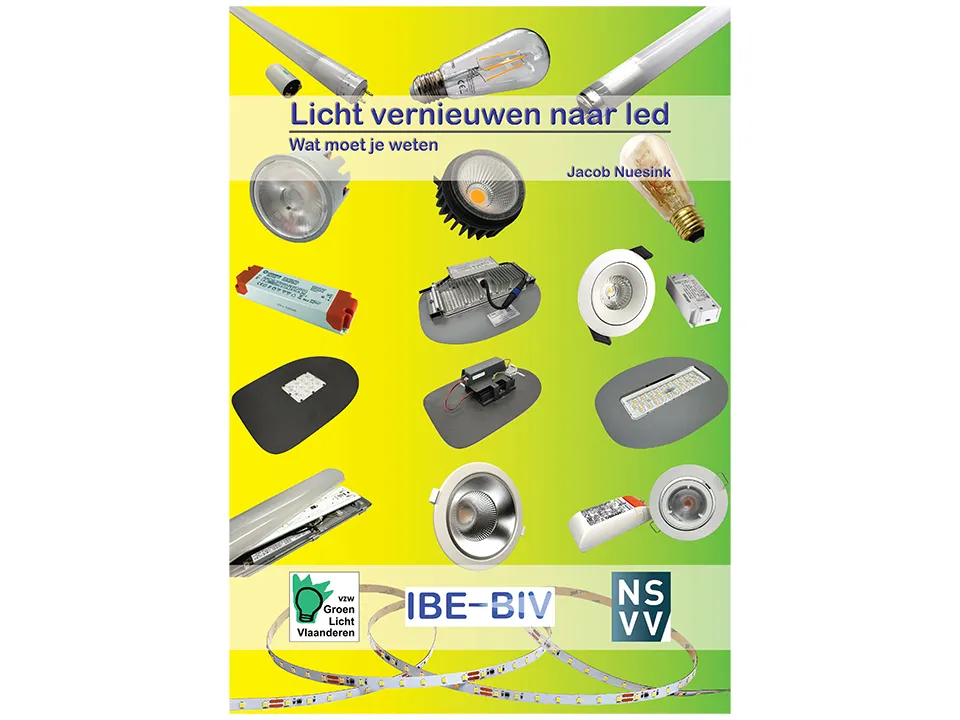
Europe is targeting light sources, not luminaires. Luminaires that are still in perfect condition can therefore remain in place. Throwing them away would be a waste, especially now that circularity and the circular economy are gaining ground. The solution is renovation: retrofitting. Logically, you would choose LED as the new light source. Lighting cluster Groen Licht Vlaanderen, the Belgian Institute of Lighting Engineering IBE-BIV and the Dutch Lighting Engineering Foundation NSVV joined forces to write a book on the subject. ‘Upgrading lighting to LED. What do you need to know?’ is available from today.
Across borders
Replacing one light source with another sounds simple. Yet there are pitfalls to watch out for. John de Joode, chair of NSVV, specifically mentions the ‘quick-fix LED salesmen and women’ who try to dazzle clients with attractive payback calculations. De Joode says: “Unfortunately, there is often insufficient knowledge of light quality and of the negative impact of poor lighting on health, wellbeing and sustainability.” There is a simple reason why the Dutch and Belgian organisations have joined forces on this book. “Good lighting knows no borders,” De Joode stresses. “The way lighting designers and consultants work is universal, wherever they operate. The challenges are the same everywhere.”
Essential knowledge
Knowledge of lighting is essential, then. A simple example illustrates the point. Jan van Riel of IBE-BIV compares knowledge of lighting with knowledge of temperature: “If I say it is about 18 degrees Celsius in my office, everyone can picture that. But if I say that the same office has an illuminance of 500 lux, that is much harder for most people to understand, perhaps even impossible. Light needs explaining. So a good, clear explanation is also needed when upgrading lighting.”
Explaining light
Three major lighting partners have joined forces to publish the book ‘Upgrading lighting to LED. What do you need to know?’. It clearly describes all the aspects that matter when retrofitting. With this publication, Groen Licht Vlaanderen, IBE-BIV and NSVV aim specifically to highlight the implications of retrofitting and clearly explain the conditions involved. Retrofitting is more than simply removing an incandescent bulb from a luminaire and replacing it with an LED lamp. Catherine Lootens of Groen Licht Vlaanderen says: “It is also about the role and liability of the installer, consultant, producer and manufacturer if something goes wrong when a lighting fixture is modified. These are issues you might not consider when retrofitting comes up. We explain the process, while also outlining the sensitivities and pitfalls.”
Practical information
‘Upgrading lighting to LED. What do you need to know?’ is available in Dutch and French. Lootens says: “If you have specific questions about the book or would like to order a copy, you can always contact us. We would also be happy to tell you more about Groen Licht Vlaanderen and the many training courses and workshops we organise. Looking for an expert or a speaker with a fresh perspective? We would be delighted to hear from you.”
Question about this story? Ask your question
Keep following this
Get an email when a new story is published. No account needed.
- ThemeLight and sound as design tools
- SubjectGeneral







