Has Covid killed the office floor?

A question we have often been asked since the first lockdown. As always, the answer is not straightforward, but in general, you could say that Covid was not a game-changer, but an accelerator. Video conferencing, remote working, working from home… these were already familiar concepts at large companies, but the pandemic has now made them commonplace among SMEs too.
Has working from home led to a drastic reduction in office space? Yes and no. We are now seeing that working from home for one and a half to two days a week, with three days in the office, is becoming the norm. A company is much more than employees working through a to-do list. It is an organism sustained by the social interaction between its team members. This is one of the most important lessons of lockdown: without this interaction, a company loses its identity and can no longer pass its DNA down through the ranks. It becomes merely the sum of its parts, with no team bonus.
You could therefore say that we are heading towards 30 to 40 per cent less office space, because you spend 40 per cent of your time at home. But that needs qualification too. Before Covid, large companies were already moving away from ever-greater density, with more people working in less space. In some cases, the ratio had fallen to 1 person per 6 square metres. The norm is now back to 1 person per 10 or even 12 square metres. As a result, we need more space again, rather than less. The two effects more or less cancel each other out, and the current consensus is that, overall, 15 per cent of the office stock is surplus to requirements at current occupancy levels.
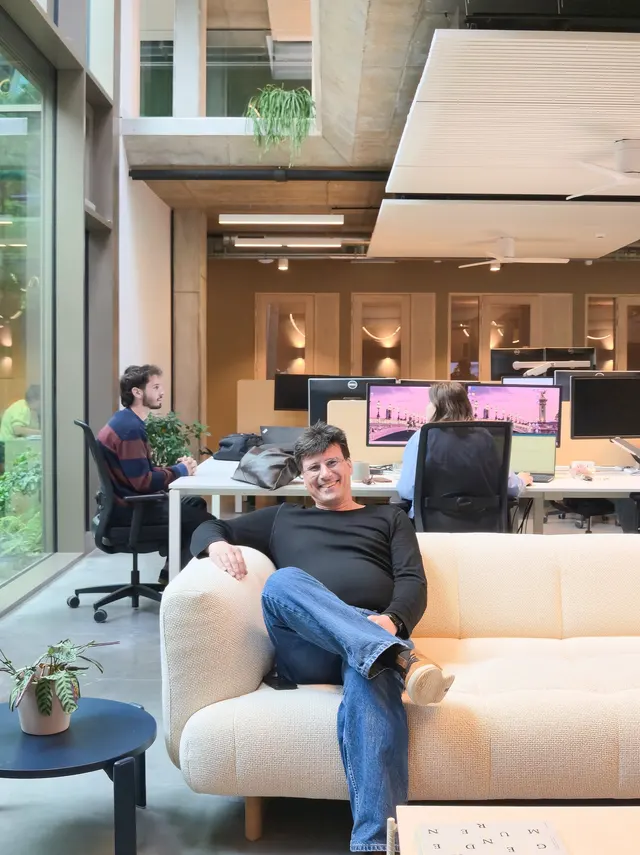
Covid has had one final consequence: greater attention to the quality of the space. To get team members back into the office, they need to see value in being there. Different types of meeting rooms, fully functioning technical support, air quality, breakout rooms and social spaces where colleagues can interact informally… the office becomes a reflection of the company you want to be. It becomes a showcase for the company’s DNA. A company’s office is becoming an integral weapon in the war on talent. That is why decisions to relocate are increasingly framed as change management initiatives, led by the Human Resources department rather than the facilities manager or CFO.
The conclusion, then, is a general flight to quality. Only the premium market is working. And the figures reveal another problem in that segment. In Brussels, 50,000 square metres of top-tier office space is available to rent. Average annual take-up in this segment is 250,000 square metres. Supply is therefore five times lower than demand. Renovating and upgrading offices is the way forward.
Frédéric Van der Planken,
CEO/founder Whitewood Group
Question about this story? Ask your question
Keep following this
Get an email when a new story is published. No account needed.
- SubjectThe pen