








Round-table discussion: the future of timber in construction

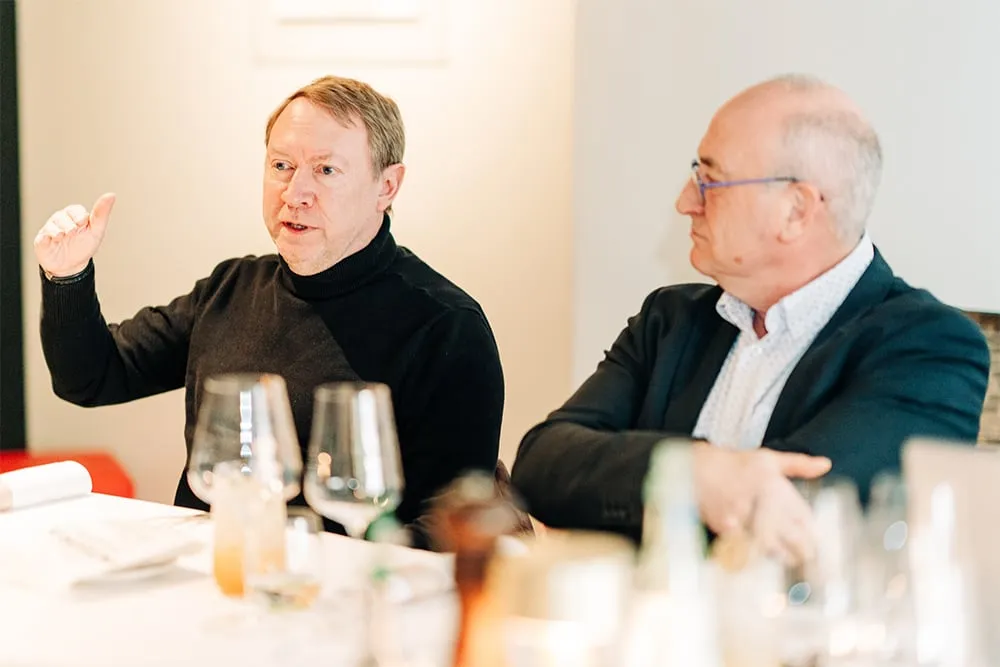
Timber construction is steadily gaining ground in Flanders. What is the key to successful applications? Where can the sector make further progress? Experts share their views in this round-table discussion. Read on for the interesting reflections that emerged.
PARTICIPANTS:
Dries Desmijter (structural engineering firm BeHeCon);
Chris De Roock (WOOD.BE, the knowledge centre for the timber and furniture industry);
Damien Maelfait, architect-engineer (M4 architecten en ingenieurs bv);
Piet Vanthournout, environmental and technical adviser (Fedustria, the sector federation for the textile, timber and furniture industries).
MODERATOR:
Bavo Boutsen (The Content Company)
Timber construction versus traditional building methods. How does the construction process differ?
Unanimously: “The trend towards shorter construction times is continuing. Timber frame construction and mass timber construction (CLT) are ideally suited to this. Modular structures are manufactured in the factory, then transported to the construction site and assembled. This saves a considerable amount of time and simplifies logistics on site. Everything is meticulously prepared, resulting in high-quality work.”
Dries: “Timber frame construction and CLT allow buildings to be occupied sooner. That is an unmistakable advantage for hospitals, care centres and so on.”
Piet: “For the sake of completeness, log construction and post-and-beam construction are also innovative timber construction techniques. However, going into detail about each method would take us too far today.”

Have these advantages been known in the construction sector for a long time, or is this knowledge relatively new?
Dries: “The advantages themselves are nothing new. However, increasingly sophisticated applications are emerging, such as computer-controlled 2D and 3D techniques. They ensure a very high standard of finish. All the techniques can be prefabricated off-site.”
Is timber a price-competitive building material? Has that changed in recent years?
Damien: “It is a good thing that competition is becoming more pronounced. This is making timber more affordable for prospective self-builders and renovators.”
Dries: “Meanwhile, since the energy crisis the traditional construction sector has seen unprecedented price rises. This gives timber construction a competitive advantage.”




How can timber construction help address the shortage of workers in the construction industry?
Damien: “The construction sector has been struggling with a staff shortage for some time. It has reached the point where workers are being recruited from abroad, including Portugal and Belarus. Timber frame construction and mass timber construction also offer a solution in this respect. The entire production process takes place in the factory under the most favourable conditions, usually with the help of advanced CNC-controlled machines. This contrasts with traditional construction, where workers regularly have to stand out in the cold and rain. Work can continue as normal even in severe frosts.”
What other advantages can timber construction offer?
Chris: “The rollout of the Flemish construction shift is a reality. This shift brings both challenges and opportunities for the construction sector. Dividing single-family homes into multiple units, building upwards: these are clear trends. Modular timber frame construction and CLT offer the best solutions. These methods use materials that are lightweight yet strong. They are also often chosen for their renewable nature.”
Why is relatively little timber construction used in Belgium?
Dries: “We keep coming back to the same point: Belgians are born with a brick in their stomach, after all…”
“Another misconception that often crops up concerns fire safety. As architects and engineers, we carefully assess the structural stability, fire resistance and fire rating of the timber species. The fire resistance, or the extent to which the building structure withstands fire, is equivalent to that of traditional construction, provided the right parameters are taken into account. This includes, for example, oversizing the structural elements to allow for charring over a certain period. If the worst comes to the worst, the outer layer chars, slowing down further charring. This means that the load-bearing structure of timber buildings remains intact in most circumstances.”
Damien: “Fortunately, things are changing. More and more clients are open to timber construction. The fact that the price difference is smaller today plays a part. We are also seeing a shift in attitudes among fire service commanders.”
Dries: “At BeHeCon, I now work full-time on designing and calculating timber construction projects, whereas a few years ago this only came up sporadically. We are seeing growth in both the private and public sectors. For architecture competitions and public-sector tenders, we put timber construction forward wherever possible. Through efficient engineering, we can offer a competitive price compared with conventional construction methods.”
How is timber construction perceived in Belgium today? Is it seen as a sustainable way to build? Why, or why not?
Chris: “Timber is a natural material with insulating properties. Although perceptions sometimes suggest otherwise, it is a sustainable choice in more than one respect. As trees grow, they absorb CO2 from the air, making them an essential part of the fight against climate change.
According to the European Commission, the construction sector accounts for 40 % of total CO2 emissions in Europe. Commission President Ursula von der Leyen therefore launched the ‘New European Bauhaus’ initiative, which aims to encourage innovation in construction and reduce CO2 emissions, including through the use of timber and other bio-based materials.”
Piet: “The proviso is that the timber comes from sustainably managed forests. FSC and PEFC are the best-known certification schemes in this area. The Scandinavian countries, for example, enjoy an excellent reputation both for careful felling and for responsible reforestation. There are many exemplary projects where biodiversity is fully protected. To be clear, this is not about irresponsible deforestation!”
How can we change this perception? How can we make timber construction more popular?
Chris: “There is a clear trend towards more conscious living, with people choosing healthy building materials. Timber fits that picture perfectly. Dutch architects such as Pablo van der Lugt and Daan Bruggink often talk about the health benefits of a biophilic and bio-based building culture. These are backed by scientific evidence. This approach strengthens the connection between people and nature, with timber and other bio-based materials playing a key role. The results are remarkable, ranging from positive psychological effects on school pupils to faster recovery among patients. It is clear that living, care, learning and working environments that incorporate elements of nature enhance wellbeing.”
Where do you see quick wins for the future?
Chris: “I believe education has a role to play here. How much timber construction is covered in architecture and civil engineering courses? Not enough, surely? There has been some improvement in recent years, though. In Geel, Thomas More Hogeschool offers a bachelor’s degree in timber construction, and UHasselt gives considerable attention to timber construction in its civil engineering technology programme. But there is room for more. Investing in talent is a springboard for the future.”
Piet: “I completely agree! Collaboration is the key, both with education and training partners and with stakeholders. Let’s discuss what we want to achieve and what we need to make it happen.”
What can we learn from neighbouring countries, where this construction method is used more widely?
Damien: “Timber construction techniques are commonplace in many European countries, including Germany, Austria and Scotland. These are forested regions, after all. In the Netherlands, they are even building fire stations in timber! That is clear proof that timber structures can meet fire safety requirements very effectively.”
Piet: “Timber construction is even being used in the Olympic village, where the Games will take place this summer.”

What can the government do to drive this shift? Is price regulation an option?
Unanimously: “Price regulation is not our preferred option, as it could distort the market. But it should encourage the government to use bio-based methods when constructing or renovating its own buildings. Or we could look to Germany, where the government offers grants for timber construction projects. Will this remain a pipe dream in Flanders…?!”
Question about this story? Ask your question
Keep following this
Get an email when a new story is published. No account needed.
- ThemeCircular construction and material awareness
- SubjectGeneral







