The growing popularity of car lifts in residential properties
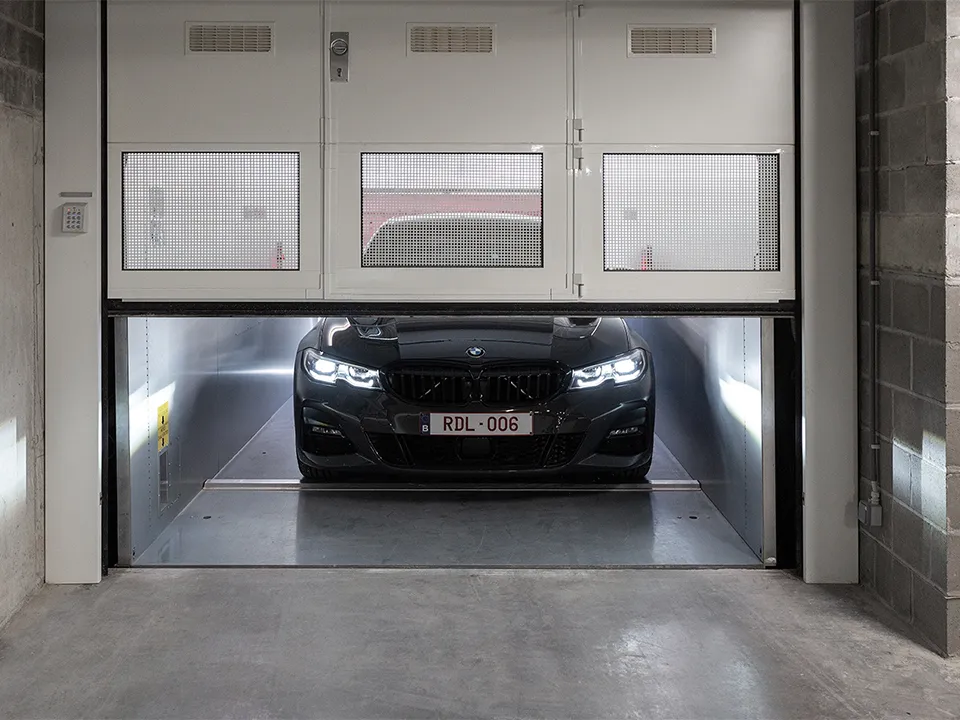
Where do we put the cars? It is a question many architects and clients ask themselves, including when designing houses and apartment buildings.
In the luxury segment, private homes are increasingly being designed with an underground garage or parking spaces combined with a car lift. The aim is to make maximum use of both above-ground and underground space, while offering the convenience of parking close to the home.
An integral garage reduces the usable living space that residents want to make the most of, especially as space and developable land become increasingly scarce. A detached garage does not always deliver the desired aesthetic result, takes up garden space and can sometimes create planning issues. An underground parking area in the basement is another option. Those who also want to avoid a ramp, and have some extra budget to spare, may opt for a car lift as a space-saving and burglar-resistant alternative. Car enthusiasts in particular are increasingly choosing this solution. Here are some of the options and points to consider, including in terms of safety.
Car lifts: two main categories
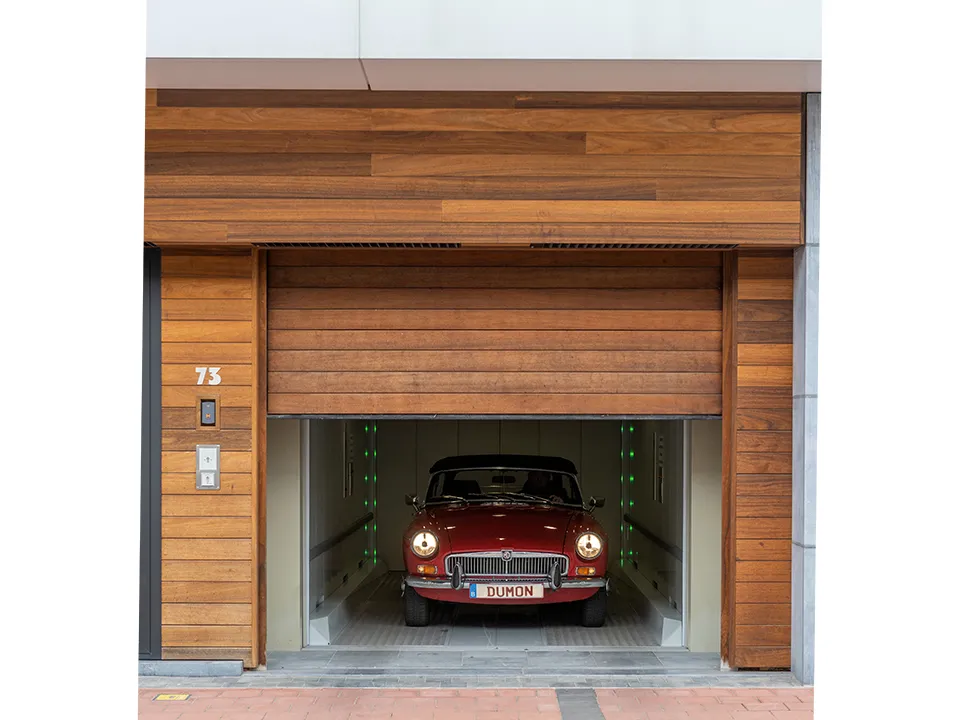
There are two main categories of car lift. First, there are car lifts covered by the European lift regulations. These are essentially comparable to passenger lifts, albeit larger, with a suitably configured interior, safety features and considerable lifting capacity. Depending on its size, a single car lift can carry as many people as a lift designed for around fifty passengers travelling at the same time. These car lifts can just as easily transport people, for example with a bicycle in tow, and are subject to the same stringent legal safety requirements and certification as passenger lifts. What is more, they must undergo regular inspections and maintenance, ensuring that this high level of safety is maintained over time. The gates or doors and the lift form an integrated system and are always perfectly matched. These lifts are also faster, particularly compared with the second category, and are primarily used in larger residential projects and apartment buildings where the lift is used intensively. The second category comprises car lifts covered by the Machinery Directive.
These are known as ‘slow lifts’ and are limited to a maximum speed of 0.15 m/s. They take a very different approach, but now have a wide range of applications.
Private homes with a limited travel height
Car lifts are proving useful not only in apartment buildings, but are also increasingly finding their way into luxury private homes. In the latter case, systems covered by the Machinery Directive are often chosen. There are two subcategories: car lifts that transport the car only, with no passengers, not even inside the car, and slow car lifts, which travel at less than 0.15 m/s and are also designed to carry cars with their occupants. There are still plenty of choices to make, however, including the lifting system, access doors, safety controls and operating stations. Where access for driving in or out is limited, the lift can also be combined with a turntable to make parking more convenient.
Lifting systems
Hydraulic scissor lift tables are a frequently proposed solution. Depending on the size of the platform, a single scissor lift can bridge a height of up to 3.5 to 4 metres. A scissor lift of this kind is mounted directly on the floor, so no wall mounting is needed, and it operates almost silently. If this lifting height is not sufficient, a double scissor lift is an option. This requires a deeper pit and can sometimes lift considerably higher than necessary. An alternative worth considering in this case is a car lift with mast guidance or a chain hoist. These can descend up to 12 metres, making them suitable for smaller apartment buildings with restricted access for vehicles.
Safe access doors
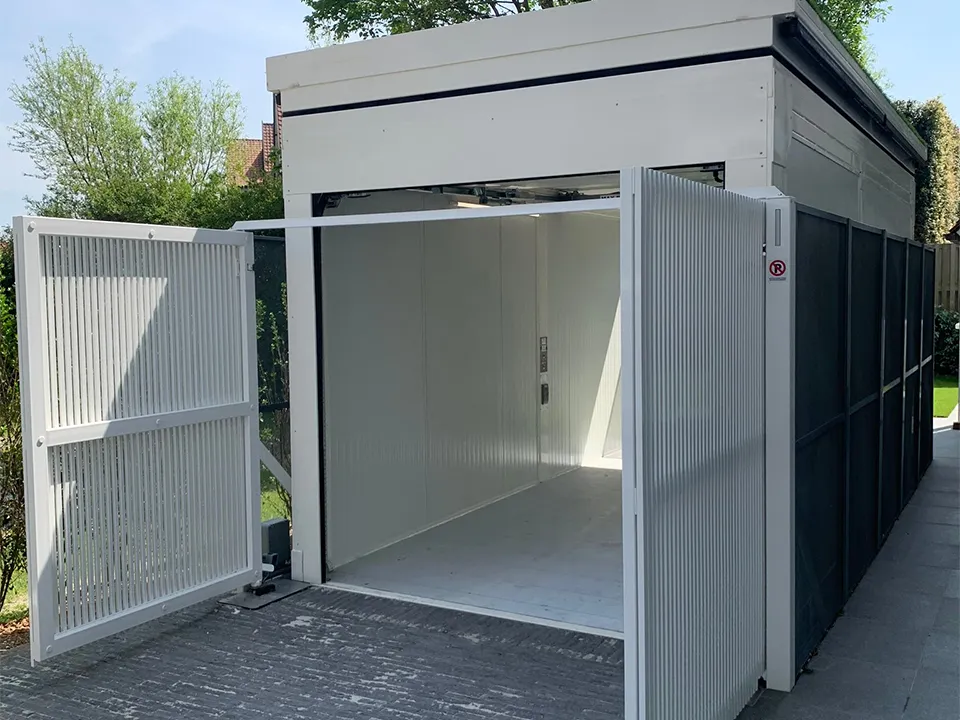
Next comes the question of access doors. For safety reasons, an integral car lift will generally have two sectional doors: an upper entrance door and another giving access to the underground garage. To prevent the risk of falls, the door controls must of course be coordinated with the operation of the car lift. The doors remain closed when the lift is not at the relevant floor. Alongside integral lifts, external car lifts are gaining popularity in particular. These are canopy lifts, with a roof that is usually recessed into the driveway. As the roof can be finished in the same paving material, this type of lift and parking solution is exceptionally discreet. A canopy lift of this kind takes up no living space and can provide access to the underground garage.
There is also the option of parking just one car underground, in the lift shaft, with no underground exit in this case. This allows the classic car to be kept below ground and the everyday car above it, on the roof. This doubles the parking area.
With or without passengers
The safety measures required depend on the specific application and how the lift is used. With a canopy lift without passengers, the controls are operated from above, allowing the user to see the area clearly. The same car lift used with passengers requires additional safety features. An extra scanner and/or CCTV, with images of the area around the lift roof visible on the operating station’s screen, provides an additional safeguard in this case. If there is no mobile phone reception in the lift shaft, a two-way communication system is also advisable. Finally, a backup battery to operate the lift and any gate in the event of a power cut is essential.
Certification and inspections
The following rule applies to certification: a car lift that travels 3 metres or more must not carry people unless it has obtained European type approval. This is therefore not mandatory for car lifts with a level difference of less than 3 metres or lifts without passengers. As for inspections, car lifts covered by the Machinery Directive and intended solely for private use are not subject to inspection by an independent designated body. Want peace of mind as an architect or client? More and more specifications require car lifts that are not covered by the Lift Directive to be inspected as well. Some distributors/installers routinely provide a statutory inspection certificate after installation, issued by an approved inspection body. A small additional cost for peace of mind.
Question about this story? Ask your question
Keep following this
Get an email when a new story is published. No account needed.
- SubjectProducts