Installing automatic doors? 10 tips from specialist ASSA ABLOY
A company’s entrance doors are its calling card. They make the first impression, quite literally. And that’s not just about looks … Doors also need to provide the right level of comfort and make the company safer and more accessible. Considering installing automatic entrance doors? Keep these ten tips from specialist ASSA ABLOY Entrance Systems in mind.
1. Match the door to its users
The main users of an automatic door determine the requirements for functionality and personal safety. When it comes to the latter, environments with many children, older people or people with additional needs place much greater demands on the door.
2. Choose a push or pull installation
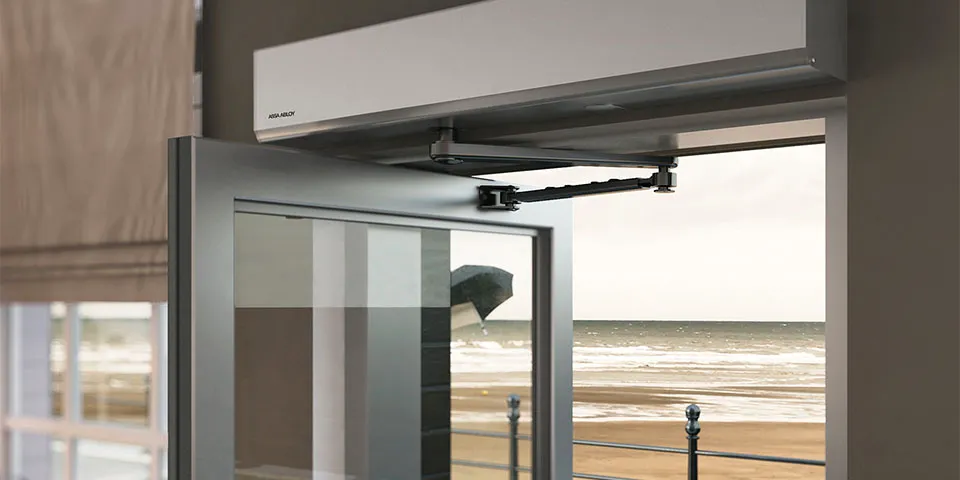
Door operators are fitted on either the opening or closing side. For external doors, the choice is straightforward: the operator is usually installed inside. For internal doors, there are two options. Fitting the operator on the closing side, in a push configuration, provides a reliable solution with a hinged arm system. A pull installation combines this with a pull arm and a guide rail on the door leaf.
3. Reinforce the wall
The functionality and maintenance requirements of a door operator depend largely on the original installation and fixing. Make sure the mounting surface for both the mechanism and the arm system is reinforced in accordance with the manufacturer’s instructions, and on the correct side of the wall.
4. Don’t forget cable and wiring management
A safe and energy-efficient door operator requires the necessary cable connections. Concealed cables require not only concealed cable loops but also cable ducts in the wall, door leaf and section, fitted with the necessary activation sensors.
5. Allow for space requirements
Automatic doors have specific space requirements. The mechanism must fit on the door frame or lintel. The operator also needs some space to the side, and vertical clearance must be provided for the arm system. As for the door leaf, there needs to be space for the presence sensor and arm system.
6. Select the width and weight
Together with the environment, the width and weight of the door leaves determine the performance level required of the mechanism.
7. Understand the escape and fire safety requirements
Will the automatic door be installed as a fire compartment closure, or are there evacuation requirements? These are important factors in determining which door operator to use. Fire safety regulations also impose requirements on the coordinated closing of the leaves of double doors.
8. Determine the controls and functionality
How do you want the automatic door operator to work? Should the door open automatically only when a button is pressed, or in response to radar sensors for improved traffic flow? And should the door section be held open or closed in the event of a fire alarm?
9. Select the right door stop
In principle, all entrance doors in the façade should be fitted with a door stop. This prevents them from being blown open or slamming open and causing damage. Door stops can be external or integrated into the operator.
10. Choose a reliable maintenance partner
The Machinery Directive MR2006/42/EC stipulates that all door operators must undergo documented maintenance in accordance with the guidelines. Choose a reliable partner who can maintain your door solutions to the highest standard.
Question about this story? Ask your question
Keep following this
Get an email when a new story is published. No account needed.
- ThemeTechnologies for safe, smart buildings
- SubjectGeneral