Innovative techniques clean up contaminated soil on site and minimise disruption to the surrounding area

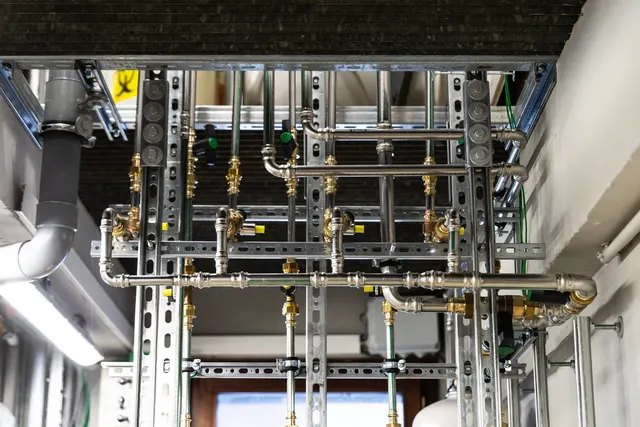
Two pilot installations for the European LIFE PFASTER project are now operational at the former De Naeyer paper mill site in Willebroek. The installations will run continuously over the coming weeks and months to test innovative techniques for remediating PFAS contamination in soil and groundwater. The results will help develop effective, sustainable solutions that can later be used at other sites.
PFAS contamination has previously been identified at and around the former De Naeyer paper mill. As the contamination is not confined to the factory site but is also present in the surrounding area, 11 partners are working together on a regional approach for the Willebroek region and the Broek de Naeyer nature reserve as part of the LIFE PFASTER project. The project receives financial support from the European Union.
From research to practice
The pilot projects are exploring how PFAS can be removed from soil and groundwater, and which techniques are best suited to the task. One innovative aspect of the pilots is that some of the contaminated soil is treated on site, without first having to be excavated and transported to an off-site treatment centre. This approach makes it possible to tackle PFAS contamination directly in the ground.
This offers several advantages. With less excavation required and less soil to transport away, disruption to the surrounding area is reduced. The number of journeys to and from the site is also kept to a minimum. In addition, this approach may be economically attractive and offers potential for sites where excavation is technically difficult or would have a significant impact on the surrounding area.
The installations will remain in operation for an extended period, allowing researchers to gather sufficient data on the performance and effectiveness of the various methods.
“PFAS contamination is a complex challenge for which ready-made solutions are not yet available everywhere. These pilot projects mark an important step from research towards practical applications on the ground. The knowledge we develop here can help address the situation in Willebroek and also prove valuable in tackling similar contamination elsewhere in Flanders and Europe,” says Jan Verheyen, spokesperson for OVAM.
Collaboration between government, research and industry
The LIFE PFASTER project brings together expertise from a range of disciplines. It is a collaboration between OVAM, the Flemish Environment Agency (VMM), the Research Institute for Nature and Forest (INBO), KU Leuven, Universiteit Antwerpen, provincie Antwerpen, VITO, Bio2Clean, Jan De Nul, TAUW and Novobiom.
The project focuses not only on remediation techniques, but also on research into the spread, behaviour and risks of PFAS in soil, water and nature. Ultimately, this knowledge should lead to a structural, area-based approach to PFAS contamination.
Limited temporary disruption
The pilot projects may cause limited temporary disruption for local residents, for example from construction traffic, technical installations or the use of space for the setups. OVAM is monitoring the work closely and will take measures where necessary to minimise disruption as much as possible.
More information about the project is available at www.pfaster.be.
Question about this story? Ask your question
Keep following this
Get an email when a new story is published. No account needed.
- SubjectGeneral