








Experimental concrete: the path to innovative applications
Text Eva GoossensImage FEBELCEM/FEBELARCH
Under the banner of ‘Experimenteel Beton’, a group of architects and concrete experts set out once again to explore innovative applications for precast concrete. Not as part of a specific project, but with complete freedom from any constraints. How can we take concrete to the next level? The results were on show at the recent edition of ARCHITECT@WORK Brussels, in the form of an installation that piqued our curiosity.
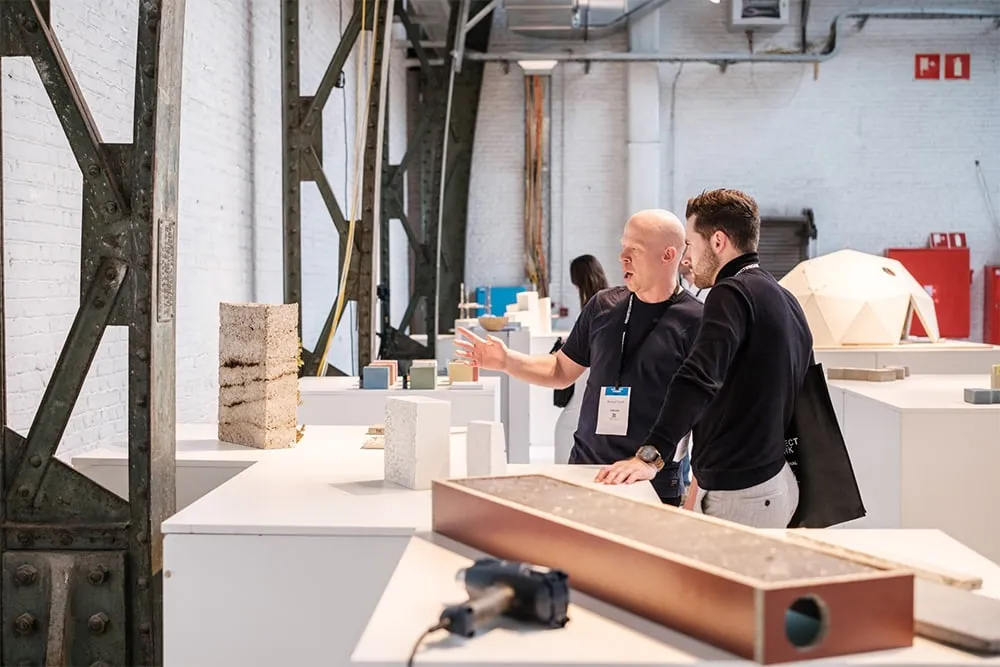
Experimenteel Beton is an initiative by FEBELARCH and FEBELCEM, based on a concept by Hans Köhne and Siebe Bakker. Its aim is to spark a dialogue between designers and manufacturers, and to explore potential future applications with an open mind and a broad perspective. Dreaming is allowed, because that is how innovative ideas develop. Some of the experiments took on a more concrete form, as explained by civil engineer-architect Arnaud Tandt of FEBELCEM.
Nature as architect
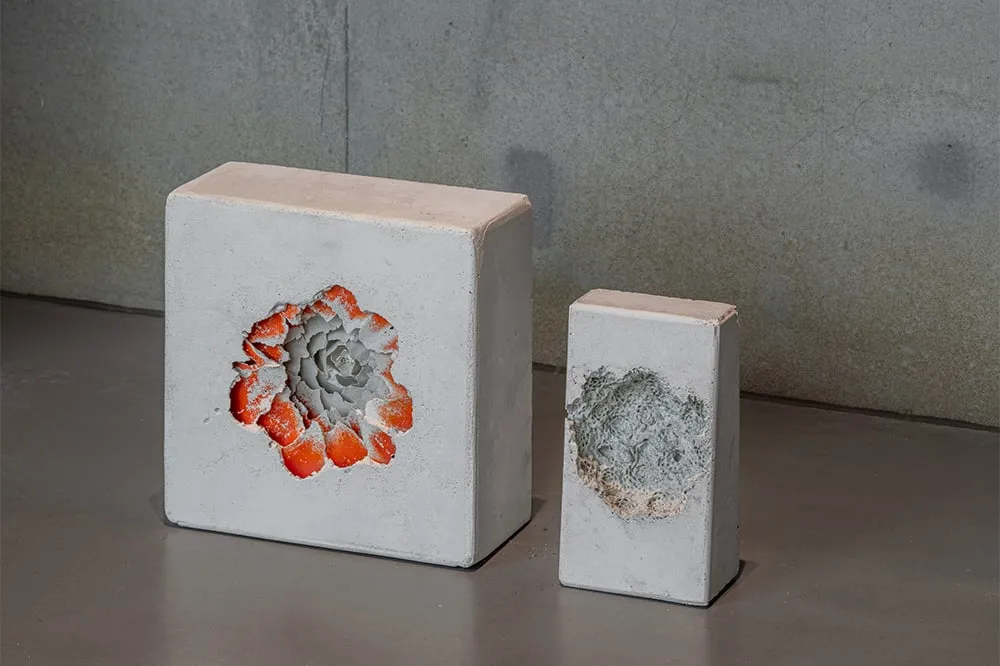
How can we make concrete bioreceptive, allowing plants, for example, to grow on it? This starting point led to three remarkable concepts. ‘Growing concrete’ was created using several layers of porous rammed concrete, interspersed with organic substrate and water crystals that absorb moisture and release it slowly. The result was quite satisfying, as was ‘Succelent concrete’, an experiment in which concrete was poured into a mould containing a succulent. This produced a negative impression reminiscent of a complex mosque dome. More subtle is ‘Snail Trail concrete’, made in formwork containing a snail trail. Nature as architect, with some rather surprising results.
From fragrant to conductive concrete
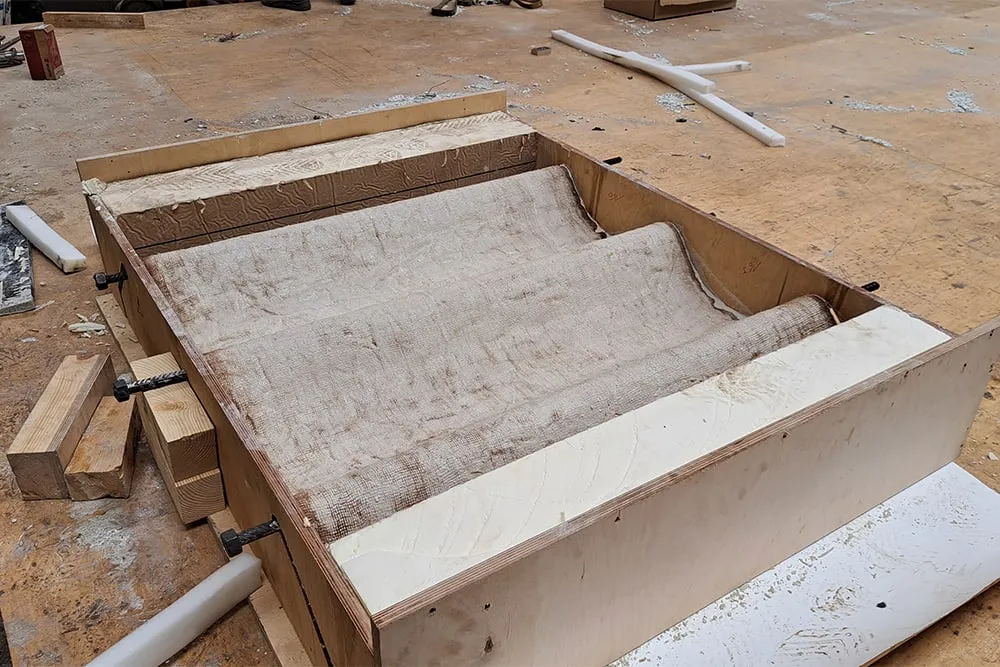
Smell is not exactly concrete’s most appealing quality, so the team considered how to improve its aroma. Potpourri in the mix proved unsuccessful. In a second experiment, small fragrance capsules were integrated into the blocks, resulting in ‘Eau de Crete’. From fragrant to conductive concrete: with ‘Conductive concrete’, they managed to light a lamp. We also saw ‘Concrete Curtain’, a curving concrete wall. The experiment explored how to alter its shape without having to make a bespoke mould each time, using jute soaked in concrete and pulled upwards and ‘into a fold’ with steel rods.
Designed for the future
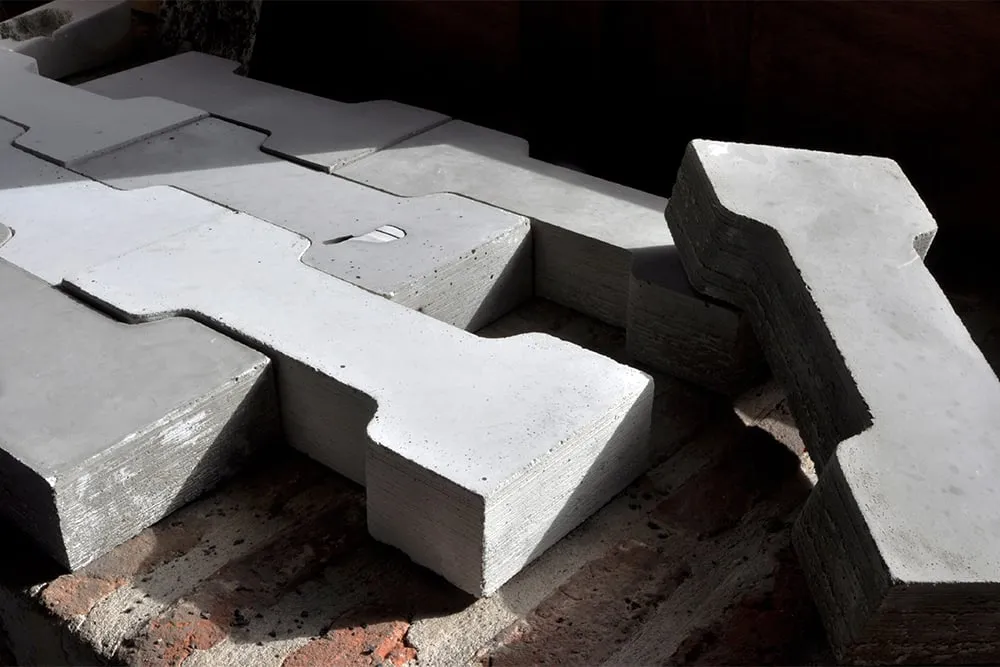
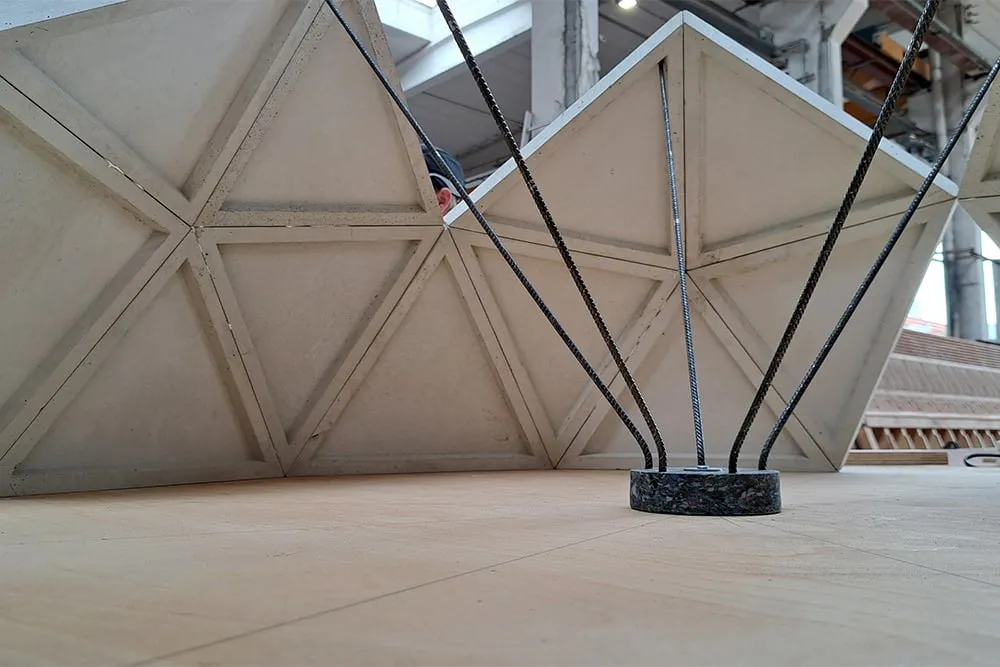
We also encountered the ‘Self-Cloning concrete’ concept, in which the concrete elements created serve both as the finished product and, together, as a mould for new, identical elements. Last but not least: ‘Coupling Cupola’, a self-supporting structure based on Richard Buckminster Fuller’s Geodisic Dome, which explores a way of building for the future through disassembly, in line with circular design principles. It is a modular system made up of different triangles, allowing each dome to be adapted to the user’s needs in a specific architectural context. Precast concrete as you have never seen it before.
Question about this story? Ask your question
In this story
- Designers:Lie Bormans (DMOA), Xaveer Claerhout (Claerhout: Van Biervliet), Benjamin Denef (DMOA), Kasper Habtie (Bureau Bouwtechniek), Siebe Jansegers (studiobont), Anas Kereknaoui, Dominiek Larsen (DNA-Architecten)
- Concrete experts:Jochem Ahmad (DECOMO), Maarten Durnez (Enjoy Concrete), Seppe Weiss (Enjoy Concrete)
- Coaches:Siebe Bakker (bureau bakker), Guy Mouton (Mouton), Jef Marinus (FEBELARCH), Arnaud Tandt (FEBELCEM)
Keep following this
Get an email when a new story is published. No account needed.
- SubjectGeneral
- CompanyEnjoy Concrete







