








Construction confidence in the red
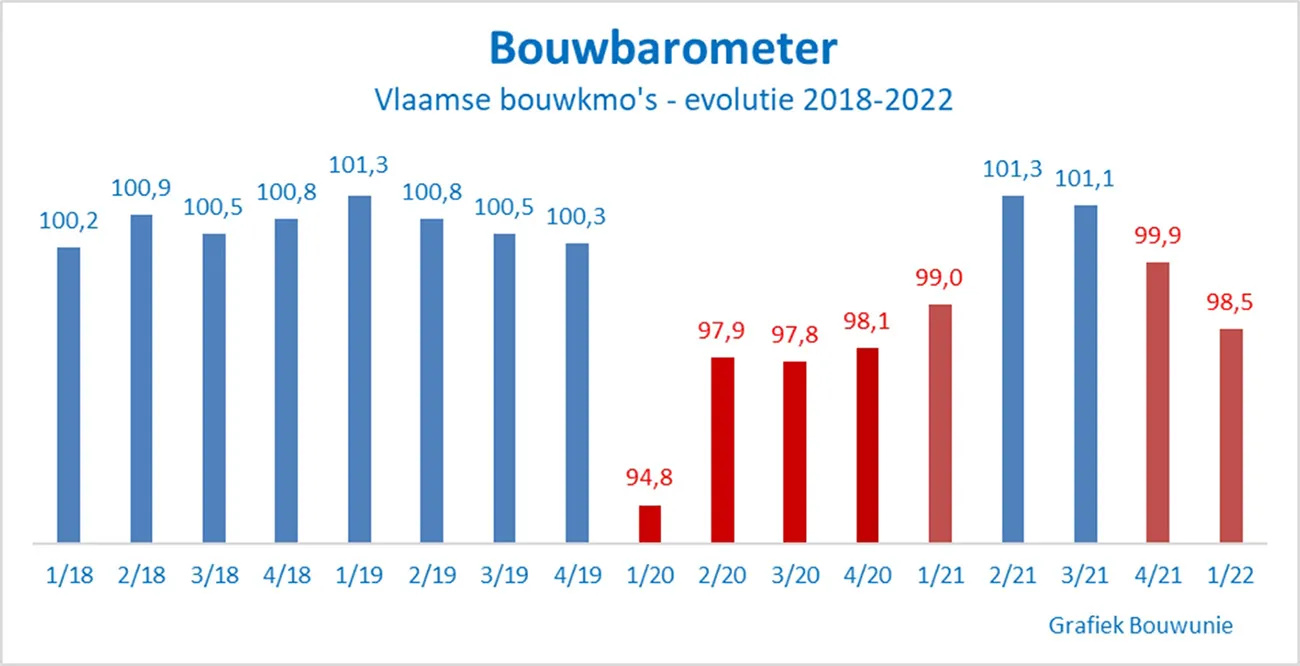
Confidence among construction companies has fallen sharply. This is clear from Bouwunie’s construction barometer, which turned negative in the first quarter of 2022. This means construction companies are taking a much less positive view of the economic situation. The sharp rise in costs is, of course, a major factor.
Bouwunie’s construction barometer fell from 99.9 to 98.5 in the first quarter of 2022, slipping further into negative territory. By comparison, the second quarter of 2021 had seen a very positive 101.3. The reason is clear: rapidly rising costs and pressure on prices.
Confidence falling
It is worth noting that this construction barometer survey dates from March 2022. But there is no immediate prospect of an improvement, quite the contrary. The many price and cost increases are eating into construction companies’ profitability. Four in ten report a further deterioration. At the end of March, order books were still well filled: one in three construction companies said it had enough work for at least six months. But if confidence among households and businesses remains at its current level, that could soon change. Uncertainty caused by Covid, the war in Ukraine, supply problems and rising prices is taking its toll. “Prices are rising across the board: timber, insulation, glass, aluminium, concrete,” Bouwunie adds. “The increase, ranging from 10 to 50 per cent, varies from product to product and supplier to supplier. Almost all materials are also now subject to longer lead times. Production of some products, such as roof tiles, has even been suspended temporarily. Suppliers are unwilling or unable to give delivery times any more. The result is delays and even worksite closures. On average, delays are around six weeks compared with before, although this too depends greatly on the product.”
Passing costs on to customers
What is happening? An increasing number of construction companies now have no choice but to pass higher material prices on to customers. In two-thirds of new contracts, higher material prices are passed on to customers, and this is more often done in full than in part, according to the monthly business survey by the Confederation of Construction, in which 325 construction companies took part between 9 and 17 May. In 44 per cent of ongoing contracts, construction companies pass higher building material prices on to customers. The increase is more often passed on partially (27%) than in full (17%). “That figure will continue to rise as long as building material prices keep going through the roof,” says Niko Demeester, CEO of the Confederation of Construction. “We therefore recommend including a price revision clause in all contracts.” This is, of course, increasing uncertainty for clients. In some cases, projects will inevitably be postponed or cancelled. “We are already hearing from the industrial construction sector that a lot of projects are being postponed,” confirms FAC, the Federation of Aluminium Constructors.
On the ground
Jan Ooms, co-director of construction company and interior design firm Ooms Woonrealisaties: “It is not just material prices themselves. Transport and energy surcharges are also major culprits, driving up invoices.” This, together with material shortages and uncertain delivery times, has led Ooms Woonrealisaties to take a different approach to stock management. “We not only order everything much earlier than before, but have also significantly increased our stock of these price-sensitive materials.” In addition to structural materials, Ooms Woningrealisaties has also experienced delivery problems with kitchen appliances, among other things. “These are now ordered almost a year in advance. To be on the safe side, we have the appliances delivered and put into storage in our warehouse. Previously, appliances were ordered on demand, but at a certain point that no longer worked either. We want to take the burden off our customers, and that is inseparable from strict planning and meeting the agreed completion date. Hence these solutions, which we hope will be temporary. But no one has a crystal ball, and the future is uncertain.”
Question about this story? Ask your question
Keep following this
Get an email when a new story is published. No account needed.
- SubjectGeneral







