Architectural lighting explained: energy-efficient light, smart technology and bespoke solutions with Tony Decavele
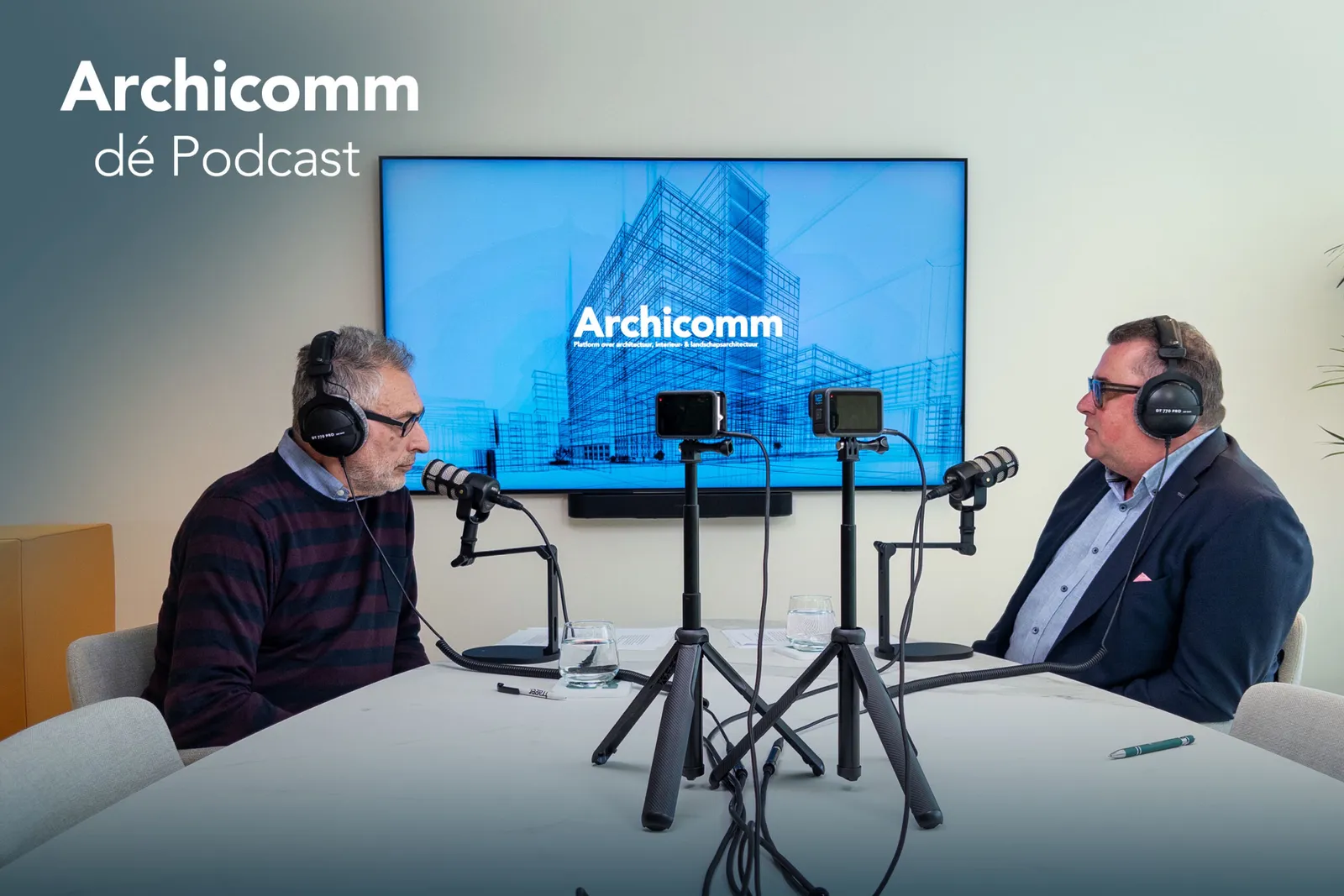
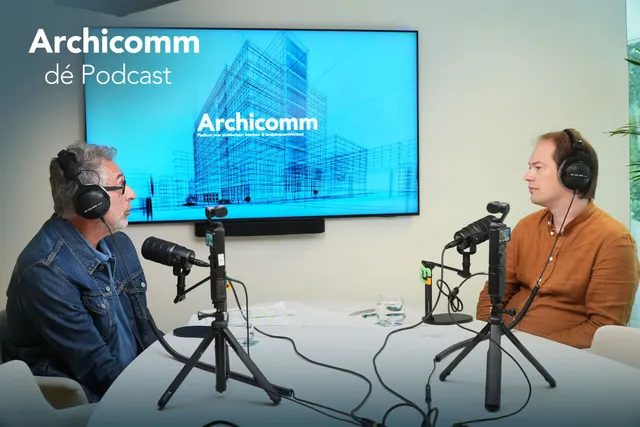
A conversation with Tony Decavele, hosted by Patrick Retour
How do you choose the right lighting for architecture? In this episode of Archicomm, host Patrick Retour speaks to Tony Decavele, Managing Director of Zumi. They discuss how lighting should not only create atmosphere, but also be functional, energy-efficient and sustainable. From lumens per watt and Zhaga standardisation to smart lighting, sensors and DIALux lighting studies: discover how modern lighting solutions enhance buildings and make them future-proof. An in-depth discussion about architectural lighting, innovation and bespoke solutions.
Full transcript
All chapters (24)
- Introduction to the episode and guest
- The origins of Zumi and the company’s development
- The name Zumi and an anecdote
- Company size and approach to solutions
- Company culture and employee engagement
- Job profiles and recruitment challenges
- A company in motion and full of energy
- The importance of lighting and sustainability
- The importance of lighting and sustainability (continued)
- Efficiency limits and the evolution towards smart technology
- Solar panels for lighting
- International ambitions and market split
- Made in Belgium and local production
- Working with architects and bespoke solutions
- Working with architects and bespoke solutions (continued)
- Technical solutions and lighting control
- Product range and applications
- New collections and wireless technology
- The link between light, art and a background as a DJ
- Acoustics as an extension of lighting
- New collection and collaboration with specialists
- A striking presence at Architect at Work
- Zumi’s vision for the future
- Closing the episode
Introduction to the episode and guest
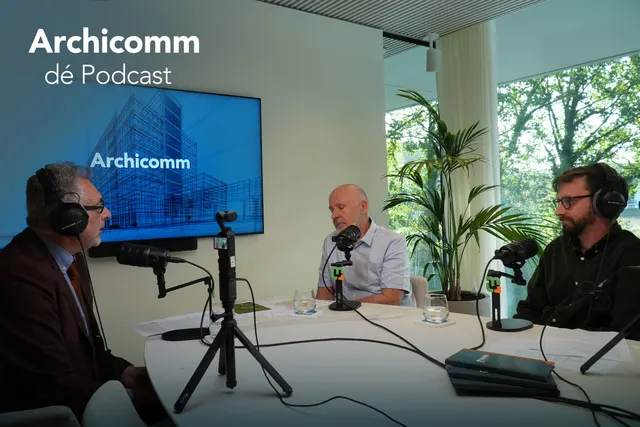
Patrick Retour A warm welcome to the tenth episode of Archicomm, the podcast. My name is Patrick Retour and, as always, I’m your moderator and host, here in the studios of Louwers Mediagroep in Oostkamp. Today we’re looking at lighting. It’s an important subject when we talk about architecture, because lighting creates atmosphere, but it also needs to be functional and, ideally, energy-efficient. So we’ve invited a specialist to shed some light on the subject. That’s Tony Decavele, Managing Director of Zumi. A warm welcome, Tony.
Tony Decavele Hello, Patrick.
The origins of Zumi and the company’s development
Patrick Retour How did Zumi come about? The name intrigues me too. And how did you get so far? Because it’s fair to say you’ve become an innovative player in the lighting market. Absolutely.
Tony Decavele We actually grew out of our parent company, Tronixx Belgium, which started in 2002 as a distributor of electronic components for the lighting industry. We represent the Austrian brand Tridonic, a subsidiary of the Zumtobel Group, one of the biggest players in the world, with more than 200 inventions and over 2,000 lighting patents to its name. Initially, we distributed its products throughout Belgium and Luxembourg, to wholesalers and, on the other hand, through lighting manufacturers. But the landscape has of course been transformed in recent years by LED technology. Many more players have also entered the market, and we’ve evolved from being a distributor to offering bespoke solutions, thanks to Weyland Hendrik Vermoortel of Bureau 2, who encouraged us to start doing bespoke work. It began with a workshop. That workshop kept getting bigger and bigger, and we acquired more and more tools. At a certain point, we decided that we had so many capabilities in-house and so much technology from Tridonic, with all its innovation. Sometimes we call ourselves a little micro micro Apple. We make beautiful things, backed by excellent technology, with a focus on sustainability, service life and low energy consumption. That’s how Zumi came about. We started developing products for the architectural market.
Read the full transcriptCollapse transcript22 more chapters
The name Zumi and an anecdote
Patrick Retour And what does the name Zumi refer to? Or is it just your imagination running wild? No, but it’s a bit banal.
Tony Decavele There’s a nice little story behind it. One of my best friends came up with the name. When I was young, a long time ago, I always drove too fast, and people used to say, “Schumi’s here”, referring to Schumacher, of course. So that’s where Zumi came from.
Patrick Retour A great name. I think it has a nice ring to it. It makes you curious. And there you go, it’s working well in the market.
Tony Decavele That’s right.
Company size and approach to solutions
Patrick Retour How many people work at Zumi now? You’re clearly on a growth trajectory.
Tony Decavele We are growing. We have 12 people, roughly half in production and half in the office. About three of the office staff are constantly carrying out lighting studies, because I always tell architects, designers and property investors that we don’t sell products, we sell solutions. It’s not about the luminaire itself, but about how it will fit into the architecture and how it will work within it. That can involve sensors, emergency lighting and wireless controls. Our offering is very broad, it’s not just about the luminaire itself.
Company culture and employee engagement
Patrick Retour In any case, Zumi’s company culture seems to set a high ethical bar too. I think you make a huge effort to ensure your employees feel good at work, which ultimately leads to optimum performance. Tell us a little about it: how do you motivate people so positively?
Tony Decavele My background is partly in entertainment, and I believe people need to feel happy. We have a very flat hierarchy, which means everyone is on the same level. Whether you work in production or in the office, everyone is treated equally. But everyone also knows that we set the bar high for the end client. They’re paying for their project, after all, and they want it to be right, look good, be neatly finished and cause no problems. Everyone in our organisation needs to understand that. We also involve them in the projects. Recently, we organised an incentive for the team and went to visit two projects. We had breakfast at Hotel Astoria in De Haan, and I gave them a full tour, from the basement right up to the top, showing them everything we’d achieved there with Zumi. Then we went to a restaurant for lunch and showed them how we’d approached the project: the atmosphere, the dimming and the colour temperature. That makes them proud. One person may have done the lighting study, while another actually made it with their own hands. That makes it fun. Every month, I also give an overview of the projects we’ve completed. We have a sort of lunch break with sandwiches, and I go through all the recently completed projects, taking photos and explaining them. I say, “Look, you made that, and there it is, completed.” That really makes them happy.
Job profiles and recruitment challenges
Patrick Retour I could see myself working at Zumi, but unfortunately I don’t have time. I’m busy as an editor, writing books about homes and gardens, and as the regular podcast host for Archicomm, the podcast, and so on and so forth. But what skills do people need if they want to work for you? What kind of talent are you still looking for?
Tony Decavele Yes, we’re still looking for quite a few people in production. The issue is that we still make everything ourselves. Everything is made in Belgium, in Gistel. Production work includes soldering, for example. That’s a very challenging task, very fine work, soldering electronics. But we also do mechanical work such as sawing, drilling and welding. You can see where this is going: it really is skilled work. You need to be very focused. That’s where we’re still looking for people. It’s not easy. In the office, we’re looking for lighting consultants. The challenge is what a lighting consultant is today. In the past, we could take an interior architect and train them to become a lighting designer. That’s no longer so straightforward, because there’s a lot of smart technology involved, and you also need to know a bit about IT and have some electronics knowledge. So we’re looking for a mix of the two: someone creative with a strong interest in technology. We do, of course, provide training, but most people who have studied architecture or interior architecture only want to focus on choosing the luminaire for the project. On the other hand, someone with a background in electronics or IT only wants to focus on controlling it. But we need both in one person. It’s not easy, but we provide the training ourselves. And bear in mind, we hire people with no prior experience. It takes two years to train them.
A company in motion and full of energy
Patrick Retour A company on the move for people on the move. You certainly have a dynamic atmosphere, from what I can tell.
Tony Decavele Keep it up. Absolutely, yes.
The importance of lighting and sustainability
Patrick Retour Tony Decavele of Zumi, an innovative player in the lighting market. We’re continuing our conversation here in our studio for Archicomm, the podcast, episode 10. Creating the right lighting conditions, putting the right light in the right place, also depends on the occasion. If we’re working in the kitchen or sitting in the home office, we need different lighting than when we’re having a party or want to relax in the living room, where the mood should be cosy. That’s one thing. But another point that always comes up with you is that you want to be kind to the planet. You always think about the environment too. I like that, it’s music to my ears.
Tony Decavele Yes, indeed. I think lighting is a long-term investment. You don’t buy it for two, five or ten years. The idea is for it to last as long as the building structure. That’s why we pay so much attention to the design of our luminaires. They are all based on Zhaga standardisation. It’s a complex term, but it means that our components are standardised worldwide, so they can be supplied by multiple players. They already have a long service life, between 60 and 100,000 hours, which is a very long time. But if something does go wrong, it’s still electronics, and it needs to be repairable. Thanks to Zhaga standardisation, replacement components can always be found. For example, we work very closely with Tridonic in Austria. Suppose they decide to stop making a component because it hasn’t been successful. We can then check the database to see who else supplies that component, and guarantee the customer that we can repair their luminaires. Some luminaires are already fitted with cradle-to-cradle components, which is also very interesting. Some cradle-to-cradle electronic components are even made from recycled materials. So they’re already taking the cradle-to-cradle concept a step further. More and more architects, engineering consultancies and end clients are also interested in this, saying that it’s really interesting to see products made this way.
The importance of lighting and sustainability (continued)
Patrick Retour Zumi wants to do good for people and the environment, and we can only applaud that. Now, bathing in luxury, bathing in opulence and bathing in light. Especially when we’re talking about the garden and the swimming pool, for example. It’s wonderful to bathe in light, to bathe in opulence. But people immediately think: “I’m going to see that on my bill, on my energy bill, and I want to keep a tight rein on my spending.” So are you also focused on making things as energy-efficient as possible, so that they don’t cost too much to run?
Tony Decavele Yes, absolutely. It all comes down to the lumens per watt of your light fitting, and that is vastly underestimated. If you ask ten architects or installers, it makes no difference which, what the lumens-per-watt ratio is of the light fitting they are buying, they will not be able to answer. Yet it is very easy to find in the datasheet, and it determines how much energy your building consumes. Let me give you an example. We are now aiming for fittings of up to 200 and sometimes 210 lumens per watt. Mainstream lighting manufacturers in the market sometimes sit between 80 and 120. That means our technology already uses 50% less energy.
Efficiency limits and the evolution towards smart technology
Patrick Retour Is there ever a limit, then? Will it ever stop? Or can efficiency keep improving? It is the same with runners, who keep pushing the records further. And our famous pole vaulter has broken his record so many times. So is there a limit, or do you think efficiency can keep improving almost indefinitely?
Tony Decavele I think physics is holding us back a little now.
Patrick Retour Zero energy consumption is impossible.
Tony Decavele Yes, zero energy consumption is impossible. I think we are at the limit now. We once aimed for 200 lumens per watt. We are now at 210, but you can feel that progress is slowing down. We will not go any further on that front. What we are seeing now is the addition of smart technology to low-energy lighting, to reduce consumption even further through sensors or other IoT solutions, Internet of Things solutions. A new sensor is due out by the summer, for example, that can measure how many people are in a room. Using that information, which is essentially data capture, we can control the heating, ventilation and lighting, switching the lights on or off. So you can see that this is where we are heading now, into everything smart technology has to offer.
Solar panels for lighting
Patrick Retour And if people have a heat pump and solar panels, they may also have electricity available that they can use.
Tony Decavele Yes, that is another development. Towards the end of the year, we are also launching solar panels for lighting. They are interesting for certain areas where it is simply impossible to get electricity to them, so we have to be self-sufficient. But it is still at a very early stage. It is an interesting development to keep an eye on, though.
Patrick Retour In any case, if architects and consumers want to keep up with the latest lighting trends, I would say: stay with us, keep listening to our podcast, because in a moment we will be shining a little more light on them. The light is on.
Tony Decavele Excellent.
International ambitions and market split
Patrick Retour Today we have Tony Decavele, Managing Director of Zumi, with us in the studio. Tony, you operate from Gistel, but your playing field is much bigger, your horizons are broad. Belgium, Europe, the world. How is the conquest of the world going?
Tony Decavele I would like to see it happen a little faster, but that day has not come yet. It will, though. We currently do 85% of our business domestically, by which I mean the Benelux, Belgium, the Netherlands and Luxembourg. The remaining 15% is in other countries, such as France, Australia, Norway, Denmark and, from time to time, the US. We have a relationship there, which allows us to work on a project now and then.
Made in Belgium and local production
Patrick Retour Made in Belgium is certainly a quality label you hold in high regard. I think it can take you a long way.
Tony Decavele Yes, Made in Belgium also has something to do with our footprint. We make everything in Belgium, and all our components come from Europe too. Bear in mind that 60% even comes from very close by, from neighbouring countries. That also means we do not buy anything from China or elsewhere. So we work locally and manufacture locally, which also reduces transport. I think that is where we make a contribution.
Working with architects and bespoke solutions
Patrick Retour Your range is also very popular with architects. Why do you think architects are so keen on it?
Tony Decavele Our story always starts with the design of a fitting, a light fitting, a concept. We then expand it so that we can offer everything within the same range. That means we can provide recessed, surface-mounted and suspended fittings, with or without a trimless finish. So there are plenty of possibilities. They all use the same light source and lenses, so the feel of the building remains consistent too. We can create different atmospheres. Another difference is that we offer a very broad spectrum. Most manufacturers limit themselves to 2700-3000 kelvin, but we start at 2200 kelvin. The lower the figure, the warmer the light. We go up to 16,000 kelvin, which is an enormous spectrum. That lets us adapt to the needs of each project.
Working with architects and bespoke solutions (continued)
Patrick Retour So you can really read the architecture and provide lighting tailored to it.
Tony Decavele Yes, and that is what is needed to enhance the architecture. We always work closely with architects, interior architects, designers and even artists, to understand what the needs are in a particular building or project, and what needs to be created. If something is not available in our collection, we can make it to measure.
Patrick Retour Yes, and light is also about experience and is part of the whole. Light is indispensable, and choosing it deserves careful consideration. We should not rush into it. Do you also provide enough support to architects and consumers? And how exactly does that work?
Tony Decavele Yes, we carry out the lighting studies ourselves. We use a software programme familiar to every lighting architect or lighting designer: DIALux. We use the architect’s DWG plans to plot the lighting, then transfer them into DIALux to run lighting calculations and check that everything is in order. Some projects have to comply with regulations for illuminance levels, while others are more about creating an atmosphere.
Technical solutions and lighting control
Patrick Retour Lighting enhances the impact of a building, whether it is an apartment block, an office building or a home. It is wonderful to see. Of course, you also need to make sure the installation works properly, with no red warning lights flashing. That is the job of the technician or technical team. I assume you also offer plenty of solutions and support for professionals.
Tony Decavele Yes, that is right. There are various lighting solutions. In offices, for example, we recommend tunable white. That gives you a morning, midday and evening setting. In other words, we vary the colour temperature in the workspace. In hospitality, we tend to go for dim-to-warm in the other direction. We go from 3000 kelvin down to 1800 kelvin to create a really sultry atmosphere, and control everything through a DALI platform. I think that has become a global standard. It is very easy to manage with any manufacturer, whether it is a home automation system or a simple push-button system. It always works. So the technician can rest easy, knowing there is no need to connect any external computers. The intelligence is built into the fitting itself.
Patrick Retour Wow, thank you, Tony. Thanks to Zumi, we can see the light in the darkness. And thanks to you, I have seen the light a little today too.
Tony Decavele I am very glad to hear that.
Product range and applications
Patrick Retour Tony from Zumi. Zumi stands for architectural lighting: light that serves and enhances architecture, adding real value. That gives the whole space more presence. On www.zumi.be, we can see a wide range, but I suggest we take another look at it here at the table. Pick out a few items from the range. What should I picture? If I have never come across Zumi before, what does your offer include?
Tony Decavele Today, we focus mainly on residential projects. A lot has changed because of Covid, but residential projects still account for 60% of our work. We also do a lot in offices and hospitality. Retail is very difficult at the moment. Everything has to be cheap, and the turnover period is shorter. But if I focus on hospitality, for example, we can see how the emphasis is shifting towards atmosphere. We need to be able to create different atmospheres. The interplay of light and shadow is a great way to do that. You do not have to light everything evenly; you can really play with it. We also experiment with materials, so we do not make everything out of aluminium. We use glass, leather and natural wool. We are now launching a whole new glass collection for the hospitality sector. It is a really exciting proposition.
New collections and wireless technology
Patrick Retour What is the latest of the latest? Is that what you would present as the jewel in the crown?
Tony Decavele After the summer, we are launching a beautiful collection in glass, using sustainable glass too. It will be great, with dim-to-warm throughout, and some collections will be fully wireless. They can be controlled by smartphone or wireless switches using EnOcean technology, with no batteries. That is another sustainable choice, avoiding disposable batteries.
Patrick Retour In this way, light becomes a little artistic, which brings me to your art gallery. You are passionate not only about light but also about art, and the two go together rather well.
Tony Decavele They go together perfectly.
The link between light, art and a background as a DJ
Tony Decavele Perhaps I should go back a little further. When I started out as a DJ, I always had a dedicated lighting DJ with me, because I felt you could play a great track, but if the lighting was not right, the atmosphere would be missing too. I had a regular DJ, and he knew the movements I made with my fingers, and which lighting to bring in for a particular track. After a while, it became second nature; he knew what to do. I did that for ten years, and it taught me that light, sound and acoustics all combine to create a single experience. I think that is in my DNA, and I carry it through into my projects and share it with architects. It is something you need to think about. It is very important.
Acoustics as an extension of lighting
Patrick Retour That brings me to the next point. I am a songwriter and singer myself, and I am very interested in sound. I know that light is not the only way to create atmosphere; sound and melody can do it too. You also work with acoustics, then, but you will have to explain that to me. You are a lighting specialist, but acoustics come into the picture as well?
Tony Decavele Yes, a project in Wijnegem, Antwerp, in the buildings of Axel Vervoordt. A very beautiful property. An office, Autodialog, was moving in, and the people there were working with an interior architect who was going to install stretch ceilings and false walls. But the problem was that it is a very beautiful, authentic building, with a lot of concrete and steel. Those are precisely the materials that are bad for acoustics. The sound reflection was incredibly poor, so you couldn’t talk to each other. That got us thinking about developing a luminaire with fully engineered acoustic properties, to which we could also add lighting. But we went a step further still. We also applied PI-LED technology, Phosphor Innovation LED. It was invented by a professor in Austria and allows us to use the spectrum from 1,800 kelvin to 16,000 kelvin, including colour changing. With all that entails. So it’s a wonderful architectural property where we’ve fully addressed the acoustics, and you can do whatever you like with the lighting. The people there even rent it out after hours as a cocktail bar and as a space for photo shoots. By solving everything in one go, we created much greater added value: acoustics, lighting and PILID technology. It really was a phenomenal project. We also won awards for this installation in London and Paris, and received a nomination in Monaco.
New collection and collaboration with specialists
Patrick Retour So has that also become a fully fledged collection for you? A new range?
Tony Decavele Yes. As you’ll see, we always, as I said earlier, we’re a micro-Apple story. We always source the technology from people who know how to do it. We also turn to a company for our acoustics that, I believe, will celebrate its 200th anniversary in 2030. So they’ve been working in acoustics for a very long time. And we get their support. So when we need to do a calculation, we leave that to them, to tell us how many square metres need to be covered with an acoustic product. Then we add the lighting, and that’s how we deliver a finished result. The right specialist in the right place. We’re now working on a new collection that was presented at Architect at Work. It’s made entirely from a kind of foam, a very soft, tactile material. We’re bringing it out in every colour, and developed it specifically for offices.
A striking presence at Architect at Work
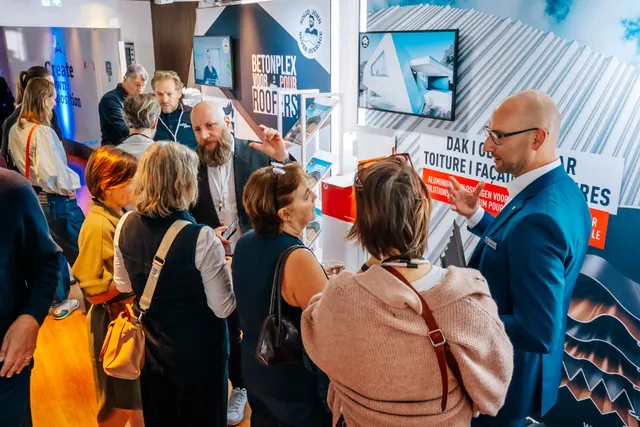
Patrick Retour I’ve also been told that you had the most striking stand at Architect at Work and even won an award for it.
Tony Decavele Yes, that was just after the pandemic. So we were going back to architects. It was the first trade fair for architects in Belgium, and I heard everyone say: ‘Yes, we’ll definitely be there, because it’s been a long time since we’ve been able to do anything hands-on.’ Then I gave the team the task of coming up with something really funny that would stand out. They asked: ‘If we come up with something, will you actually do it?’ I said: ‘Yes, let’s do it.’ So we put up a completely pink stand, wore a pink suit and painted the luminaires pink. You couldn’t miss it.
Patrick Retour There you go, an entertainer. Once an entertainer, always an entertainer.
Tony Decavele Absolutely.
Zumi’s vision for the future
Patrick Retour Finally, Tony, what does the future hold for Zumi?
Tony Decavele We’ll definitely continue developing our products. We’ll broaden our product families so that we become a truly all-round player across all projects. The second phase is also about exports. We want to continue growing internationally and find people who can champion our product in their region. They need to be passionate and able to convey the same message to architects.
Closing the episode
Patrick Retour We’re very excited to see what’s next. We’ll be cheering you on from the sidelines and continuing to support you. Thank you. Tony, incorporating architectural lighting into the development of living environments is no easy feat, but fortunately you’ve shed some light on it for us today. Thank you for that. Thank you for joining us, Tony Decavele, Managing Director of Zumi. That was another episode of Archicomm, the podcast from the Louwers Mediagroep studios in Oostkamp. You can listen to all episodes of the podcast on Spotify. I’ll be back soon for another episode. All the best, goodbye.
Companies in this story
Keep following this
Get an email when a new story is published. No account needed.
- ThemeLight and sound as design tools
- SubjectGeneral
- CompanyTronixx Belgium