Showing true colours, pushing boundaries and translating stories into space
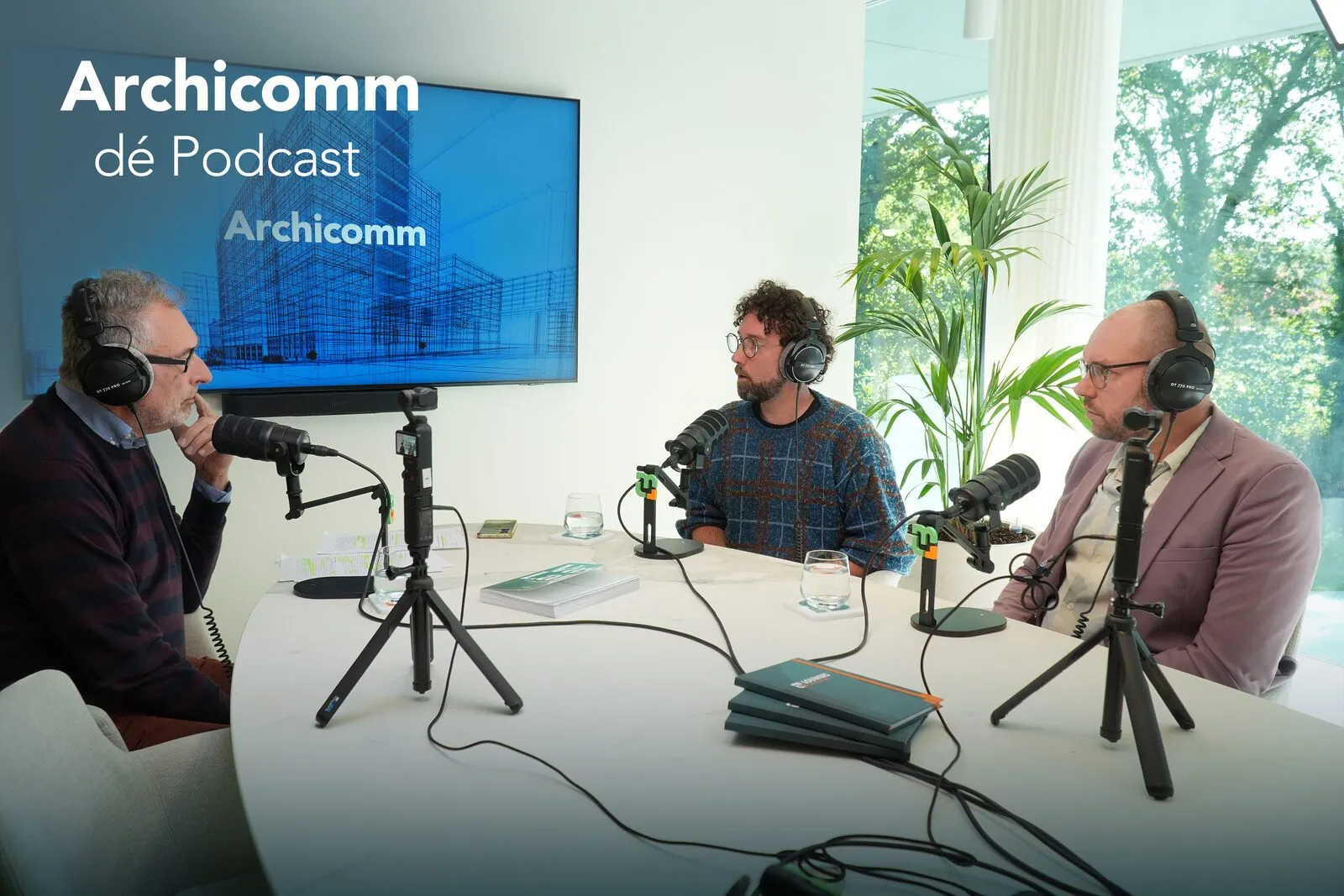
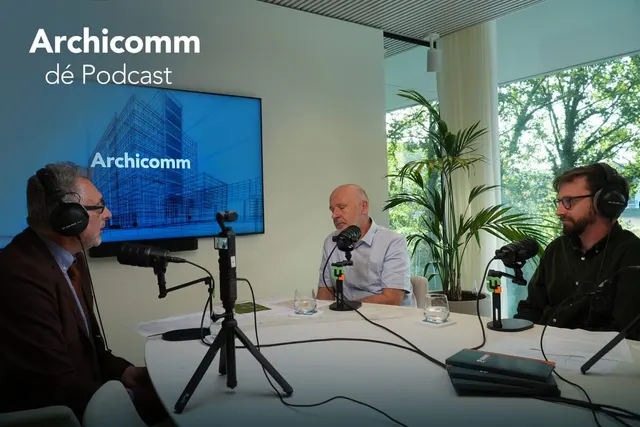
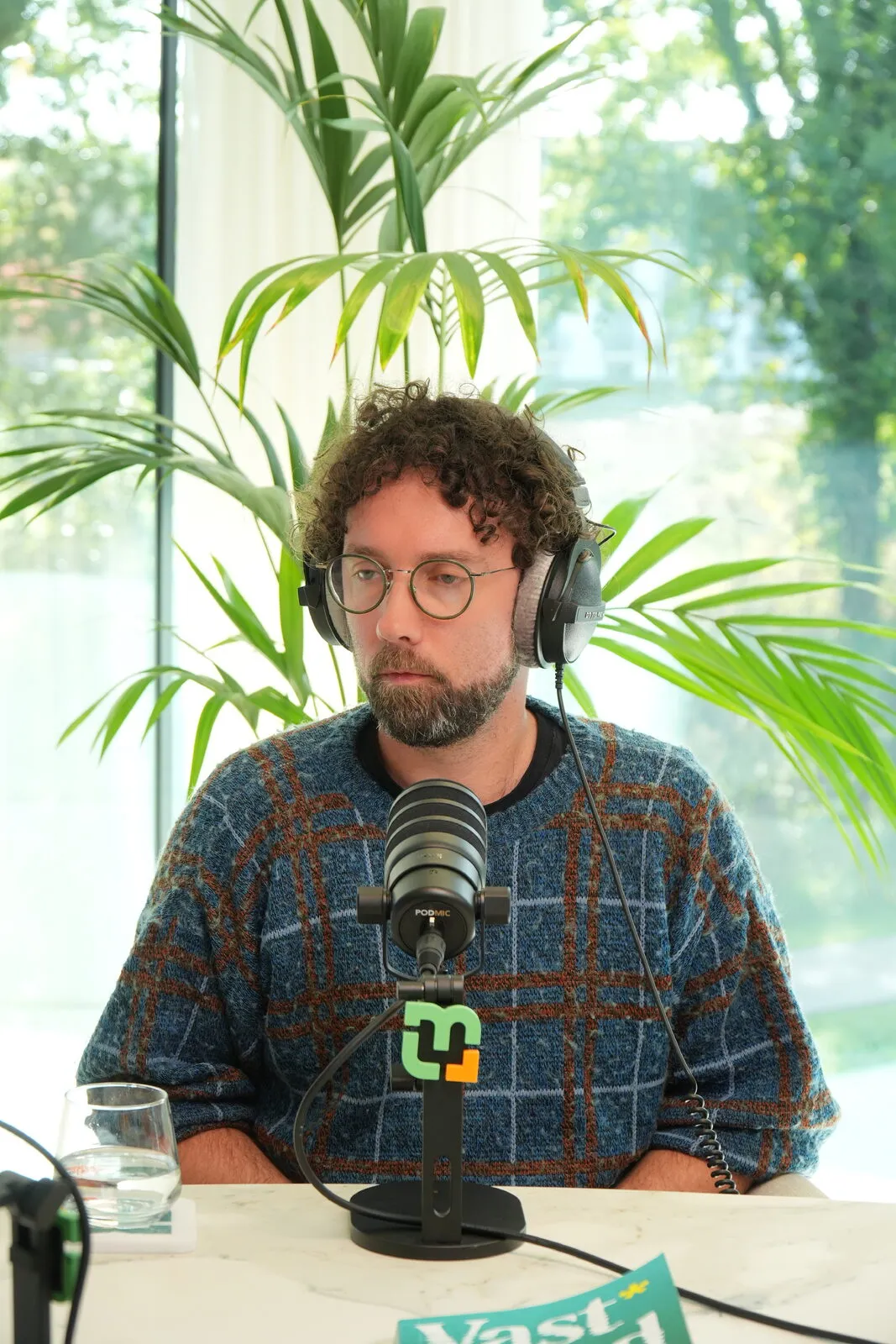
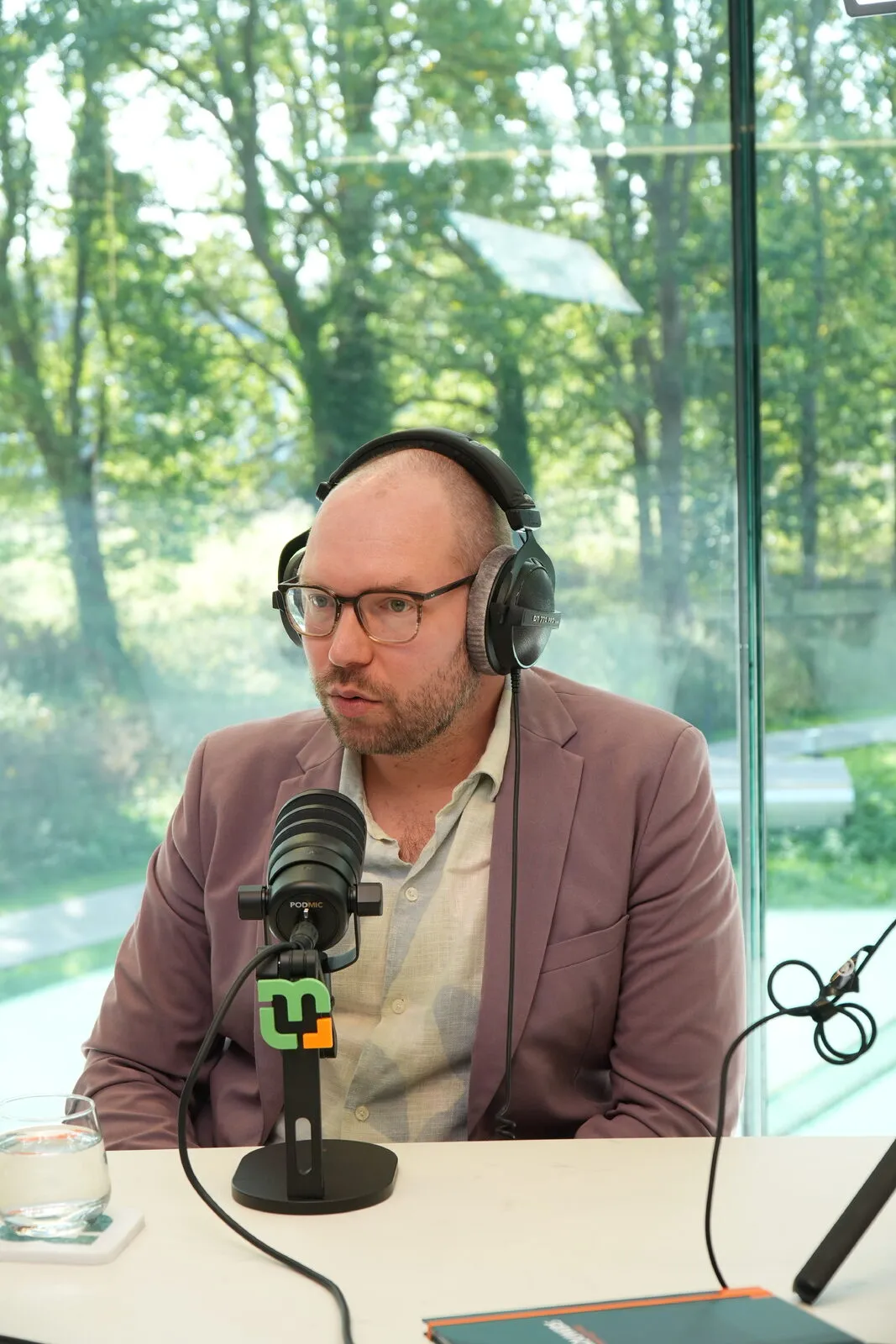
Guests: Thomas Roelandts and Steven Schreurs | Host: Patrick Retour
What began as a concrete boat during their student days grew into an idiosyncratic architecture practice with a clear vision. Thomas Roelandts and Steven Schreurs founded MARGE architecten in Ghent in 2016. Today, together with their team, they design colourful architecture in which inventiveness, involvement and entrepreneurship take centre stage.
In this episode of Archicomm, host Patrick Retour talks to the two founders about their search for opportunities off the beaten track. Projects range from modular building in Sint-Michiels and a light-filled townhouse in Brussels to the conversion of Villa Geurts and the future of the Plaatsmolen in Pittem. In every case they start from the stories of people and places, with particular attention to bespoke solutions, circularity and heritage.
Their design philosophy, their collaboration with clients and the importance of healthy entrepreneurship also come up. Finally, Thomas and Steven talk about their book Vast * Land, in which they look back on ten years of MARGE.
A conversation about architecture that looks beyond the obvious, discovers opportunities in the margins and turns stories into space.
Full transcript
All chapters (29)
- Introducing MARGE architecten and the concrete boat
- How the concrete boat came about
- From fellow students to founders of an architecture practice
- The team and the commissions of MARGE architecten
- Colourful stories as a starting point for architecture
- The design process and collaboration with the client
- Inventiveness and bespoke work as added value
- The three core values: involved, enterprising and resourceful
- Entrepreneurship as the basis for creative architecture
- Fair pay and committed staff
- The meaning behind the name MARGE
- The international resonance of MARGE
- Modular building in Sint-Michiels
- Circularity and reclaimed brick-drying boards as facade cladding
- Reconnecting a Brussels townhouse with light and outdoor space
- Urban densification and projects spread across Belgium
- New techniques make light and openness accessible
- De Plaatsmolen in Pittem as a new heritage project
- Working with public authorities and fine-grained heritage
- Redress as the restoration unit within MARGE
- Villa Geurts: Repurposing an eclectic park villa
- Private investment as a solution for heritage conservation
- Five dwellings with private outdoor space
- Progress on the restoration of Villa Geurts
- Margeplekken: The origin of a design philosophy
- The book Vast * Land, Tien jaar MARGE architecten
- The asterisk as a reference to the ferrocement boat
- Availability and authorship of the book
- A sequel and the close of the episode
Read the full transcriptCollapse transcript29 chapters
Introducing MARGE architecten and the concrete boat
Patrick Retour Hello everyone, and a warm welcome. Here we are again with a new episode of Archicomm, the podcast, already number 18 in a row. Today we have once again invited some special gentlemen from Ghent. It all began in 2011. They were still architecture students then, and they built a concrete boat. Everyone thought it would sink. But no: the pitcher goes to the well until it breaks. The boat did not break, and it never touched the bottom either. Meanwhile they set sail together, in 2016. And that ship is on a good course towards a rosy future, I may say. And I say that deliberately, because everything they do falls under the banner: we show our true colours. We give the world colour. That is a considerable merit in itself and a reason to invite them here. Steven and Thomas, a warm welcome from MARGE architecten in Ghent.
Thomas Roelandts Hello, thanks for inviting us.
How the concrete boat came about
Patrick Retour Congratulations on your book. That's wonderful too, and we'll come back to it shortly, because I really want to get to the bottom of it. This heavyweight is lying right here in front of me. I do want to know the story behind it. But first, let's go back to the beginning, perhaps: that concrete boat and then setting sail together. Go ahead. How did you come to build that concrete boat? Was it a kind of final-year project?
Steven Schreurs Well, it came about in two ways, really. On the one hand, during our studies we were taught how reinforced concrete came into being. And that actually originated with, what was his name again?
Thomas Roelandts Monier.
Steven Schreurs Monier, I think. He was actually a gardener who had invented his own version of the material ferrocement to make flowerpots. Chicken wire with mortar pressed into it. And just to show how watertight it was, he made a little boat out of it and demonstrated, in 1800-something, that it could stay afloat.
Patrick Retour And you put that into practice.
Steven Schreurs We saw that in a lecture once. Then, during our studies, we took part in a summer camp course with architects from all over Europe. 400 students came together, each year in a different city. The students organised everything and were also allowed to run a workshop themselves. We wanted to make a boat. That proposal was not accepted at the time, so we thought: we'll just do it in Ghent itself. And that is how we organised it.
From fellow students to founders of an architecture practice
Patrick Retour Meanwhile you set sail together in 2016, I believe. And that architecture practice, that ship, is really thriving. It is heading towards a beautiful, rosy future. It is sailing a fine course. How did it come about that you set sail together? You were already working together during your studies. You complement each other. You are both engineers too. So you are not only innovative and inventive as architects, but your work is always technically grounded as well. And that makes it rather special, I think.
Thomas Roelandts Yes, that's right. I think we did find each other, collaborating often during our studies and simply noticing that you approach life in much the same way, which means you also approach the profession in much the same way.
Patrick Retour Yes, of course.
Thomas Roelandts And then you start working, you start doing internships and so on. But it kept itching. So after hours we started doing small projects. That began with the concrete boat, but soon became little design projects, purely on our own initiative. Those then turned into commissioned architecture work. And so it kept gathering more and more momentum, until it had too much and we felt we had to jump. So we basically said: quit your day job and go for it. And that was indeed in 2016.
The team and the commissions of MARGE architecten
Patrick Retour And by now it has become a serious team behind MARGE architecten, I think. How many of you are there in total, and who does what?
Steven Schreurs Fifteen including ourselves, both of us being partners. There are two other partners by now, eleven other architects and an office manager.
Patrick Retour What does your practice do, broadly speaking?
Steven Schreurs Very broadly. We started small. We still do a bit of design now and then, more for fun, and art interventions. At the moment two thirds of our commissions, in terms of volume, are private clients and family homes, renovation and new build. But we are gradually starting to scale up to multi-family housing, restoration, the occasional bit of project development and public commissions.
Colourful stories as a starting point for architecture
Patrick Retour Your designs are never grey, but colourful, figuratively and sometimes literally. They are colourful stories that we find in your architecture. Stories, they fascinate you, don't they? Stories from the past, the new stories you then write through that architecture, and everything in between.
Thomas Roelandts Yes, absolutely.
Patrick Retour You are captivated by them, aren't you?
Thomas Roelandts Yes, really. A bit like you mentioned, with that engineering background. So objective constraints are very important in architecture. But from the start we felt that many subjective constraints could also be formative and deserved a place at the design table. And that is often about stories, large and small. With certain heritage objects those stories are very big, of course. That is literally about the history of a building. But it can also be about something very small. A client who says he is messy in the kitchen and that he loves cooking, but that he also likes to keep that kitchen out of sight.
Patrick Retour Everything has to be easy to tidy away, really. And the architect can contribute to that.
Thomas Roelandts Yes, indeed. Or someone who likes to read a book in the sun. All those sentiments, those little stories, how you approach life as a client: those are things we like to translate into projects.
The design process and collaboration with the client
Patrick Retour In any case, the focus is always not only on the end product but also on the process, whatever the commission. So how it all comes about, and the relationship with the client, is very important to you too.
Steven Schreurs Yes, indeed. And since you mention our engineering background yourself: it's not only about the objective constraints, but we have in a way made the process more scientific. At the very least, we have standardised it, so that as much time as possible can go to the enjoyable part, designing. And so that the detailing can happen in as predictable a way as possible, so we don't have to reinvent the wheel every time in the areas where that isn't necessary. That is the process: a closely guided one, designing iteratively together with the client, to arrive at truly bespoke designs that can only come about through thorough authorship in every direction.
Patrick Retour You never regard anything as self-evident or obvious. It is always explored in depth, and you don't rush into things.
Thomas Roelandts Yes, that's right. Template solutions work too, but only until they stop working.
Inventiveness and bespoke work as added value
Patrick Retour So inventiveness is right at the top of your agenda. Always coming up with something original and creative. And there are always solutions to be found.
Thomas Roelandts Yes, and I think that is precisely where our added value lies. The more complex the puzzle is to put together, the more fun we find it, I think. But it's also about genuinely providing added value for the client.
Patrick Retour You are not only good at listening to what people want and what is needed. You are also good at talking. And the language you use is of course the one you have mastered best: the language of architecture. Translating stories into space and then actually building it. That is still a pleasure. You love doing it. I can see it in your smiles.
Steven Schreurs Yes, of course. And that works especially well with clients. Ultimately everyone has a story to tell, but the more specific and the smaller in scale it is, the easier it is to draw an enormous amount of information from it to translate into space, into something that could only have come about for that particular client. That can be for a family, but just as well for a village that has a very specific identity and a certain kind of heritage. Or a developer who invests in small-scale, high-quality architecture instead of rolling a hundred homes off the production line, let's say.
The three core values: involved, enterprising and resourceful
Patrick Retour In any case, I find it magnificent how you contribute to a more beautiful world that makes everyone happy. Now we move on to the core values. Thomas and Steven of MARGE architecten in Ghent. You are truly persistent people who show their true colours. And you know it: perseverance pays off. They are stories that you translate into space. And that space you then ultimately build. That's quite something. Let's turn to your three core values: involved, enterprising and resourceful. We could say a bit more about those.
Thomas Roelandts Yes, I'd like to take involved, if I may.
Patrick Retour Yes, that's fine.
Thomas Roelandts That is indeed a key value for us. On the one hand it concerns the involvement of the client in the process, and on the other the involvement within the team. Involvement with clients is something we hold in very high regard, and have done since our founding, really. It stems from our belief that a good process should stand alongside a fine portfolio. And to a large extent that is rooted in the client's involvement. That means communicating, informing people clearly about every step and so on. But it is perhaps even more about co-authorship. What we really like to do is involve people actively in decision-making and making processes by working iteratively. In other words, rather than putting forward one solution, we put forward several solutions at the same moment and enter into an open conversation about them. So it is not the case that a preferred scenario has to be chosen on the spot. It is more about opening a conversation about preferences, things they do not like, and so on. And that runs through a number of rounds. Some scenarios drop out, others are merged. Some scenarios split again into variants, and so on.
Patrick Retour So brainstorming, not only with the team of architects, but with the clients involved as well.
Thomas Roelandts Yes, absolutely.
Patrick Retour Not the easiest route, though, is it?
Thomas Roelandts Well.
Patrick Retour But interesting.
Thomas Roelandts It is a very interesting avenue. Usually it works well, provided everyone is prepared for it to happen that way, let me put it like that. By now people know they can expect this from us. And the team knows that this is how we work. And you actually see that everyone gets a lot of enjoyment out of it. And that it effectively creates that very strong involvement with those clients.
Entrepreneurship as the basis for creative architecture
Patrick Retour And you also believe that the architect has to be an entrepreneur.
Steven Schreurs Yes, like involvement, that is a value we project outwards but also inwards. We believe, and that is the value that comes up shortly, that if you want to be resourceful, if you want to build beautiful things that are unique and well conceived, then you have to create the space for that yourself. And that only works if you are a healthy business that does not do things haphazardly and simply hope it will all turn out fine.
Patrick Retour Yes, that is right.
Steven Schreurs So from the very beginning, but more and more, we have been working hard on the business itself. We constantly question how our protocols are set up, our methodology, and whether we can change things there. And we look at the health of the company. That is necessary, on the one hand, to understand professional clients, but also simply to show clients that you know what you are doing, including with their money. And we project the same towards our staff. From the start we have been completely transparent about our finances, our way of working, the hours available for particular tasks and so on, so that everyone among us also becomes an entrepreneur within the company and takes that seriously.
Fair pay and committed staff
Patrick Retour You are very artistic, but also enterprising. And that is why it all adds up, of course. Because in the end the bill has to be paid and the numbers have to work.
Steven Schreurs Especially if you want to pay people fairly. You can also be very artistic by having people work for starvation wages with endless hours, but that is precisely what we try not to do. We also want to improve the sector when it comes to pay and give everyone a good chance.
Patrick Retour That way you end up with a team that is happy to stay on board.
Thomas Roelandts Yes, I think so. Definitely. That is also that internal involvement. Transparency. I think it is a good system that tightens the bonds in both directions.
The meaning behind the name MARGE
Patrick Retour Resourceful also brings me to the name. MARGE. You are interested in the space in the margin, the nooks and corners. There you often see opportunities to approach them differently, to fit them out differently. I call that working in the margin. And doing something with that margin, those scraps of space, making something special of them. That is why the name feels right to me too. MARGE, March. I do not know how you originally arrived at that name.
Thomas Roelandts To a large extent it is just as you explain it yourself.
Patrick Retour You also always have room for manoeuvre to arrive at solutions.
Thomas Roelandts That is certainly true as well. No, because it does stem from a kind of awareness. Sometimes you are scribbling notes in the margin of a page full of text. It is that kind of thought that we always use as a metaphor. The text is one thing. Forming thoughts on that text and then scribbling them down is a second thing. It is a kind of processing. And I think that rather typifies our attitude. We feel that very interesting things happen at the edges of things, or at the transition between things. That it is always there that the boundary is pushed. So it is, how shall I put it, an attitude you adopt towards innovation. Not purely for the sake of innovation, but also because, on the one hand, it moves your client forward and, on the other, it is simply fascinating. You cannot do the same thing for forty years.
The international resonance of MARGE
Patrick Retour Have you ever considered that it is actually a name with international resonance? MARGE, March. You can pronounce it in all sorts of ways. And it exists in other languages too.
Steven Schreurs We have noticed that as well.
Patrick Retour That is quite right.
Steven Schreurs We have also noticed that there are MARGE architects in other countries. Still, so be it.
Patrick Retour Those are copycats, because you have a book.
Steven Schreurs They perhaps do not.
Modular building in Sint-Michiels
Patrick Retour We always like to visit projects during the conversation. People can then find them in our magazine as well, where of course they can admire the photographs. But here we want to paint a kind of virtual picture. And I would like to take you to Sint-Michiels. That is really about testing the limits of modular building. It is prefab, and yet you arrive at an original result. It is also affordable housing, which is something we must invest heavily in. Tell us something about that project.
Steven Schreurs Yes, that is with one of the parties we enjoy working with, Mobble. They are a modular builder from Eeklo. They offer, there are others, but they offer a modular building system in which parts of the house are made entirely in the workshop, placed on an abnormal-load lorry, assembled on site and, in theory, a few days later you have a fully habitable home, including fitted kitchen, bathroom and so on. All of that has been done in the workshop. The "disadvantage", in inverted commas, of that system is that you have quite strict conditions. You have a certain length, a certain weight, a certain height and so on. That is a rigid framework to work within. And what I think our added value for Mobble is, is that we try to push those limits until you arrive at a design in which the modularity recedes into the background and it simply becomes a house to live in. And that the identity is not: this is a modular thing.
Patrick Retour You are creative within that straitjacket.
Steven Schreurs Yes, within the rules that exist.
Patrick Retour Hats off. Because you cannot tell. It is a magnificent house, I think, with those solar panels and a green roof. It also blends into the landscape. It must be wonderful to live there.
Thomas Roelandts Yes, absolutely. I think it is a bit of a showpiece. The facade cladding is part of that too.
Patrick Retour Yes, splendid. Is there a story behind it?
Circularity and reclaimed brick-drying boards as facade cladding
Steven Schreurs Yes, that is something where, as a practice, a quick detour. We are very keen to invest in circularity, but that can also mean reuse, pure and simple. Some parties say: we are going a hundred per cent for circularity. For us it is rather: do it where you can, it should not be so forced. In this project we did it for one thing: the facade cladding. We looked at the fact that if a module has to be literally liftable by a crane for transport, it must not be too heavy. A facing brick is not the best solution in that case. So what did we do? We used the material on which facing bricks are baked or dried. Those are brick-drying boards.
Patrick Retour And what material are they made of?
Steven Schreurs Wood. In this case it is larch, but there are various types of wood. Larch is a very durable timber that is also used as facade cladding. And these boards go through hundreds to thousands of drying cycles, because red-hot bricks are laid on them to dry. Then they cool down, then they go back into the kiln and so on. And these are boards four centimetres thick.
Patrick Retour Remarkable.
Steven Schreurs They cannot be used indefinitely for those bricks. But afterwards they are in effect pretreated. Farmers sometimes use them to build stables and so on, but we thought: let us do something of higher quality with them.
Patrick Retour In a way a material like that is priceless. Because if you had to manufacture it, that would be quite something. But right now it is actually waste.
Steven Schreurs Yes, it really is.
Patrick Retour But it does not go to the landfill, and it is not burned either.
Steven Schreurs No, and it is also superb to look at.
Patrick Retour Very decorative.
Reconnecting a Brussels townhouse with light and outdoor space
Patrick Retour We are also going to Brussels, to a townhouse. There you completely stripped out the garden and the house. You dug a path upwards, towards the light. Everything there revolves around light, views and the opposite of density. Quite a feat, wasn't it?
Thomas Roelandts Yes, certainly. I think it is a great typology. Internally, and externally too, we call it the reaching typology, in which buildings reach towards the sky and stand on tiptoe, so to speak.
Patrick Retour Out of hibernation. You bring a house like that out of hibernation. You dig a way upwards.
Thomas Roelandts Yes, indeed.
Patrick Retour You open it up completely.
Thomas Roelandts Certainly, certainly. These are often relatively large houses, but they often stand on a very small plot. It is a truly urban typology that you come across often. Over the course of history the solution was to build those plots out completely, because people perhaps did not see the added value of that leftover space. Whereas now we try to do exactly the inverse, a hundred per cent. These are houses that we clear completely of rear extensions. So often only the historic main volume remains.
Patrick Retour The ramshackle outbuildings are gone, then.
Thomas Roelandts All the outbuildings are gone. And no new ones come in their place. That is important.
Patrick Retour And yet those people have enough space inside, thanks to you.
Thomas Roelandts Yes, absolutely. These are indeed typologies in which we tend to stack all the functions vertically. So that doesn't necessarily mean you get the typical sequence of three spaces: the kitchen, the dining room, the living room, all in a row. Because, well, there is a rear extension. This time there isn't one. So those functions get stacked, which means you might suddenly start working with voids and so on. But it is all in service of activating the outdoor space. Often it has been lying there doing nothing for a hundred years. And suddenly we get some lovely urban gardens and the like.
Urban densification and projects spread across Belgium
Patrick Retour Of course. What strikes me is that you are also active all over the country. Here we are in Brussels. The name recognition of MARGE architecten is spreading further afield.
Steven Schreurs Yes, our philosophy is that we want to contribute to the densification of the country. So we try above all to be active in regional centres or on the edge of them. Or if we do work in rural areas, it is because those buildings have a right to exist. For example, an old farmstead that has stood there for a hundred years, even if it is out of zone. So if it is reachable by train, or by car in a short time, it gives me a great deal of pleasure. Our country is not actually huge. We simply have to cross that mental boundary. So we are happy to work anywhere, even in Wallonia.
New techniques make light and openness accessible
Patrick Retour Can we say a bit more about that building in Brussels over there? I saw that you still had a few words on the tip of your tongue.
Steven Schreurs I wanted to add something, and it is perhaps a positive point about the current architectural landscape: almost every client comes to us asking: give me lots of light, give me a good connection with the outdoors. It is logical that we then try to make very large windows and voids through the house. But that is something we can actually give to clients as a gift, because the technology allows it. We can make enormous windows without the house overheating. We can make voids without it being cold downstairs.
Patrick Retour Lots of possibilities.
Steven Schreurs Yes, so this is really an old request that is now becoming accessible to everyone. And that is why we are delighted that we can make the most of it.
Patrick Retour Wonderful, thank you for that. Congratulations too. This house has now awoken from its hibernation and is leading a fine second life. Thank you for that.
De Plaatsmolen in Pittem as a new heritage project
Patrick Retour Our guests today are Thomas Roelandts and Steven Schreurs of MARGE architecten from Ghent. We also always visit a few projects that are still under construction, which you are working on. The first one we land on is the Plaatsmolen in Pittem. That is really your thing as well. It is heritage. I believe the mill has since been restored. But you also have special plans for the outbuildings, or the mill building.
Thomas Roelandts Yes, absolutely. The Plaatsmolen in Pittem is a mill that lies along a recreational cycle route. On that site there is also a building from the 1980s that is not particularly valuable. The idea could have been simply to demolish it and clear the site, but in consultation with the municipality we arrived at an alternative approach in which that building is stripped back into a kind of garden ruin. And that, of course, forms the ideal picnic spot. Eating your sandwiches in the shade of the mill. That is really lovely.
Patrick Retour Were they on board with that story straight away?
Thomas Roelandts Yes, absolutely. I thought it was a very progressive attitude on their part. In any case, they were looking to add a layer of history, a layer of meaning, to the site. And we found common ground very quickly. Then it was mainly a matter of testing how to go about it. You can do it in different ways. A lawn is in itself enough for a picnic. Of course, the mill does invite you to stop along your route. That is certainly true. But we are trying to achieve that additionally by adding a number of soft, unmanned, small functions to the site. That means a place where you can shelter from the rain, a drinking tap, a place to pump up your bicycle tyre.
Patrick Retour So there is plenty possible in the margin after all.
Thomas Roelandts Absolutely. So in the overgrown garden ruin you will find all kinds of small facilities that make your ride a little more pleasant.
Patrick Retour And will all of that be possible by this coming summer? Or when will it be completed?
Thomas Roelandts Yes, normally. We are hoping so. It looks as if we will manage. No promises. But indeed, we hope to spread our picnic blankets on the lawn there this summer.
Working with public authorities and fine-grained heritage
Patrick Retour So working with public authorities is also something that comes up quite often in your practice.
Thomas Roelandts Yes, absolutely. We like working for public authorities, especially smaller ones. What we personally find fascinating, and the Plaatsmolen in Pittem is a very good example, is that there is a great deal of small-scale or fine-grained heritage in Flanders. A lot of attention sometimes goes to the big projects. Of course, those are also very large projects that define the image of the city. But Flanders is in fact strewn with all kinds of fine-grained heritage. And those mills are one component of it. What we find so rewarding about a project like the one in Pittem is that the mill, the heritage object, acts as a catalyst for doing even more with the site. And I think there is great added value in that, both for the residents themselves and for passers-by and recreational routes. There is still a lot of potential to be unlocked there.
Patrick Retour Something to look forward to.
Redress as the restoration unit within MARGE
Steven Schreurs Perhaps a small addition. MARGE also took over the firm of a restoration architect who retired. We turned that into our restoration unit, Redress. It is in effect a sub-brand under MARGE. The idea is that it is restorative, but we don't just want to be a restoration architect: we want above all to restore in order to offer added value in other respects. And that is where MARGE as a design practice comes in. It is always a symbiotic collaboration between restoration and design. Not merely to restore something, but to let a story unfold.
Patrick Retour So the firm just keeps evolving. You are doing well, and your ship is in good form. It certainly won't sink, it seems to me.
Villa Geurts: Repurposing an eclectic park villa
Patrick Retour I would also like to move on to Villa Geurts. That is the repurposing of an eclectic park villa. You should tell us the details there as well, because I can see the 3D visualisation and it is quite something.
Thomas Roelandts Yes, it is an impressive building. It used to be simply one person's home.
Patrick Retour Yes, yes.
Thomas Roelandts Nowadays we are astonished by that, of course. And that house came with a very large estate. Of course, these days that is no longer a very sustainable model. There are in fact a great many sites of this kind in Flanders. Lots of small castles and the like, with a large estate attached. What happened here is an interesting case in itself. Part of the estate was developed. It has been kept fairly green, but some development has also been added. Part of the proceeds of that development was used to restore and repurpose the heritage building itself. That is something we often run up against these days.
Private investment as a solution for heritage conservation
Thomas Roelandts Heritage costs a great deal of money. On the one hand, we have to realise that public budgets are no longer sufficient, or that it simply won't work. There is simply too much heritage for the state to carry. So we need private heroes. But even in the private sector this is by no means a given. These buildings are often exceptionally expensive to restore, to repurpose and so on. As an isolated object, this would not have succeeded. In this case it did succeed, precisely because there was development alongside it. So in a combined package it suddenly becomes much more attractive. And instead of decay, because this particular Villa Geurts is not protected, which is a bit odd, it is a very fine building, but fine, there is no protection. Instead of decay, it has been possible here to arrive at a very good restoration file.
Five dwellings with private outdoor space
Patrick Retour How many people will ultimately find a home here?
Thomas Roelandts Five families can be housed in a house where only one family used to live.
Patrick Retour And they will have enough space. There is margin.
Thomas Roelandts Yes, they are fairly spacious units. They are also quite beautiful. They are truly embedded in greenery. It is a detached building, so there are quite a few free-standing façades. And every unit, including those on the upper floor, has its own private outdoor space. Not only in the park at ground level, but also a proper terrace.
Patrick Retour Upstairs you seem to be stepping straight out of the façade. And I can already picture myself waking up here. You look out over the treetops, bathing in the midday sun. It is going to be an idyllic spot.
Thomas Roelandts Yes, absolutely. That is a lovely design move, facing nicely south towards those treetops, while also leaving the very defining front façade somewhat free. Officially it is actually the side façade, even though that is also highly decorative. We thought that was a nice intervention.
Progress on the restoration of Villa Geurts
Patrick Retour When will the sun wake me up here, if I lay myself down to sleep there? Roughly when will that be?
Thomas Roelandts Yes, I'll wait and see on that one. All I can say is: we have now finished the shell restoration, so it already looks very good. But now we need to look at making the project ready for sale.
Steven Schreurs What I would say is: give us your details and we will put you in touch.
Patrick Retour Thomas and Steven, we are looking forward to it. And do keep us posted.
Margeplekken: The origin of a design philosophy
Patrick Retour Let's go back in time for a moment. In those days you were also working on a student project called Margeplekken. That naturally brings us to the name. It was so interesting, undefined and indeterminate. And it offered a broad range of possibilities for how to fill it in. You were already working on that then, and in the end it became your mission.
Steven Schreurs Yes, it came about organically from a short essay we had written as a school assignment. And I think we had not known each other at school for very long. We discovered that we had both spent our childhoods in undefined places. Places on the edge of the defined, literally between two fields or between two building sites. Often those unassigned places where there is actually nothing. No bench, no infrastructure, but where you feel freer and have the sense of: I am standing a bit behind the scenes of society here, or something like that.
Patrick Retour I find that very suspicious. I would park my caravan there and have a little holiday.
Steven Schreurs We had earlier something about your freedom, well, as a child, to play or whatever. But we wrote a bit about that. About the fact that our landscape in Flanders is at once hyperdefined and, as a result, also hyperfragmented, so that little scraps of confetti fall in between that are not defined. And for us that was precisely what made it so interesting, at the edge of what is defined. Margin, so, marginal places. That is more or less how the name came about, and also our attitude to life and as designers.
The book Vast * Land, Tien jaar MARGE architecten
Patrick Retour And that is how you always arrive at well-founded designs with a high experiential value. Which brings me to your book. Congratulations once again. Vast asterisk Land, that needs some explanation.
Thomas Roelandts Yes, you don't often have an erratum asterisk on the front cover, of course. It is a book in which we look back on ten years of MARGE. That was mainly the occasion to talk about all sorts of things. I think that is also what sets this book apart from other books. It is not purely a portfolio book. It is full of projects, many projects are included. But it also contains quite a few other things, such as entrepreneurial stories, a lot of figures and knowledge that we would like to pass on to our colleagues. Also some fine anecdotes and reflections on the profession, tout court.
The asterisk as a reference to the ferrocement boat
Steven Schreurs To explain the asterisk.
Patrick Retour Ah yes, of course.
Steven Schreurs In the introduction I also said: we started with a concrete boat. When that boat was no longer in the water, we placed it in the Verbeke Foundation in Kemzeke. And at the same time we wrote our first little book. You can always see it there. And there is also a mini publication left, a concrete boat book.
Patrick Retour So you are already present in a museum at such a young age.
Steven Schreurs Correct, correct. But it is actually not a concrete boat, hence the asterisk. It is a ferrocement boat. So hence the erratum. And we thought: let's carry that through. It is now ten years later. We are looking back on the past ten years. And I assume that in ten years' time we will look back again, so that we can create a sort of encyclopaedia of books.
Availability and authorship of the book
Patrick Retour Where can people get hold of the book?
Thomas Roelandts They can get it at Copyright in Ghent and in our own webshop.
Patrick Retour Okay, okay. Who actually wrote it? Who wrote which part? How did that work in practice?
Thomas Roelandts Oh, it is really a joint effort.
Patrick Retour Yes, yes.
Steven Schreurs The two of us, as founders, because we grew out of a duo, looked back. You have four typologies, indeed: memories, data insights. And we each have our own interests. So Thomas focused more on essays and on the moments of looking back. And I put a bit more focus on the data insights. But in the end we both wrote different pieces. And that is also the nice thing: the book is mostly written in the first person plural, occasionally in the first person singular, but you actually have no idea who is speaking.
A sequel and the close of the episode
Patrick Retour Writing a book is a tour de force in any case, I should know. I have written 42, books on home and garden. So it takes a fair amount of time and energy. Congratulations on it. And in ten years' time, the sequel.
Thomas Roelandts Yes, that's right.
Patrick Retour We are going for it. I would like to thank you, Thomas and Steven of MARGE architecten, for being our guests here today. We are already looking forward to the next architects' story. Our podcast just keeps going. We never run out of stories, just like you. The counter stands at twenty this year, and next year there are again quite a few episodes in the pipeline. My name is Patrick Retour and, as always, I am your regular host and moderator on duty. You will hear from me soon. Retour, until then. Bye.
Keep following this
Get an email when a new story is published. No account needed.
- SubjectArchitect & project