








2023: the year of energy-efficient renovations
How to renovate an energy-guzzling home while meeting stricter energy requirements
Belgium has ambitious plans to use energy more efficiently. It must reduce its CO₂ emissions by 80 to 95% by 2050. In other words, all homes must be energy-efficient by 2050. Belgium has around 4.5 million homes, of which approximately 60% are not or insufficiently insulated. There is still plenty of work to be done. This is leading to a range of new energy-saving measures for the residential sector and extensive renovation work. The impact of insulated external walls on a home's energy efficiency should not be underestimated. Sto aims to contribute to the net-zero emissions plan for 2050 by proposing solutions that improve energy consumption management and reduce greenhouse gas emissions. What changes from 2023 for prospective buyers?
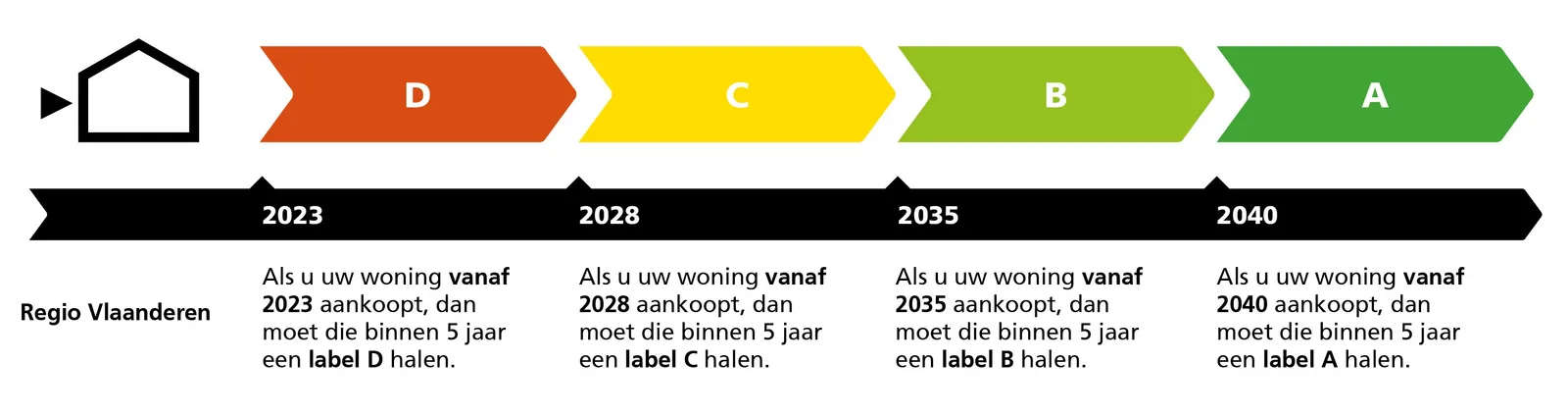
Stricter energy requirements in Flanders: it all starts with the Energy Performance Certificate (EPC) rating
Since 1 January 2023, Flanders has required owners to renovate energy-guzzling residential properties after purchase. New owners of a property with an EPC rating of E or F must carry out energy renovations to achieve an EPC rating of D (between 400 and 300 kWh/m2 per year) within 5 years of transfer of ownership. An EPC rating is mandatory when a property is sold, giving the buyer an indication of the building's energy efficiency. Through the new renovation requirement, Flanders aims to have a fully energy-efficient housing stock with energy label A by 2050. When buying a house, therefore, take its energy efficiency into account and set aside the necessary budget for energy renovations.
A Type A energy expert prepares the certificate. During a site visit, they assess factors including the level of insulation, the heating system and the use of renewable energy. A government tool allows you to calculate an indication of a property's energy efficiency yourself: Test uw EPC | VEKA (energiesparen.be)
The importance of good façade insulation
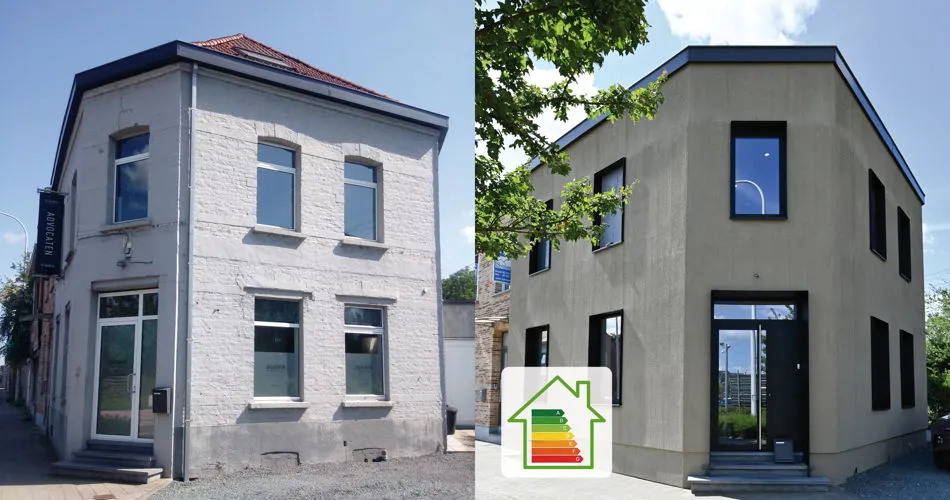
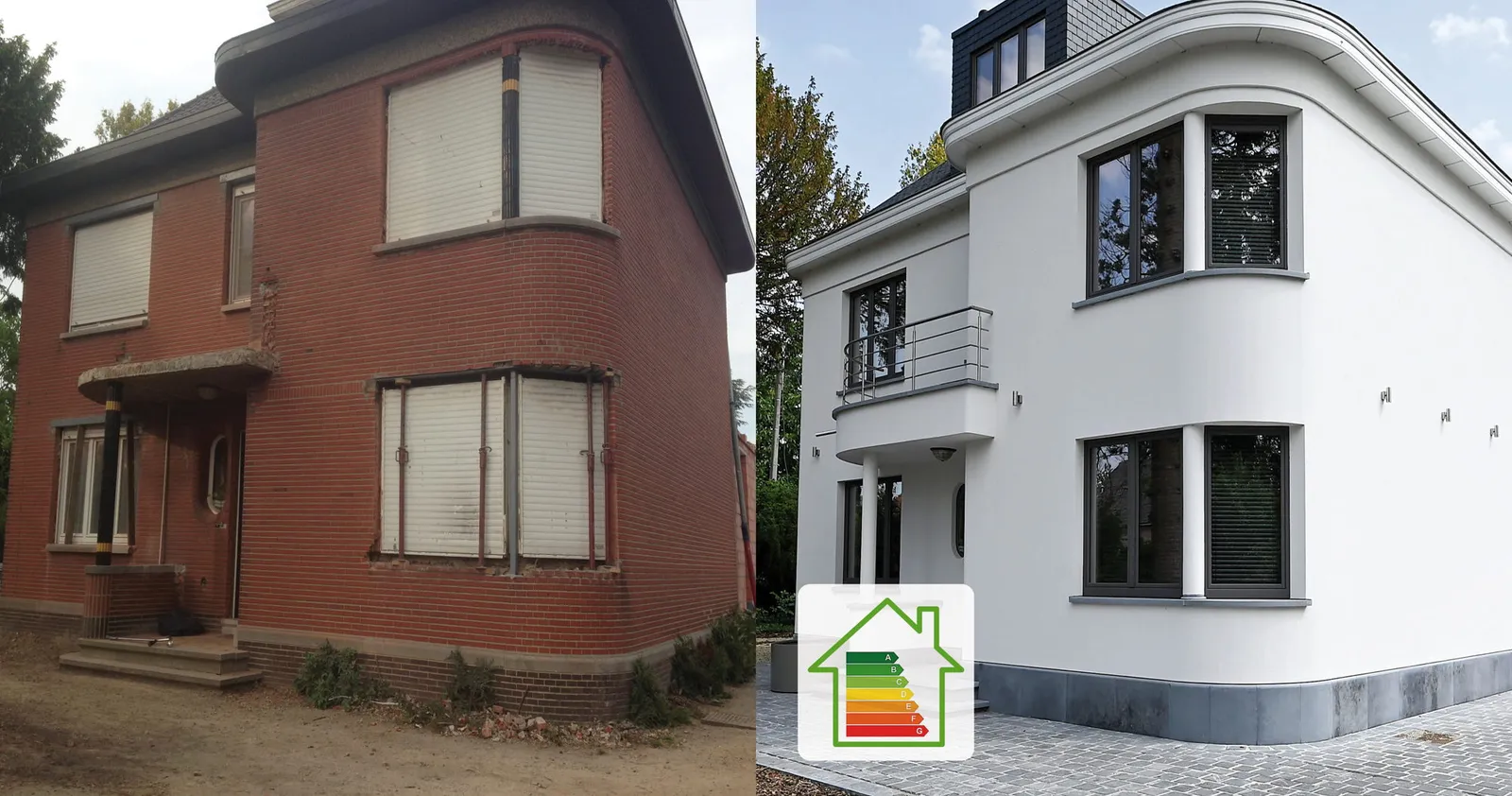
Alongside roof insulation, quality façade insulation has a positive effect on a home's EPC rating. This was demonstrated in an earlier study by Pixii, an independent scientific research institute that supports construction professionals, and Sto, a façade insulation specialist.
For the study, Sto and Pixii examined the energy performance of a detached house dating from the 1960s and compared it before and after insulating the building envelope. Before renovation, the house had an energy label F, equivalent to consumption of 566 kWh/m2 per year. This is also representative of many Belgian homes. Installing external wall insulation alone improved the home's energy performance to label D, 329 kWh /m2 per year. This means the house saves 237 kWh/m2 per year.
Grants and subsidies, renovation loans
The government offers support measures such as Mijn VerbouwPremie, which provides a grant to builders and renovators who install new external wall insulation. They are also eligible for the grant if they finish the external walls with cladding or render, provided this is combined with the installation of external wall insulation.
Sto believes these measures will have a positive impact on the transition to more energy-efficient homes:
“The major step towards sustainable living has now clearly been taken. The home of the future is well insulated, and effective façade insulation is a way to save energy. Support measures such as grants and subsidies help lower the barrier to taking action,” says Alexander Rickert, product manager at Sto.
More information about Mijn VerbouwPremie: Mijn VerbouwPremie voor buitenmuur | Vlaanderen.be
Energy-efficient homes mean lower energy bills and CO2 emissions
In addition to financial support, an energy-efficient home with façade insulation offers greater living comfort, lower CO2 emissions and lower energy bills. Façade insulation reduces heating demand, meaning less energy is needed to heat the home.
“A quality insulation system is an investment, but it pays for itself over time,” says Alexander Rickert, product manager at Sto.
Sto offers a range of façade insulation systems to suit both new-build and renovation projects. Once the insulation has been installed, a bespoke façade finish, such as render or brick slips, gives the home a fresh look. In addition, a home's energy efficiency is playing an increasingly important role in determining its value. An insulated home has a higher market value and is future-proof.
More information about Sto façade insulation on the website: www.mijngevelisoleren.be
What about Wallonia and Brussels?
As building stock in Belgium is a regional matter, the legislation differs from one region to another. The regulations outlined above apply to Flanders. The question is whether Wallonia and the Brussels-Capital Region will follow suit or introduce different rules, and when this might happen. Brussels and Wallonia currently have strict energy-saving requirements, including mandatory ventilation and insulation standards and the requirement for a certificate. Brussels has the EPB certificate (Energy Performance of Buildings), while Wallonia has the PEB (Performance Energétique des Bâtiments).
In Brussels, Renolution is a government renovation strategy designed to help the region achieve its ambitious climate targets, primarily through financial support and guidance for renovation projects.
More information about the 2023 Renolution grants: De RENOLUTION-premies 2023 | Renolution
Wallonia requires an energy audit of the home before a grant can be applied for. This must be carried out by an accredited auditor, who lists all the work that must be done. The auditor also calculates the energy savings achieved by the building as a result of the work.
More information about the energy audit: L’audit Logement, Site énergie du Service public de Wallonie
Question about this story? Ask your question
Keep following this
Get an email when a new story is published. No account needed.
- ThemeGiving existing buildings a new future
- SubjectGeneral







