Smart window prevents overheating
Sustainable construction
A window that blocks solar heat, but only when temperatures get too high? No longer science fiction. The results of an initial pilot project, testing performance in real-world conditions, are already promising.
The Earth is warming, summers are getting hotter and so are our homes. We have felt the effects at first hand in recent months. Looking ahead, even to the very near future, the challenge is to control indoor temperatures without placing additional pressure on the environment or electricity bills. There is a ‘sense of urgency’ around insulation and sustainable heating in the energy transition, but so far much less attention has been paid to cooling homes. That said, a number of initiatives are also seeking innovative ways to tackle this problem.
Switching between blocking and letting in solar heat
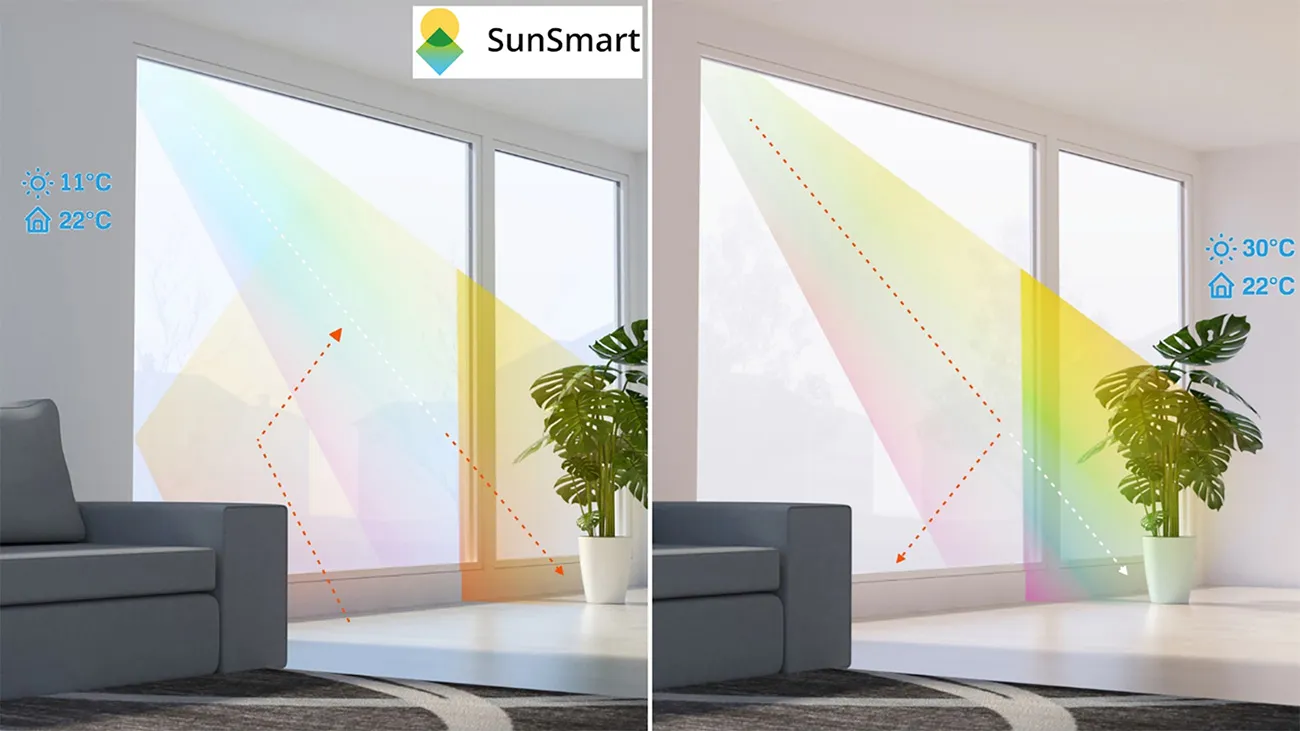
Sunovate is a project aimed at improving energy efficiency in buildings through heat regulation in windows and solar panels. It is run by TNO, short for the Netherlands Organisation for Applied Scientific Research, in collaboration with Universiteit Hasselt, IMEV, KU Leuven, Yparex, Everlam, Glass for Glass and Soltec. What particularly intrigues us is the so-called ‘smart window’, which uses the active material thermochromic, designed to switch automatically between blocking and letting in solar heat. As soon as sunlight falls on the window and the ambient temperature rises above 20 degrees Celsius, infrared light is blocked, while the glass remains completely transparent to the human eye. When the glass surface cools, it automatically switches back to letting infrared light through. The aim is to make optimal use of solar heat and save energy for both heating and cooling.
According to the researchers, these savings could reach 8 per cent and €23.70/m² of glass per year compared with the most advanced HR++ windows. End users are reported to face a payback period of less than seven years. An initial pilot project at the SolarBEAT test facility in Eindhoven is already showing promise. The aim is to further develop the technology and bring it to market within two to three years, helping to advance progress towards European energy and climate targets.
Question about this story? Ask your question
Keep following this
Get an email when a new story is published. No account needed.
- SubjectExteriors