NOA outdoor living promotes sustainable designs and materials
Text Anastasia VerleysenImage horace - Eli Lammertyn
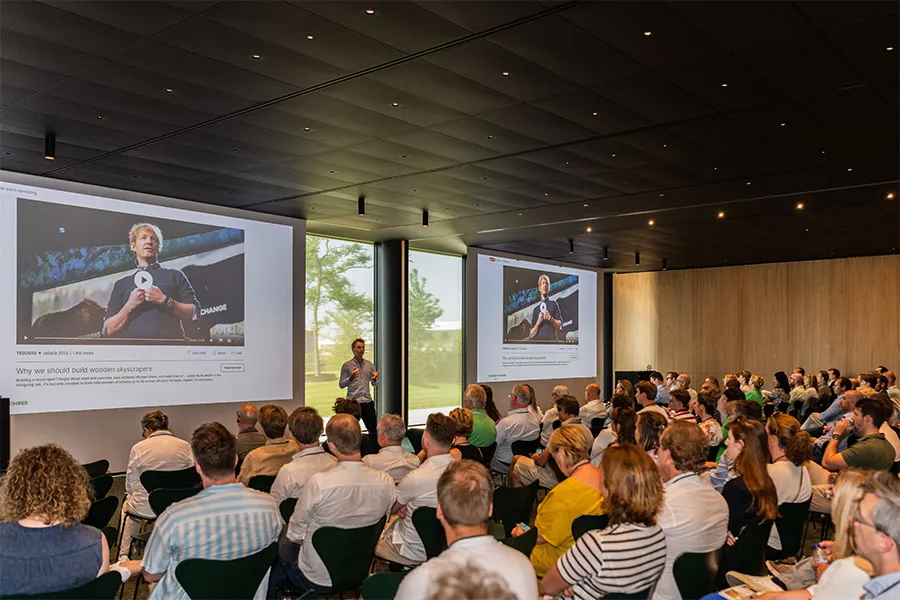
NOA outdoor living offers complete solutions and products from thirty high-end outdoor experts, for the ultimate outdoor experience. But comfortable outdoor living also means considering the ecological dimension, with sustainable and socially responsible business practices taking centre stage. At the Inspiration & Design Event, Dr Ir Pablo van der Lugt and landscape architect Arne Deruyter visited NOA to highlight the possibilities of bio-based construction and a varied green outdoor environment.
NOA outdoor living is keen to support a sustainable construction sector. To give its target audience an in-depth understanding of the subject, the inspiration centre invited two speakers able to make a valuable contribution. Dr Ir Pablo van der Lugt works at the AMS Institute at TU Delft and specialises in timber construction and bio-based materials that enhance the circularity of buildings. “Circular construction is essential because resources are running out. This scarcity, combined with climate change, is driving resource-intensive industries such as construction to switch to other materials,” he says. Timber is one such alternative. But is it sustainable? And is it safe? “Above all, it’s necessary,” says Pablo. “Around 39 per cent of emissions are caused by urban environments. A third of that comes from building materials. Yet timber can remove a great deal of CO2 from the air. A timber building carries out photosynthesis and acts as a CO2 vault for as long as it stands. This makes the importance of circular buildings clear.”
Timber was once an unpredictable material. The Industrial Revolution brought other, more stable materials. “That’s no longer the case today,” says Pablo. “CLT eliminates its weaknesses. The timber is then glued together in cross-laminated layers to create a stable panel that can be perfectly integrated into a project using BIM. Timber is also five times lighter than concrete. That makes it suitable for large buildings, while a house’s worth of material can often be transported in fewer lorries. There are now factories that produce complete prefabricated homes, which only need to be erected on site. Other companies make plug-and-play modules that are assembled on site. All this means lower transport costs, a faster construction process and greater efficiency.”
Debunking myths about timber construction
The world’s tallest timber building is currently in Norway: Mjøstårnet, standing 86 metres tall. Another example of timber construction is the Astor project in Geel. This combines timber with a concrete core, a common approach today to help consumers get used to the idea of timber construction. “Fire safety is another frequently cited argument against choosing timber. People point to examples from the Middle Ages, when entire streets went up in flames. But buildings weren’t as well constructed back then. Timber burns in a very predictable way, so you can calculate this precisely and allow for it in the design to ensure fire safety,” says Pablo. “Choosing the right type of timber also makes it more sustainable. It’s a myth that there isn’t enough forest. At present, less timber is harvested than grows back, especially when you choose timber from sustainably managed forests. Timber can also be combined perfectly with other materials such as nettles, bamboo, straw, elephant grass, … We need a different mindset. Circular construction also means designing buildings circularly and considering what will happen to them at the end of their life.”
Making nature accessible
In our pursuit of sustainability and circularity, we must not forget nature. Garden designer Arne Deruyter of aAD makes the same call. “Today, we carve out the areas we need to build on,” he says. “We need to move towards creating architecture that responds to nature, and away from expanses of lawn. Why do we need so many football pitches or stone deserts? The less-is-more principle doesn’t apply in nature. What matters is diversity, with woodland, planted and open areas in large and small gardens. For me, the hardest challenge is choosing between all the different plants.”
With botanical, ecological and historical starting points, you can make the landscape the guiding principle in your designs. “You need to make nature and trees accessible,” says Arne. “You can create openings in a garden path to give a tree’s roots room to grow, or create a coherent green space with openings for buildings. Or you can landscape a car park thoughtfully, so that the sightlines from a building connect with nature. A car park makes an immediate first impression.”
Maximising the landscape
The garden designer considers digging and removing soil unnecessary if you choose plants carefully. He follows the principle of ‘doubling by dividing’. “Events, infrastructure and green spaces can go hand in hand in a street that accommodates all these functions. A swale doesn’t have to be a dull ditch, it can be a beautiful profusion of flowers. There’s no such thing as leftover space: fill it with flowers and plants. Some places mustn’t be damaged. But they can be repurposed to accommodate the infrastructure that’s needed. I’m convinced that every design can be green. Maximise the landscape and make it expressive.”
Plant choices are influenced by the climate. We need resilient plants that can withstand drought and flooding. Non-native species will therefore become increasingly common. “We’ve also noticed that the planting season has changed. We need to plant before winter so that plants can take root before the first heatwave,” says Arne. “At the same time, when designing and shaping an outdoor environment, we need to keep the end result in mind. Choose plant combinations that won’t outgrow one another. The possibilities are there, but we all need to act on them. Everyone is responsible for tomorrow.”
Question about this story? Ask your question
Keep following this
Get an email when a new story is published. No account needed.
- ThemeDesigning green and outdoor spaces
- SubjectExteriors