“To achieve our climate goals, we need bolder measures”
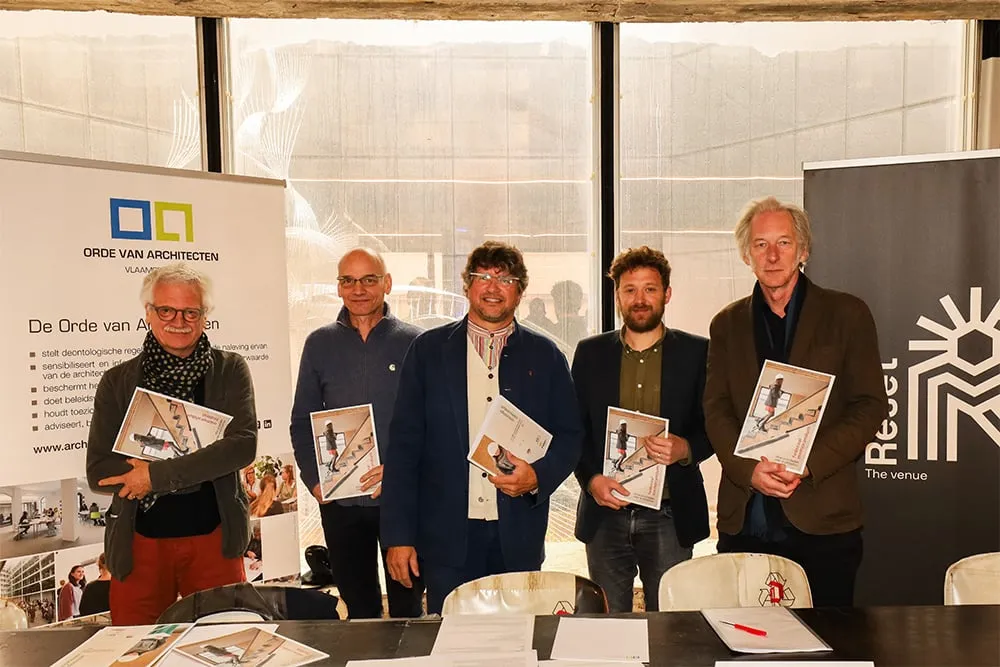
From better permit policies to stronger consumer protection, Belgium’s architectural organisations are calling for more decisive measures in a joint action plan to make spatial planning and the existing building stock sustainable at a faster pace. “The urgency of our climate goals means we must act in unison,” say Belgium’s architectural organisations.
Ahead of the next regional and federal elections, Belgium’s architectural organisations have joined forces and drawn up a joint action plan for the first time. It sets out concrete solutions for a more sustainable living environment. “We are calling on the authorities in our country, whether federal, regional or local, to take measures that enable everyone to benefit from quality architecture and a quality living environment. Our aim is to encourage sustainability and promote quality of life by making people and nature the starting point for all spatial and urban design,” adds Mr Jos Leyssens (Ordre des Architectes).
Challenges to address
Rising costs, higher interest rates and problems with permit policies have made building and renovation increasingly difficult in recent times, while investment in our building stock needs to accelerate. Existing buildings must become more sustainable, and there is a pressing need for new climate-neutral buildings. Architects play a crucial role in this transition as innovators, partners and advisers. Unfortunately, they constantly encounter challenges and obstacles that could be avoided.
Belgium’s architectural organisations have therefore drawn up a number of proposals, both at federal level (Ordre des architectes, NAV, G30 and FAB) and at regional level (Conseils de l’Ordre des architectes, NAV and BVA). The action plan is also part of the New European Bauhaus initiative, which aims to turn the European Commission’s Green Deal into creative projects for an attractive, sustainable and inclusive living environment.
They propose these five concrete measures:
1. Effective protection for clients in the construction sector
Many steps have already been taken to provide the best possible protection for clients in the construction sector. These include the 2017 and 2019 reforms to compulsory insurance, which represent significant progress. However, better enforcement is still needed to eliminate inequalities between the different parties involved.
“Today, anyone who hires a contractor for a project can hold that contractor liable only for damage caused by the construction work. Architects, by contrast, are required to take out professional liability insurance for every phase of every project. A more balanced allocation of responsibilities is needed, above all to protect consumers. A platform should also be set up to allow consumers to check whether a contractor is registered, insured and authorised to provide their services,” says Mr Dag Boutsen (Ordre des Architectes).
2. Comprehensive reform of VAT rules
Consumers, who need to be willing to invest, are a key driver in making the building stock more sustainable. Belgium’s architectural organisations note that current VAT rates for construction and renovation do not reflect social needs and are therefore a disincentive.
“For example, the distinction between demolition and reconstruction on the one hand and renovation on the other is a purely tax-driven construct that only partly supports circular construction. For instance, luxury finishes in a renovated flat are eligible for the reduced VAT rate, whereas the advice of an architect and an EPB assessor for the renovation of a terraced house is not. The rules are also unnecessarily complex, leading to a lack of clarity, grey areas and legal uncertainty,” explains Mr Steven Lannoo (NAV).
Belgium’s architects are therefore calling for far-reaching VAT reform. “Reconstruction and renovation projects should be taxed in the same way, and the difference between VAT on works (6 %) and VAT on services (21 %) should also be reviewed. No more copy-and-paste provisions. They add further complexity and only hinder the sustainability of our building stock.”
3. Better organisation of procurement
One way governments can speed up construction procedures is by organising procurement more effectively. “In most public tenders, architects are already asked to produce a design at the tender stage, which means they have to complete 15 to 20 % of the total commission before it has even been awarded. If they are unsuccessful, all that work is for nothing. Not only is this time-consuming and costly, it often fails to produce the best design, since there is very little opportunity for architects and clients to engage with one another at this early stage,” explains Mr Dirk D’herde (G30).
Tender procedures should therefore focus not only on the design, but also on the designers. “And if a design is still required, it must be properly remunerated: 80 % of the costs incurred. In addition, the expected output should be limited by setting clear expectations in the tender procedure.”
4. Encouraging innovation
Challenges such as relocating buildings, densifying space, strengthening urban centres and improving the energy efficiency of buildings cannot be tackled optimally if we stick to familiar approaches. “That is why governments should invest more in design research and cross-sector experimentation, while putting in place the regulations and legislation needed to enable it. In the meantime, as a sector, we want to reach out to all institutions and are happy to share our knowledge and expertise to find solutions for a more sustainable and inclusive living environment,” said Mr Olivier Bastin (FAB).
5. Better urban planning permit policies (regional competence)
Finally, the problem of slow urban planning permit procedures remains. The authorisation process is now so inefficient and slow that investors are questioning whether they still want to pursue projects in Belgium. This must change, and architectural organisations believe regional and even local authorities have a major role to play. “By requiring cities and municipalities to develop a clear spatial vision and create more opportunities for densification, the growing demand for built functions can be met with the least possible impact on land use,” explains Mr Jos Leyssens (Ordre des Architectes).
In addition, the government could provide better support to local environmental services and ease their workload. “The ‘Handreiking Vooroverleg’, which offers advice on how to obtain an environmental permit more quickly, is already a step in the right direction, but it should also be open to revision after a few years. We would also like access to the Flemish real estate information platform, as it contains a great deal of information that is relevant to us too.
Question about this story? Ask your question
Keep following this
Get an email when a new story is published. No account needed.
- ThemeRenovating without erasing heritage
- SubjectNews